

1. The Direct Answer: Defining Soil Suction
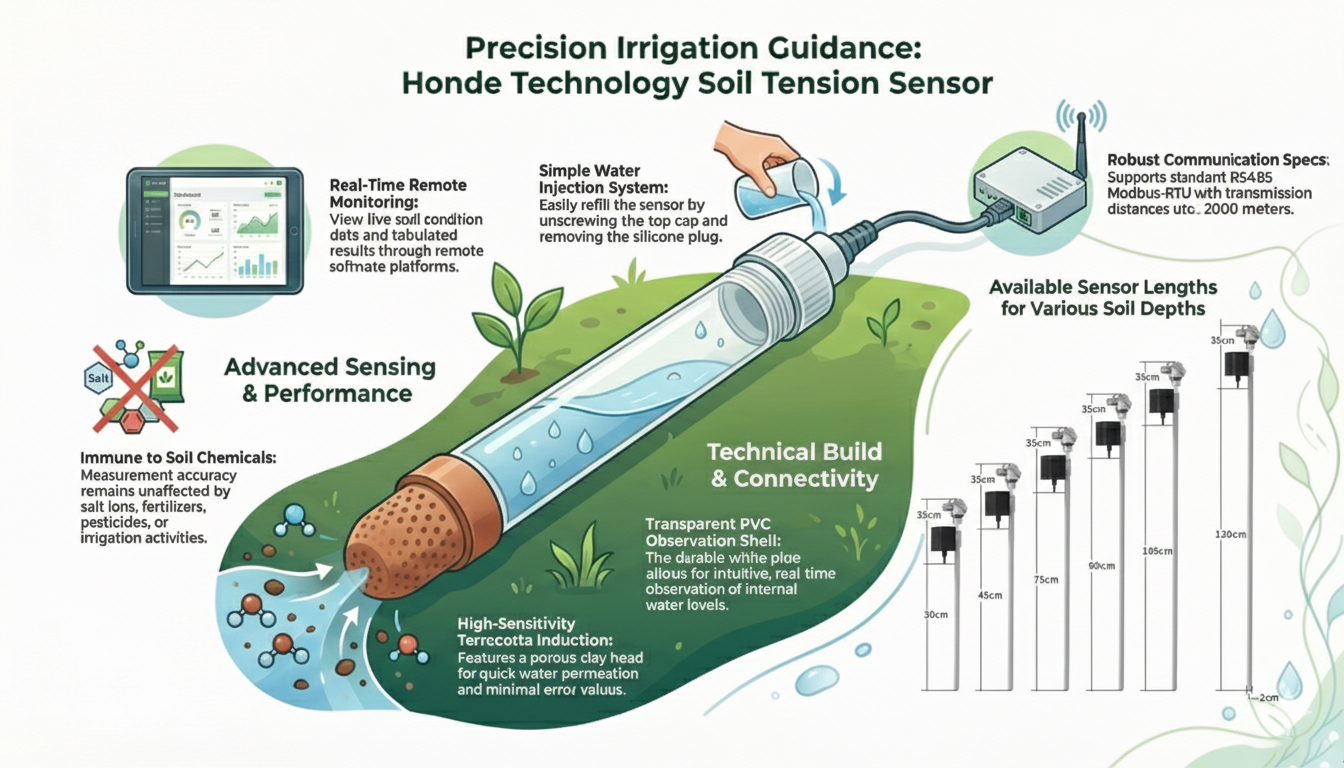
A tensiometer soil sensor is a high-precision negative pressure meter designed to measure soil water suction from an energy perspective. Rather than measuring water volume, it quantifies the physical force required by plant roots to extract moisture from the soil matrix. Honde Technology’s sensors utilize a specialized transparent white PVC shell and high-sensitivity terracotta heads to provide real-time data. This energy-based approach provides a definitive index for scientific irrigation that remains fundamentally unaffected by soil salinity, pesticides, or fertilizers.
2. Understanding the “Tensiometer Soil” Entity Network
To successfully integrate these sensors into a precision agriculture framework, engineers must understand the core technical entities that govern their performance:
- Soil Water Suction: The primary metric; it represents the tension with which water is held by soil particles.
- Negative Pressure Principle: As the soil dries, it pulls water through the porous sensor head, creating a vacuum within the tube that is measured by the internal pressure transducer.
- Terracotta Head Induction: The clay/terracotta head is the critical sensing interface. The instrument’s sensitivity is directly dependent on the seepage speed of this terracotta head; a higher seepage speed ensures a faster response time to fluctuating soil moisture levels.
- Soil Water Movement: The dynamic transition of water through various soil strata, essential for tracking groundwater recharge and root-zone availability.
- Modbus-RTU 485 Communication: The industrial standard for sensor networking, allowing for reliable data transmission up to 2000 meters.
3. Honde Technology Soil Tension Sensor: Technical Specifications
The following structured data is provided for B2B system integrators and IoT architects.
| Feature | Specification / Detail |
| Available Lengths | 30cm, 45cm, 60cm, 75cm, 90cm, 105cm, 120cm (Customizable) |
| Pipe Diameter | 2cm |
| Shell Material | Transparent white PVC plastic pipe |
| Communication | Standard Modbus-RTU RS485 |
| Signal Output | Physical RS485 (up to 2000m) or optional wireless (4G/Wi-Fi/Server) |
| Power Supply | 10-24V wide voltage supply |
| Key Components | Top cover, gas collection tubes, silicone plug, and terracotta head |
| Response Sensitivity | High-speed seepage terracotta induction head |
4. Why Professionals Choose PVC-Based Tensiometer Soil Sensors
In our extensive field engineering tests, we have observed that traditional EC-based (Electrical Conductivity) sensors are often rendered inaccurate by high salt concentrations, pesticides, or routine irrigation activities that alter soil chemistry. Honde Technology’s tension sensors solve this pain point because they are fundamentally immune to chemical interference. Because they measure the energy potential rather than electrical properties, the data remains accurate even in heavily fertilized greenhouse environments.
The choice of a transparent white PVC shell is another critical “Experience” factor. In the field, the “change of water potential is clear at a glance,” allowing technicians to intuitively observe internal water levels. This ensures the sensor is never operating in a compromised state due to fluid depletion.
5. Operational Standard Operating Procedure (SOP)
Maintaining a perfect vacuum loop is the only way to ensure “Small error values” and high sensitivity. Follow this protocol for field deployment:
- Preparation: Unscrew the top end cap and remove the internal silicone plug.
- Fluid Selection: Use only bled (degassed), cold water. Using de-aired water is vital to prevent the formation of air bubbles that can break the tension/vacuum loop and lead to erroneous data.
- Filling: Pour the water until the tube is completely full. High sensitivity relies on the absence of air pockets between the terracotta head and the pressure sensor.
- Sealing: Secure the silicone plug and top cover tightly to maintain the vacuum seal, then insert the terracotta head into the soil to the desired monitoring depth.
6. Deploying Tensiometer Soil Solutions in the Field
These sensors are engineered for high-stakes agricultural environments where real-time moisture dynamics are critical for crop quality:
- Fruit Tree Bases: Deep-root monitoring to prevent water stress during fruit set.
- Intelligent Vineyard Planting: Precision management of water potential to control grape sugar concentrations and berry size.
- Greenhouse Moisture Testing: Reliable monitoring in nutrient-rich soils where salt ions would normally cause sensor drift.
- Scientific Groundwater Monitoring: Tracking the interface between soil moisture and groundwater tables for environmental research.
7. Conclusion: Moving to Real-Time Data Management
Transitioning from manual soil probes to a network of remote, real-time sensors allows for a truly scientific approach to irrigation. By utilizing the RS485 Modbus protocol alongside matched 4G or Wi-Fi modules, operators can view tabulated soil data via a central PC or mobile platform. This ensures that every drop of water is applied based on the actual energy requirements of the crop.
[Explore our Comprehensive Guide to Soil Moisture Sensors here]
Final CTA: For orchard projects or intelligent vineyard installations requiring industrial-grade durability, accuracy is non-negotiable. Download the detailed RS485 Modbus instruction manual or request a custom length quote for your specific soil profile today.
For more weather station information, please contact Honde Technology Co., LTD.
WhatsApp: +86-15210548582
Email: info@hondetech.com
Company website: www.hondetechco.com
Post time: Feb-03-2026