

Introduction: Challenge – Experience or Data?
A 120-mu late-maturing mango orchard once faced a seemingly unsolvable predicament for a long time: every spring, the sudden “late spring cold snap” would always cause heavy losses to all the blooming flowers in the orchard. In summer, uneven rainfall and hot and dry winds often cause fruits to vary in size and quality. Master Wang, the owner of the orchard, has been managing the orchard for fifteen years and has accumulated rich experience. However, in the face of the unpredictable microclimate in the mountainous area, his experience often fails. “Feeling that the temperature is going to drop” or “seeing that the weather is not right” was the main basis for his past decisions on frost prevention and irrigation. This operation mode, which relies on intuition and lagging observation, keeps the yield and quality of the orchard in an unstable range all the time, and its ability to resist climate risks is weak.
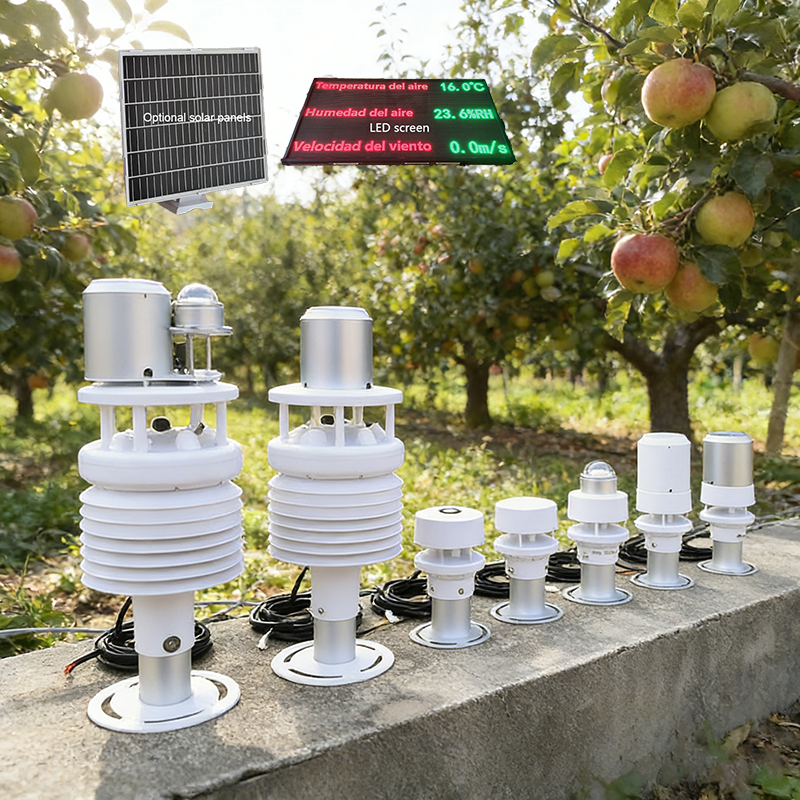
The turning point of all this began with a seemingly simple white pole erected in the center of the orchard – the HONDE integrated agricultural weather Station. It is not merely a meteorological observation device, but also becomes an intelligent fulcrum that drives the entire orchard operation logic to shift from “experience-driven” to “data-driven”.
Chapter One: Deployment – Equipping Orchards with “Digital Senses”
This weather station is deployed in the highest and most representative area of the orchard. The sensors it integrates are like the “nerve endings” extending from the orchard:
Temperature and humidity sensor: Real-time perception of the cold and warmth, dryness and humidity of the micro-environment where flowers, fruits and leaves are located.
Wind speed and direction sensor: It monitors the path and intensity of mountain winds, which is crucial for assessing the risk of frost and determining the timing of spraying pesticides.
Tipping bucket rain gauge: Accurately measures each rainfall, distinguishing between effective precipitation and ineffective precipitation.
Total solar radiation sensor: Quantifies the total amount of light energy received by the orchard.
All data is synchronized to Master Wang and the orchard technician’s mobile App and cloud management platform every 10 minutes via 4G network.
Chapter Two: Transformation – Reconstruction of the Four Major Operational Logics
Logic Reconstruction One: Frost Prevention and Control: From “Passive Emergency Response” to “Proactive Early Warning and Precise Defense”
The old logic: When patrolling the garden at night and shining a flashlight on the thermometer, if the temperature is close to 0℃, it is often too late to hurriedly start the diesel engine and light the smoke generator.
New logic: The meteorological station monitors the temperature in real time. When the forecast shows a strong radiative cooling, the technician sets 2.5℃ as the first-level warning line. At 3 a.m. on a certain day, the App sent an alert: “The current temperature is 2.8℃ and is continuously dropping. The wind speed is below 1m/s (under static and stable conditions, with a high risk of frost).” The orchard immediately activated the anti-frost fans throughout the garden to stir the air and set off heating smoke blocks in advance in the 20 mu of the lowest-lying area.
Result: During this process, the minimum temperature dropped to -0.5℃, but the warning and intervention were advanced by 90 minutes. Post-event statistics show that the fruit setting rate in precisely fortified areas is 35% higher than that in areas without particularly enhanced protection. Master Wang said, “In the past, it was’ putting out fires’, but now it’s ‘preventing fires’.” The data tells us where the fire will break out.
Logic Reconstruction Two: Irrigation Management, from “Timed and Quantified” to “Water Demand Based on Evaporation”
Old logic: Irrigate twice a week at a fixed time, and add once during the dry season. It often occurs that after irrigation, it rains, or after hot, dry and windy days, there is insufficient irrigation.
New logic: The system automatically calculates the evaporation and transpiration of reference crops based on real-time monitoring data of temperature, humidity, wind speed and radiation. Based on the water requirement coefficients of mangoes at different phenological stages, a “Daily Water Consumption in Orchards” report is generated.
Practice: During the fruit expansion period, the system showed that the daily water consumption reached 5 millimeters for three consecutive days, while the soil probe indicated that the moisture content in the root layer was decreasing. Based on this, the technician initiated precise drip irrigation to make up for the water shortage. Before an irrigation day when moderate rain was forecasted, the system suggested, “Postpone irrigation. It is expected that natural precipitation will meet the demand.”
Result: After one growing season, the total amount of water used for irrigation in the orchard was saved by 28%, and at the same time, the fruit enlargement was uniform, and the cracking rate decreased significantly.
Logic Reconstruction Three: Disease Control, from “Regular Spraying of Pesticides” to “Acting According to the Situation”
Old logic: Depending on the weather feeling damp, or spray fungicides at fixed intervals (such as every 7 to 10 days) to prevent anthracnose.
New logic: The germination and infection of anthracnose spores require continuous moisture on the leaf surface (usually more than 6 hours) and suitable temperature. The “duration of leaf moisture” can be calculated by combining meteorological station data with leaf moisture models.
Practice: The system recorded that after a rainfall, combined with a high-humidity environment, the simulated moist duration of the leaves reached 7.5 hours, and the temperature was within the high-incidence zone of diseases between 18 and 25℃. App push: “The high-risk window period for anthracnose infection has been formed. It is recommended to carry out protective spraying within 24 hours.”
Result: The frequency of pesticide application decreased from 12 times in the previous growing season to 8 times, and all were carried out at the most efficient time. The incidence of diseases remained unchanged, and the control cost and the risk of pesticide residues decreased simultaneously.
Logic Reconstruction Four: Harvesting and Agricultural Arrangements, From “Looking at the Weather” to “Looking at Data”
The old logic: Roughly determine the harvest period based on the date and the color of the fruit, and stop work when it rains.
New logic: Long-term light and accumulated temperature data provide a reference for predicting fruit maturity. More importantly, real-time wind speed data has become a safety permit for outdoor farming, especially when using aerial work platforms for harvesting. All workers must confirm that the real-time wind speed on the App is below the safety threshold (such as below level 4 wind) before conducting high-altitude operations.
Result: Agricultural safety is guaranteed, and the harvest plan can be flexibly and efficiently arranged according to the precise weather window period, reducing the downtime losses caused by sudden weather changes.
Chapter Three: Effectiveness – Quantifiable Value Leaps
After a complete growth cycle is over, the data provides a clear answer:
1. Disaster prevention and loss reduction: The direct production loss caused by the spring frost disaster is estimated to be reduced by 70%.
2. Resource conservation: Irrigation water is saved by 28%, and the overall cost of pesticides is reduced by 25%.
3. Quality and output improvement: The rate of high-quality fruits (including single fruit weight, sugar content, and appearance meeting standards) has increased by 15%, and the overall output value of the orchard has risen by approximately 20%.
4. Management efficiency improvement: Technicians and workers are liberated from frequent and uncertain garden patrols and emergency responses, making work arrangements more planned and enhancing overall labor productivity.
Conclusion: From managing land to managing “data ecology”
The story of this hundred-mu orchard goes far beyond the installation of just one piece of equipment. It profoundly reveals a shift in operational philosophy: the core objects of agricultural production are moving from the land and crops themselves to the data ecosystem that envelops them.
In this case, the HONDE meteorological station does not merely play the role of a “weather presenter”, but rather acts as a “real-time translator” for the microclimate of the orchard, a “quantitative assessor” for the physiological needs of crops, and a “prophet and early warning provider” for agricultural risks. It transforms the elusive “heavenly timing” into structured instructions that can be stored, analyzed and executed.
Master Wang’s reflection summed everything up: “In the past, I was in charge of this mountain and these trees.” Now, what I manage every day is this “data map” on my phone. It made me feel that for the first time I truly “understood” what the orchard was saying. This is not replacing experience, but rather giving it a pair of eyes that can see a thousand miles and ears that can follow the wind.
This case demonstrates that for modern orchards, investing in an agricultural meteorological station is essentially investing in a decision-making system that transforms climate uncertainty into operational certainty. It has not only changed a few agricultural operations, but also the attitude and logic of the entire production system towards nature – from a passive recipient and guesser to an active observer and planner. Against the backdrop of intensifying climate change, this data-based precision and resilience are becoming the most core competitiveness of modern agriculture.
For more weather station information, please contact Honde Technology Co., LTD.
WhatsApp: +86-15210548582
Email: info@hondetech.com
Company website: www.hondetechco.com
Post time: Dec-25-2025