

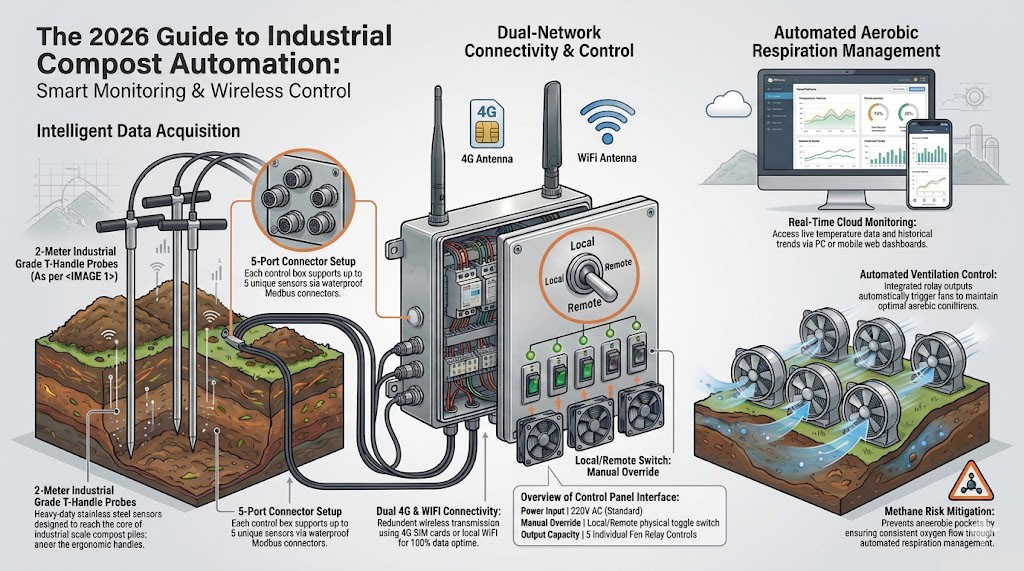
An automated compost monitoring system is an integrated IoT framework that combines specialized hardware and cloud software to maintain optimal pile conditions. To be effective in an industrial setting, a system must utilize 2-meter stainless steel probes to reach the pile core and a dual-connectivity (4G/WiFi) wireless module to transmit real-time data for automated ventilation control.
This technology is essential for modern agriculture because it replaces manual labor with Aerobic Respiration Management, ensuring peak decomposition efficiency while preventing the methane risks associated with anaerobic pockets deep within the pile.
Key Features of the Honde Technology Compost Temperature Sensor
Reliable data begins at the core. The Honde temperature probe is engineered for the rigors of high-volume industrial composting where chemical and physical durability are paramount.
- ▶ T-Handle Industrial Design: Unlike consumer-grade sensors, these probes feature a rugged T-handle top. This design is a critical ergonomic requirement for field engineers, allowing for easy insertion and extraction from densely packed compost piles.
- ▶ Deep Core Penetration: At a total length of 2 meters, the probe reaches the geometric center of the pile. This is vital because surface temperatures are often misleading; the core is where thermal runaway or anaerobic conditions typically begin.
- ▶ RS485 Modbus Protocol: The sensors utilize the industrial-standard RS485 Modbus protocol. This ensures high-fidelity data transmission even over long cable runs and allows for seamless integration into broader SCADA or PLC-based agricultural environments.
The Wireless Control System: 4G vs. WiFi Connectivity
The central control unit serves as the intelligence hub, bridging the gap between the field probes and the cloud server. Honde provides a dual-module system to ensure connectivity regardless of site infrastructure.
Connectivity and 4G Configuration
For remote sites lacking local networks, the system supports 4G LTE. The installation is streamlined: simply press the yellow eject button on the wireless module to pop out the card slot and insert a standard 4G SIM card.
Dual-Antenna Integrity
Signal stability is maintained through two dedicated antennas. Expert Note: It is imperative to check the labels on the wireless module itself (marked “4G” and “WiFi”) and match them to the corresponding antenna ports. Misconnecting these will result in signal degradation or total communication failure.
Technical Specifications & System Capacity
The Honde Wireless Compost Control System is built with high-tier components, including CHNT circuit breakers, to ensure 24/7 uptime in industrial environments.
| Feature | Specification / Detail | ROI-Focused Benefit |
|---|---|---|
| Sensor Capacity | Up to 5 probes per control unit | Enables “Zone-Based Monitoring” for high-accuracy pile management. |
| Control Output | 5-channel relay (KM1-KM5) | Reduces energy costs by only activating fans in high-heat zones. |
| Power Input | 220V AC (Industrial Standard) | Compatible with existing facility power grids without transformers. |
| Module Hardware | CHNT Circuit Breakers & Contactors | Minimizes downtime through superior electrical surge protection. |
| Communication | 4G / WiFi / RS485 Modbus | Eliminates manual data collection, reducing labor overhead. |
| Enclosure | Stainless Steel / Waterproof | Extends equipment lifespan in corrosive, high-humidity environments. |
Operational Logic: The Local/Remote/Middle System
The front panel of the control box is designed for both automated operation and emergency manual override. The three-position logic is essential for safe facility management:
- 1
Remote Mode: When toggled to “Remote,” the system follows the automation logic set on the cloud platform. The physical switches are bypassed, allowing the software to trigger fans based on sensor thresholds.
- 2
Local Mode: This activates the five physical switches on the panel for manual override. Turning a switch to the Left turns the fan ON; turning it to the Right turns it OFF.
- 3
The Middle Position (Neutral): For safety and maintenance, switches should be kept in the Middle position when not in active local use. This serves as the “Off” state, preventing accidental activation or software interference during manual inspections.
Agricultural Application: Aerobic Respiration Management
From a technical strategy perspective, the primary goal of this system is maintaining an aerobic environment. By linking specific sensor addresses (IDs 1-5) to corresponding relay channels (KM1-KM5), the system performs Zone-Based Ventilation.
If Sensor #3 detects a temperature spike indicating high microbial activity or impending anaerobic conditions, the controller triggers Relay #3 to power the specific fan for that zone. This precision prevents the entire pile from cooling unnecessarily, which preserves the biological “heat” required for pathogen destruction while optimizing oxygen levels.
Installation & Connection Checklist
To ensure system integrity and E-E-A-T compliant deployment, follow this sequence:
- 1
Power Wiring: Connect the 220V AC supply to the internal terminals. Professionals must use the designated Live (L), Neutral (N), and Protective Earth (PE) terminals to ensure electrical safety.
- 2
Probe Deployment: Insert the 2-meter T-handle probes into the compost.
- 3
Sensor ID Warning: Each sensor is pre-configured with a unique Address/ID (1, 2, 3, 4, or 5). Pro-Tip: You must match the physical sensor ID to the labeled port on the control box. If two sensors share an ID or are plugged into the wrong sequence, the cloud data will be corrupted.
- 4
Waterproof Connections: Secure the sensors using the waterproof pro-connectors to prevent moisture ingress.
- 5
Antenna Setup: Attach the 4G and WiFi antennas to their specifically marked ports.
- 6
Fan Integration: Wire the ventilation fans to the KM1-KM5 contactors.
- 7
Cloud Verification: Power on the system (check for the LED power indicator), login to the web dashboard, and verify real-time data stream.
Conclusion & CTA
Honde Technology Co., Ltd. provides a sophisticated yet accessible path to industrial IoT for the agricultural sector. By integrating robust CHNT electrical components with high-reach stainless steel sensors, we allow compost facilities to scale their operations while ensuring consistent, high-quality output through automated data-driven ventilation.
For custom system configurations or to download the full RS485 Modbus protocol technical sheet, visit our headquarters online.
Post time: Mar-31-2026