

Continuous CH4, LEL, H2, H2S and CO monitoring with local alarm, industrial control and cloud connectivity
Gas leakage is rarely a problem that begins with a dramatic event. In many industrial facilities, risk starts with a small leak around a valve, flange, pump, storage connection or process pipeline. If the leakage is not detected early, combustible gas can accumulate or toxic gas can reach an unsafe concentration.
This is why fixed gas detection is widely used in oil and gas facilities, petrochemical plants, chemical production, hydrogen facilities, gas storage areas and other hazardous industrial environments. The requirement is no longer limited to detecting a gas locally. Operators increasingly need a complete chain from detection and alarm to equipment linkage, remote transmission and historical data management. 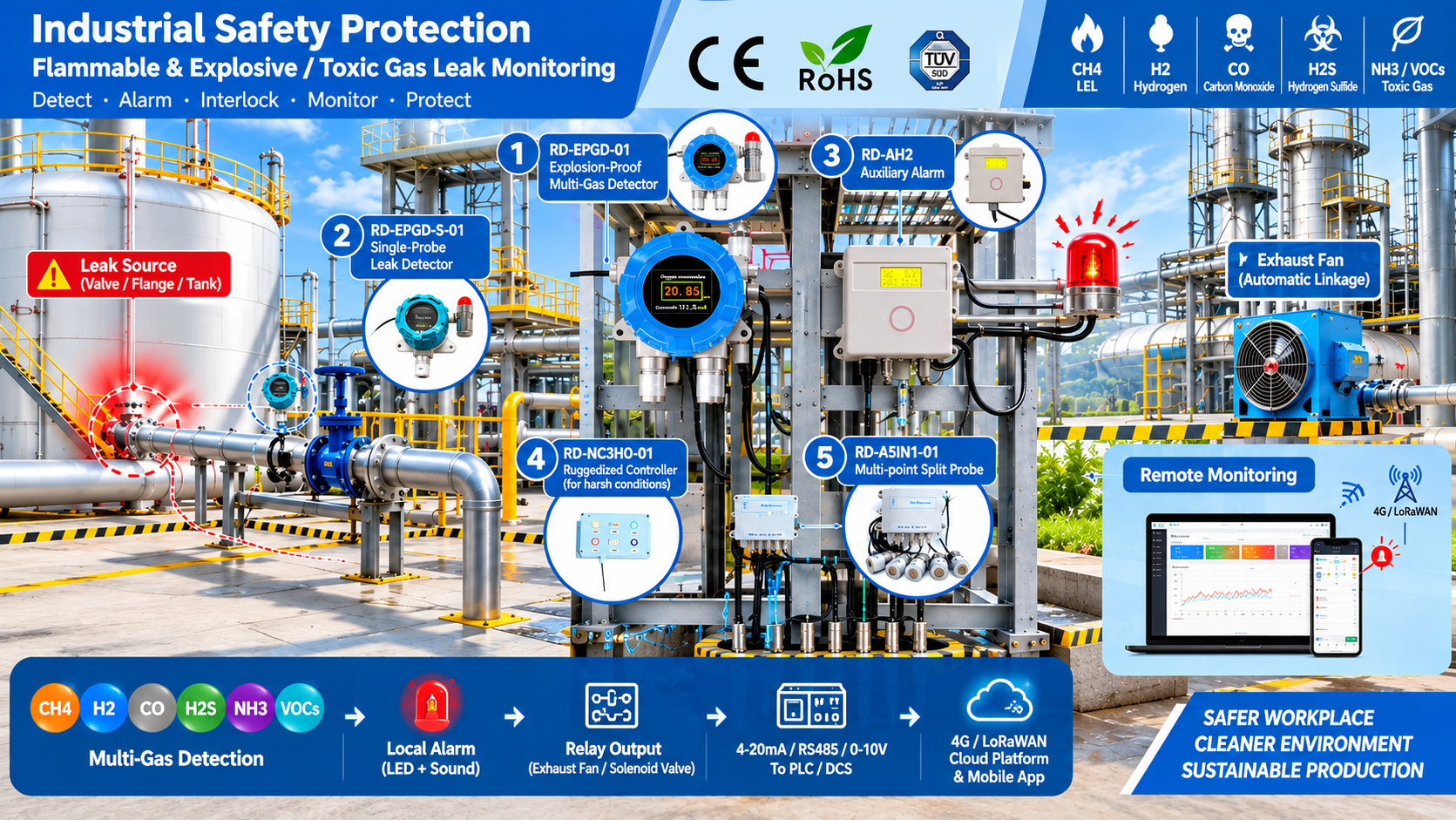
Industrial Gas Detection Is Becoming a Connected Safety System
Typical industrial monitoring targets include methane (CH4), combustible gas expressed as %LEL, hydrogen (H2), carbon monoxide (CO), hydrogen sulfide (H2S), ammonia (NH3) and VOCs. Temperature, humidity and pressure can also provide useful environmental information for interpreting field conditions.
| Monitoring Target | Typical Industrial Risk | Common Application |
|---|---|---|
| CH4 / LEL | Combustible gas accumulation | Oil & gas, gas storage, pipelines, compressor areas |
| H2 | Flammable hydrogen leakage | Hydrogen production, storage and process areas |
| H2S | Toxic gas exposure | Oil & gas, wastewater, chemical processing |
| CO | Toxic combustion gas | Boiler rooms, industrial combustion areas |
| NH3 | Toxic and corrosive gas | Chemical and refrigeration facilities |
| VOCs | Volatile organic compound leakage | Chemical storage and process areas |
Where Is Demand Particularly Relevant?
Several developed industrial markets provide strong application environments for fixed gas detection.
| Market | Industrial Environment | Typical Detection Needs |
|---|---|---|
| United States | Oil & gas, LNG, petrochemical, chemical production | CH4, LEL, H2S, CO, VOCs |
| Germany | Chemical, pharmaceutical, manufacturing and energy | Combustible and toxic gas monitoring |
| Japan | High-pressure gas, hydrogen, chemical and industrial facilities | H2, CH4, H2S, CO and connected monitoring |
| United Kingdom | Energy, offshore and chemical facilities | CH4, LEL, H2S and VOC monitoring |
The U.S. is particularly relevant because of the scale of its oil and natural gas infrastructure. Germany has a large and highly developed chemical manufacturing base. Japan continues to develop hydrogen and high-pressure gas applications while maintaining strict industrial safety management. The UK combines offshore energy infrastructure with chemical and industrial facilities.
Application Case: Petrochemical Storage and Processing Area
Consider a typical petrochemical facility in the U.S. Gulf Coast region. The site contains storage tanks, pumps, valves, transfer pipelines and loading areas. Many of the potential leakage points are concentrated around equipment connections rather than in the middle of an open production area.
A fixed detector can therefore be installed near identified risk points. The exact mounting height and location should be determined from the target gas density, possible release point, ventilation pattern, equipment layout and the site’s hazardous-area engineering requirements.
Potential Leakage → Gas Detector → Local Alarm → Relay Output → PLC/DCS → Ventilation or Equipment Interlock → Remote Monitoring → Historical Data
| System Layer | Function |
|---|---|
| Gas detector | Measures the selected combustible or toxic gas |
| Local alarm | Provides immediate indication at the installation site |
| Relay output | Can participate in an engineered alarm or equipment-control circuit |
| 4-20mA / RS485 | Transfers measurement data to industrial control equipment |
| PLC / DCS | Integrates gas information into the plant control system |
| Wireless gateway | Transfers field information through 4G, WiFi or LoRaWAN |
| Cloud platform | Displays real-time values, alarms and historical records |
Honde Explosion-Proof Gas Detection Product Options
| Model | Recommended Use | Main Features |
|---|---|---|
| RD-EPGD-01 | Main fixed-point industrial monitoring | Single, dual, triple or four-probe configurations; explosion-proof housing; LED display; relay; 4-20mA; RS485 Modbus; 0-10V |
| RD-EPGD-S-01 | Specific leakage points | Single-probe fixed gas leakage detection |
| RD-NC3HO-01 | Harsh industrial environments | Control/display unit for applications with high humidity and heavy dust |
| RD-A5IN1-01 | Remote or difficult sampling locations | Separated controller and stainless-steel probe |
| RD-AH2 | Local workshop warning | Integrated audible and visual alarm |
Three Levels of Gas Safety Monitoring
1. On-Site Detection
The detector measures the target gas and provides a local indication when the concentration reaches the configured alarm condition.
2. Factory-Level Control
Through relay, 4-20mA or RS485 Modbus communication, gas information can be incorporated into the plant’s PLC or DCS architecture. Where the engineering design permits, alarm outputs can participate in ventilation, warning or shut-off functions.
3. Remote IoT Monitoring
Field devices can be connected to GPRS/4G/WIFI/LORA/LORAWAN wireless modules. The communication module supports MQTT and JSON formats for transmission to a cloud server.
Field Detector → RS485 / 4-20mA → Wireless Module → MQTT / JSON → Cloud Server → PC / Mobile Monitoring
Handheld Inspection Complements Fixed Detection
Fixed detectors provide continuous coverage, but maintenance personnel still need a practical way to inspect individual areas. A handheld instrument and data logger can be used for on-site inspection, maintenance checks, spot measurements and field records.
Fixed Monitoring for Continuous Protection + Handmeter/Data Logger for Mobile Inspection
Cloud Monitoring for Real-Time and Historical Data
| Cloud Function | Practical Value |
|---|---|
| Real-time data | View current gas concentration from connected monitoring points |
| Alarm records | Review when and where an alarm occurred |
| Historical curves | Identify concentration changes over time |
| Device status | Monitor connected equipment and communication status |
| Data export | Support internal maintenance and safety records |
| Multi-site monitoring | Manage distributed facilities from a central platform |
Application Example: Chemical Plant in Germany
A chemical production site may contain storage tanks, reactors, pumps, transfer pipelines and enclosed equipment rooms. Different areas can have different gas risks. A practical architecture is:
Gas Detector → 4-20mA / RS485 → PLC/DCS → Local Alarm / Engineered Control → 4G or LoRaWAN → Cloud Platform
Application Example: Hydrogen and High-Pressure Gas Facility in Japan
Hydrogen facilities require particular attention to leakage. A connected monitoring architecture can combine:
- H2 fixed gas detection
- Local audible/visual alarm
- Relay output
- RS485 Modbus communication
- 4G or LoRaWAN wireless transmission
- Cloud-based real-time monitoring
- Historical alarm and measurement records
What Industrial Buyers Should Verify Before Purchasing
| Item | Recommended Verification |
|---|---|
| Explosion-proof certification | Certificate number, protection type, gas group and temperature class |
| Target gas | CH4, LEL, H2, H2S, CO, NH3, VOCs or other required gas |
| Measuring range | Confirm the actual range and unit required by the application |
High-Intent Search Terms for Industrial Gas Detection
Industrial Gas Detector | Fixed Gas Detector | Explosion Proof Gas Detector | Industrial Gas Detection System | Gas Leak Detector | Methane Gas Detector | CH4 Gas Detector | LEL Gas Detector | Hydrogen Gas Detector | H2S Gas Detector | Carbon Monoxide Gas Detector | Toxic Gas Detector | Combustible Gas Detector | 4-20mA Gas Detector | RS485 Gas Detector | Modbus Gas Detector | Gas Detection Alarm System | Petrochemical Gas Detection | Chemical Plant Gas Detector | Hydrogen Safety Monitoring | Remote Gas Monitoring System | LoRaWAN Gas Monitoring System | Cloud Gas Detection System
Contact Honde Technology
Company: Honde Technology Co., Ltd.
Website: www.hondetechco.com
Email: info@hondetech.com
WhatsApp: +86-15210548582
Post time: Sep-29-2026