

Ok, let’s take a detailed look at the features of capacitive rain and snow sensors.
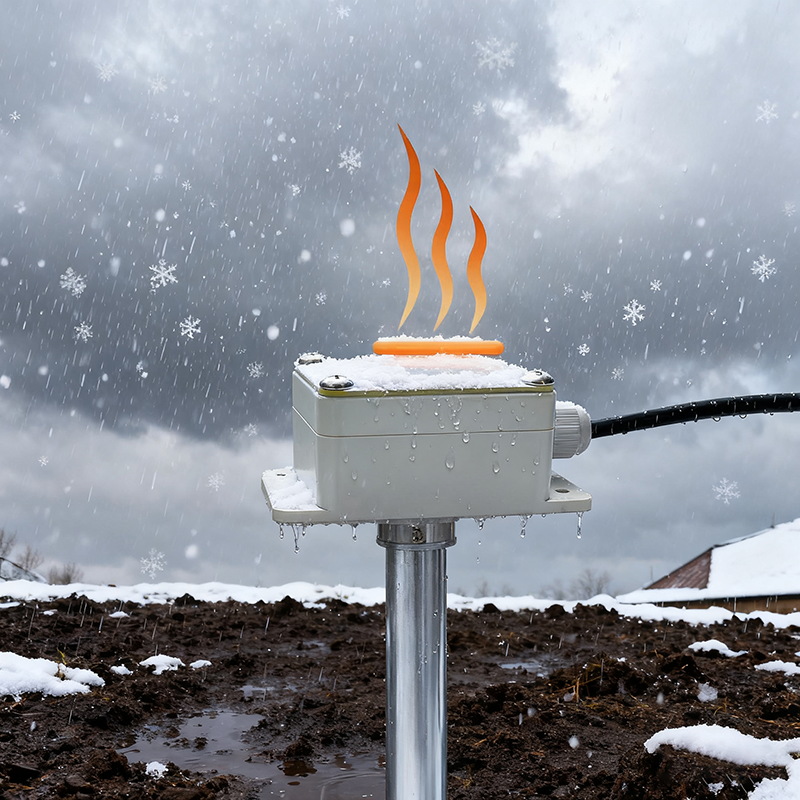
This sensor is mainly used to detect whether precipitation occurs and distinguish the types of precipitation (rain, snow, mixed). Its core principle is to use an exposed capacitor to measure the change in dielectric constant of substances that fall on its surface.
A brief description of the core principle
The sensing surface of the sensor is composed of one or more capacitive plates. When precipitation (raindrops or snowflakes) falls on the sensing surface, it will change the properties of the dielectric between the plates, thereby causing changes in the capacitance value. Due to the different dielectric constants of water, ice and air, by analyzing the patterns, rates and amplitudes of capacitance changes, it is possible to determine whether there is precipitation and whether it is rain or snow.
Main features and advantages
1. No moving parts, high reliability
Unlike traditional tipping bucket rain gauges (with mechanical tipping buckets), capacitive sensors have no moving parts at all. This significantly reduces malfunctions caused by mechanical wear, jamming (such as being blocked by sand, dust or leaves) or freezing, has extremely low maintenance requirements and a long service life.
2. It can distinguish the types of precipitation (rain/snow/mixed)
This is one of its most prominent advantages. By analyzing the characteristics of capacitive signals through algorithms, the phase state of precipitation can be determined. It is crucial for application scenarios that require an accurate understanding of the types of winter precipitation (which is important for transportation, heating, and agricultural warnings).
3. Detectable precipitation intensity and accumulation (estimated)
By measuring the frequency and intensity of capacitance changes, the intensity and cumulative amount of precipitation can be estimated. Although its absolute accuracy is usually not as good as that of strictly calibrated tipping bucket or weighing rain gauges, it is sufficient for trend monitoring and qualitative/semi-quantitative analysis.
4. Quick response
It can detect the start and end of very light precipitation (such as drizzle and light snow) with almost no delay.
5. Low power consumption and easy integration
It is highly suitable for integration with solar-powered automatic weather stations and can remotely transmit data through Internet of Things technology.
6. It can output rich information
It can not only output simple “with/without precipitation” switch signals, but also output more dimensional information such as precipitation type codes and precipitation intensity levels.
Limitations and Challenges
The measurement accuracy is relatively limited (especially for rainfall)
For scenarios that require high-precision measurement (such as hydrological research and precipitation observation in meteorological operations), it is usually not the first choice. The precipitation value measured by it is easily affected by factors such as precipitation type, temperature and wind, and requires local calibration.
2. It is susceptible to non-precipitation disturbances
Dew, frost and rime ice: These non-precipitation condensate water adhering to the sensing surface will be misjudged by the sensor as very weak precipitation.
Dust, salt particles, insects, bird droppings: Any substance adhering to the sensing surface may change the capacitance value, leading to false alarms. Although some models have self-cleaning coatings or heating functions to alleviate the problem, it cannot be completely eradicated.
Dust or splashing water in strong winds: It may also cause a brief false trigger.
3. Regular cleaning and calibration are required
To ensure the accuracy of the data, the sensing surface must be kept clean and requires regular inspection and maintenance. After long-term use, recalibration may be necessary.
4. The cost is relatively high
Compared with the simple tipping bucket rain gauge, its electronic components and algorithms are more complex, so the procurement cost is usually higher.
Compared with the core of the tipping bucket rain gauge
Suggested applicable scenarios
| Characteristics | Capacitive rain and snow sensor | Tipping bucket rain gauge |
| Working principle
|
Measurement of dielectric constant changes (electronic type) | The number of flips of the measuring bucket (mechanical type) |
| Core advantage
|
It can distinguish between rain and snow, has no moving parts, requires little maintenance and responds quickly | Single-point precipitation measurement has high accuracy, relatively low cost and mature technology |
| Main disadvantages
|
It is susceptible to non-precipitation interference, has relatively low rainfall accuracy and high cost | There are moving parts that are prone to wear and tear or jamming, cannot distinguish between rain and snow, and are prone to freezing in winter |
| Typical applications | Traffic meteorological stations, road warning systems, smart cities, and general-purpose automatic stations
|
Meteorological business observation stations, hydrological stations, agricultural monitoring |
Very suitable scenarios
Traffic meteorological monitoring: Installed beside expressways, airports and Bridges, it can promptly warn of the risks of slippery roads and icing (rain turning into snow).
General-purpose automatic weather stations: They need to obtain information on “whether there is precipitation” and “precipitation types” all day long and with low maintenance.
Smart cities and the Internet of Things: As part of the urban weather perception network, it monitors the occurrence of precipitation.
It is necessary to distinguish between rainy and snowy occasions, such as ski resorts and winter sports event support.
Not recommended scenarios: In situations where extremely high accuracy is required for precipitation measurement (such as legal meteorological observation and core hydrological calculation stations), tipping bucket or weighing rain gauges should be given priority as the main measurement equipment. Capacitive sensors can be used as a supplement for identifying precipitation types.
Summary
The capacitive rain and snow sensor is an “intelligent sentry”. Its core value does not lie in providing laboratory-level precise rainfall data, but in reliably and with low maintenance identifying the occurrence and types of precipitation events, and providing crucial qualitative information for automated decision-making systems (such as the automatic activation of road snow-melting systems). When making a choice, one should clearly define whether their own needs are “precise measurement” or “quick identification”.
For more weather sensor information, please contact Honde Technology Co., LTD.
WhatsApp: +86-15210548582
Email: info@hondetech.com
Company website: www.hondetechco.com
Post time: Dec-02-2025