

Against the backdrop of the global active practice of circular economy and climate action, Southeast Asia is standing at a critical juncture in urban organic waste management and the green transformation of agriculture. Efficiently converting abundant agricultural residues, garden waste and kitchen waste into high-quality compost is a strategic path to achieving internal resource circulation and soil remediation. However, the unique high temperature and humidity climate of the tropics often poses numerous challenges to traditional composting processes due to uncontrolled temperature and humidity, such as low fermentation efficiency, unstable product quality, as well as unpleasant odors and greenhouse gas emissions. HONDE’s wireless composting temperature and humidity intelligent monitoring system, which has been deeply developed for tropical environments, is providing data-driven solutions for communities, farms and municipal projects in Southeast Asia with its precise perception and remote intelligent control capabilities, making the resource utilization process of organic waste efficient, controllable and environmentally friendly.
Core challenge: The unique context of composting in Southeast Asia
Promoting the industrialization of composting in Southeast Asia not only enjoys the natural advantage of abundant raw materials but also needs to overcome its special environmental constraints:
The double-edged sword effect of climate : Although perennial high temperatures can accelerate microbial activities, the internal temperature of the pile can easily exceed the critical point of 65℃, leading to the inactivation of beneficial microbial communities. Frequent rainfall and high environmental humidity can easily cause the pile to be overly wet and poorly ventilated, thereby triggering anaerobic putrefaction and accompanied by the generation of methane and unpleasant odors.
The limitations of traditional craftsmanship: Relying on manual observation, tactile judgment and regular turning of the pile for experience-based management, it is difficult to achieve large-scale and standardized production, resulting in large fluctuations in efficiency and uneven product quality.
Market Demand for high-quality and stable products : With the popularization of ecological agriculture concepts, the market demand for fully decomposed and staber-quality organic fertilizers is increasing day by day, and higher requirements are put forward for the controllability and traceability of the production process.
Therefore, precise, continuous and traceable monitoring and intelligent regulation of the core fermentation parameters of the pile – temperature and moisture – have become the core technical levers for improving the success rate of composting, ensuring product quality and enhancing the economic benefits of the industry.
2. HONDE Solution: Implanting “digital senses” in the fermentation process
The HONDE system is specifically designed for the harsh environment of high temperature, high humidity and high corrosion at composting sites
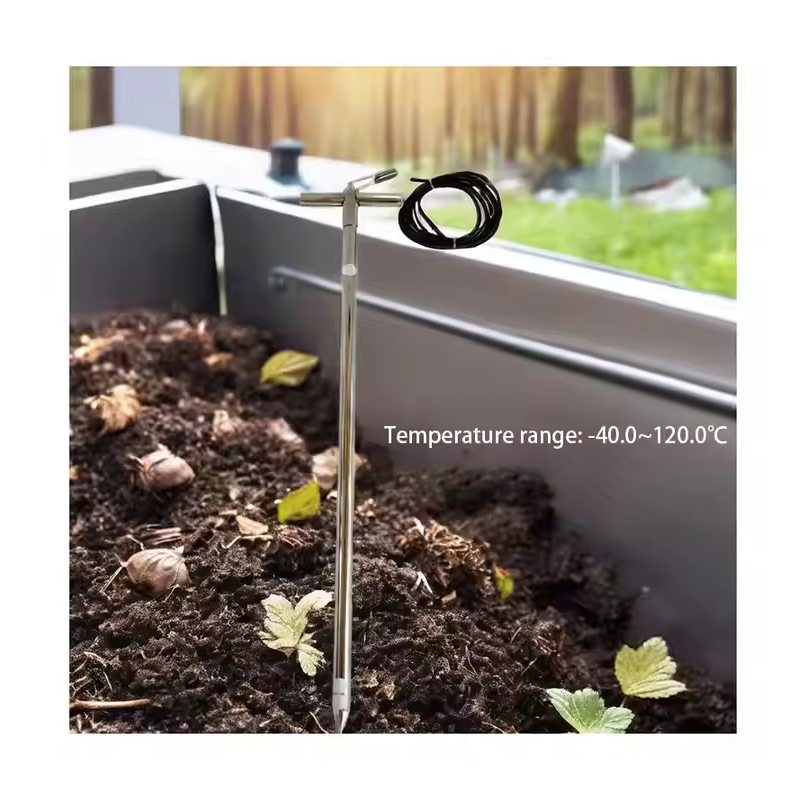
Weather-resistant probe sensor: It adopts a special stainless steel probe, which can be implanted into the pile at multiple depths (surface layer, core layer, bottom layer) to synchronously and in real time monitor the temperature and volume moisture content, accurately reflecting the fermentation dynamics.
Low-power wireless iot Architecture : Integrated LoRa or NB-IoT wireless modules, data is remotely transmitted to the gateway, completely eliminating complex wiring, flexible installation, and especially suitable for dynamic operation requirements in open-air storage yards.
Off-grid power Supply and cloud-based intelligent control : The system supports solar power supply to ensure long-term stable operation. Data is uploaded to the cloud in real time, and distributed composting projects can be remotely and centrally monitored and intelligently managed through a visualization platform.
Intelligent Early Warning and Process Guidance : Users can customize temperature and humidity thresholds that meet process requirements. Once the monitoring data indicates that the reactor temperature has entered the harmful high-temperature zone or that the humidity is too high, triggering the anaerobic risk , the system will immediately send multi-level alerts to the management personnel and can provide precise operation suggestions such as turning the reactor, adjusting the coverage or regulating the carbon-nitrogen ratio.
III. Application Scenarios: Empowering Diversified Green practices
1. Municipal and community kitchen waste resource utilization
Deployed in communities or treatment centers of major cities such as Bangkok and Jakarta, it ensures hygiene and harmlessness through precise temperature control (maintaining the critical temperature range of 55-65℃), and significantly supposes odors through scientific humidity control, enhancing community acceptance. Data-driven management can help shorten the composting cycle by 20% to 30% and stably produce high-quality fertilizers.
2. Closed-loop utilization of agricultural waste from large-scale plantations
It is applied to oil palm plantations, banana plantations, etc., for large-scale treatment of organic residues such as fruit bunches, stems and leaves. Convert waste on-site into customized soil conditioners, reduce the cost of external fertilizers, restore the soil, and complete the ecological cycle of “planting – harvesting – waste – composting – returning to the field”, enhancing the sustainability and market competitiveness of the farm.
3. High-quality production by small and medium-sized farmers and cooperatives
Provide lightweight and easy-to-operate solutions for small and medium-sized producers engaged in ecological planting. Ensure that self-produced compost is fully decomposed, meets organic certification standards, and lower the technical threshold through mobile applications to empower small-scale farmers to enhance product value and market competitiveness.
4. Working Together to address Climate change
By optimizing the composting process to maintain an aerobic environment, the generation of the potent greenhouse gas methane can be suppressed from the source. The high-quality compost produced and returned to the fields can further increase the soil’s organic carbon storage, providing a nature-based solution for the regional carbon neutrality goal.
IV. Empirical Case: Data-driven Green Transformation of Communities
A certain tourist community in Bali, Indonesia, has introduced the HONDE system to address the pressure of kitchen waste. Through precise monitoring, the community quantitatively identified that the excessively high humidity of the pile during the rainy season was the main cause of fermentation delay, and then optimized the rainproof and ventilation designs. During the dry season, the system guides the turning of the pile at the best time. After the project was implemented, the community successfully recycled over 70% of its organic waste on-site. The compost produced was used for greening and educating the farm, reducing the cost of collection and transportation while fostering a positive environmental protection culture in the community.
Conclusion
In the process of building a circular society in Southeast Asia, composting, as a core link connecting waste management and ecological agriculture, the precision and intelligence of its process are of vital importance. The HONDE composting temperature and humidity sensing system infuses this traditional technique with modern wisdom by transforming the traditional “black box” fermentation process into a transparent, traceable and optimizable data stream. It is helping various projects to systematically transform organic “burdens” into “black gold” that nourishes the land with higher efficiency and better quality, providing reliable technological empowerment for the sustainable development blueprint of Southeast Asia.
For more Agriculture sensor information, please contact Honde Technology Co., LTD.
WhatsApp: +86-15210548582
Email: info@hondetech.com
Company website: www.hondetechco.com
Post time: Dec-24-2025