

In the pursuit of high yield and efficiency in modern greenhouses, the control of the environment has extended from the macroscopic aspects of air temperature and humidity to the microscopic interfaces of crop canopies and even leaves. Leaves, as the core organs for photosynthesis, transpiration and gas exchange in crops, the temperature, humidity and micro-environment on their surface directly affect physiological activity, stress status and the risk of disease occurrence. However, this key interface has long been like a “black box”. The introduction of leaf surface temperature and humidity sensors has directly extended the monitoring reach to the surface of crops, providing unprecedented precise insights for greenhouse management and initiating a new stage from “environmental management” to “physiological management of crops themselves”.
I. Why Pay Attention to “Leaf Surface” Microclimate?
The temperature and humidity data of the greenhouse air cannot accurately reflect the true condition of the leaf surface. Due to transpiration, radiative heat transfer and boundary layer effect, there is often a significant difference between the leaf surface temperature and the air temperature (which can be 2-8°C lower or even higher), and the duration of dew condensation or moisture on the leaf surface is something that air humidity cannot directly represent. This micro-environment is key to multiple processes:
The breeding ground for diseases: The spore germination and infection of the vast majority of fungal and bacterial diseases (such as downy mildew, gray mold, and powdery mildew) strictly depend on the specific duration of continuous moisture on the leaf surface and the temperature window.
The “valve” of transpiration: The opening and closing of leaf stomata are driven by leaf temperature and the water vapor pressure difference between leaves and air, directly affecting water use efficiency and photosynthetic rate.
Indicators of physiological stress: Abnormal increase in leaf temperature may be an early signal of water stress, root problems or excessive light.
Ii. Sensor Technology: Simulating the “Sensing Skin” of Blades
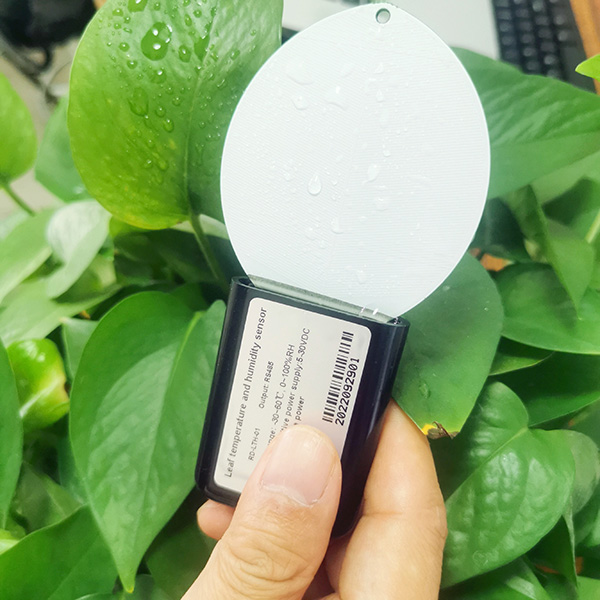
The leaf surface temperature and humidity sensor is not directly installed on real leaves, but is a carefully designed sensing element that can simulate the typical thermal and moisture characteristics of leaves.
Bionic design: Its sensing surface simulates real blades in terms of material, color, inclination Angle and heat capacity, ensuring that its response to radiation, convection and condensation is consistent with the height of real blades.
Dual-parameter synchronous monitoring
Leaf surface temperature: Precisely measure the temperature of the simulated leaf surface to reflect the energy balance status of the crop canopy.
Leaf surface humidity/moist state: By measuring changes in dielectric constant or resistance, accurately determine whether the sensing surface is dry, moist (with dew or just after irrigation), or saturated, and quantify the duration of leaf moisture.
Non-destructive and representative: It avoids the damage or interference that may be caused by contact with real leaves and can be deployed at multiple points to represent the microclimate of different canopy positions.
Iii. Revolutionary Applications in Greenhouses
The “Gold Standard” for disease Prediction and Precise Control
This is the most core value of the leaf surface sensor.
Practice: Preset the temperature-humidity duration models for the occurrence of specific diseases (such as late blight of tomato and downy mildew of cucumber) in the system. The sensor continuously monitors the actual temperature and humidity conditions on the leaf surface.
Decision: When environmental conditions continuously meet the “critical window” for disease infection, the system automatically issues a high-level early warning.
Value
Achieve preventive pesticide application: Carry out precise control during the most effective period before pathogenic bacteria may infect or in the early stage of infection, nipping the disease in the bud.
Significantly reduce pesticide use: Alter the regular pesticide application model to achieve on-demand application. Practical experience shows that it can reduce the frequency of unnecessary spraying by 30% to 50%, lowering costs and the risk of pesticide residues.
Supporting green production: It is a key technical tool for achieving organic or integrated pest and disease management.
2. Optimize environmental control strategies to avoid physiological stress
Practice: Real-time monitoring of the difference between leaf temperature and air temperature.
Decision
When the leaf temperature is significantly higher than the air temperature and continues to rise, it may indicate insufficient transpiration (restricted water absorption by the root system or high humidity causing stomata to close), and it is necessary to check irrigation or increase ventilation.
During winter nights, by monitoring the risk of condensation on the leaf surface, heating can be precisely controlled or the internal circulation fan can be turned on to prevent the leaf area from being exposed, thereby reducing the risk of diseases.
Value: More directly regulate the greenhouse environment based on the physiological responses of crops, enhancing crop health and resource utilization efficiency.
3. Guide precise irrigation and water and fertilizer management
Practice: Combined with soil moisture data, leaf surface temperature is a sensitive indicator for judging water stress in crops.
Decision: In the afternoon when the sunlight is intense, if the leaf temperature abnormally rises, it may indicate that even though the soil moisture is still acceptable, the transpiration demand has exceeded the water supply capacity of the root system. It is necessary to consider supplementary irrigation or spraying for cooling.
Value: Achieve more refined water management and prevent yield and quality losses caused by hidden stress.
4. Evaluate the effectiveness of agronomic measures
Practice: Compare the changes in the microclimate of the leaf surface within the canopy before and after implementing different agronomic operations (such as adjusting row spacing, using different coverings, and changing ventilation strategies).
Value: Quantitatively assess the actual effects of these measures on improving the ventilation of crop canopies, reducing humidity, and balancing temperature, providing data support for optimizing cultivation plans.
Iv. Deployment Points: Capture the real canopy signal
Representativeness of location: It should be deployed at a representative position within the crop canopy, usually at the height of the main functional leaves in the middle of the plant, and avoid the water line of direct sprinkler irrigation.
Multi-point monitoring: In large or multi-span greenhouses, multiple points should be deployed in different areas (near the air vents, in the middle, and at the far end) to grasp the spatial variations of the microclimate.
Regular calibration and maintenance: Ensure that the sensing surface is clean and the characteristics of the simulated blade have not changed to guarantee the long-term reliability of the data.
V. Empirical Case: Data-driven “Zero Occurrence” Management of Late Blight in Tomatoes
A high-tech tomato greenhouse in the Netherlands has fully introduced a leaf surface temperature and humidity monitoring network. The system integrates the infection model of late blight in tomatoes. In a typical spring production cycle:
The sensor has repeatedly detected that the duration of leaf surface moisture at night has reached the disease risk threshold, but the temperature conditions have not been fully met.
2. Only during the “high-risk window period” when both temperature and humidity duration conditions were simultaneously met three times did the system issue the highest-level pesticide application warning.
3. Growers only carried out precise targeted control measures after the above three warnings.
Throughout the entire growing season, the greenhouse successfully achieved a “zero occurrence” of late blight in tomatoes by reducing the frequency of regular preventive pesticide application from 12 to 3 times. At the same time, due to the reduction of manual and mechanical interference in pesticide application, the growth of crops became more stable, and the final yield increased by approximately 5%. The greenhouse manager commented: “Previously, we sprayed pesticides every week for the ‘possible’ risks.” Now, the leaf surface sensor tells us when the risk truly exists. This is not merely about cost savings; it is also the greatest respect for crops and the environment.
Conclusion
In the process of greenhouse production moving towards ultra-precision, the direct perception of the physiological state of crops themselves is becoming a higher-level competitiveness that transcends environmental control. The leaf surface temperature and humidity sensor is like installing a pair of discerning eyes for growers that can “see” the respiration of leaves and “sense” the latent diseases. It transforms crops from managed “objects” into intelligent entities that actively “express” their needs. By decoding the code of foliar microclimate, greenhouse management has been elevated from extensive environmental parameter regulation to proactive and predictive management centered on crop health and physiological needs. This is not only a breakthrough in production technology, but also a vivid practice of the concept of sustainable agriculture – achieving the greatest production benefits and ecological harmony with the least external intervention. With the advancement of algorithms, these data will be further integrated into the artificial intelligence brain of greenhouses, driving facility agriculture into a truly intelligent new era of “knowing the temperature of crops and understanding the needs of plants”.
For more Agriculture sensor information, please contact Honde Technology Co., LTD.
WhatsApp: +86-15210548582
Email: info@hondetech.com
Company website: www.hondetechco.com
Post time: Dec-24-2025