

FDR is the specific implementation method of the most mainstream capacitive soil moisture measurement technology at present. It indirectly and rapidly acquires the volumetric water content of the soil by measuring the dielectric constant (capacitance effect) of the soil. The principle is to emit an electromagnetic wave signal of a specific frequency (usually 70-150 MHz) into the electrode (probe) inserted into the soil, and measure the resonant frequency or impedance change determined by the dielectric properties of the soil, thereby calculating the dielectric constant and moisture content.
The following are the detailed features of the FDR soil sensor:
Core strengths and advantages
The measurement is fast, continuous and automated
It can achieve continuous measurement at the second level or even faster, making it highly suitable for scenarios that require high temporal resolution data recording, automated irrigation control, and dynamic process research.
High cost performance and easy to popularize
Compared with the more precise and expensive TDR (Time Domain Reflectometry) sensors, the FDR circuit design and manufacturing are simpler, and the cost is significantly reduced, making it an ideal choice for large-scale deployment in fields such as smart agriculture and landscaping.
Extremely low power consumption
The power consumption of the measurement circuit is very low, usually only requiring milliampere-level current, making it highly suitable for field monitoring stations and Internet of Things systems that are powered by batteries and solar panels for a long time.
The probe is flexibly designed and easy to install
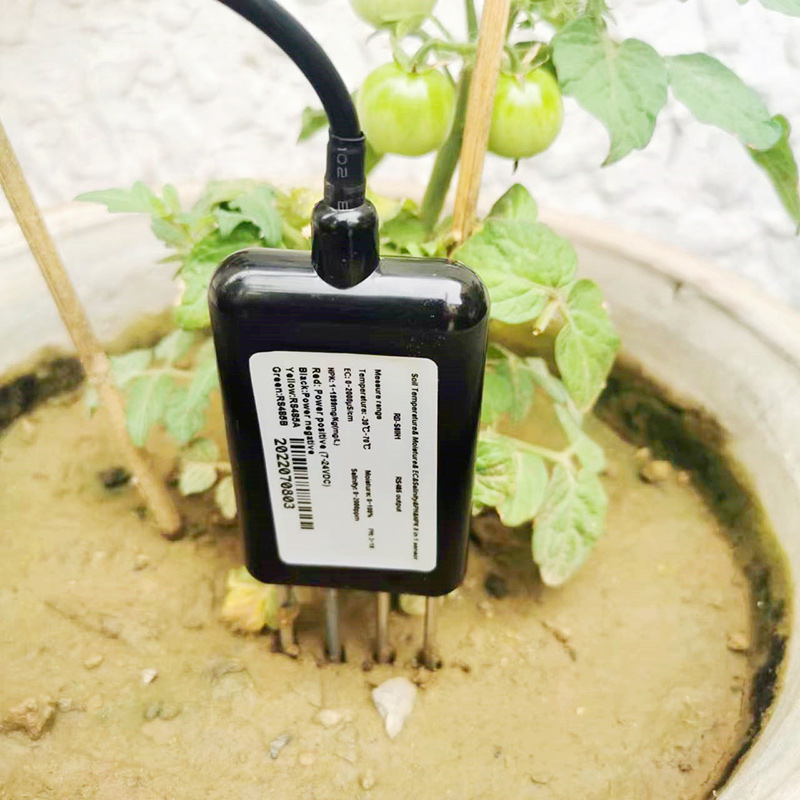
The probes come in various forms (such as rod type, puncture type, multi-depth profile type, etc.), and only need to be inserted into the soil. They cause little damage to the soil structure and are very easy to install.
It has good stability and high security
It contains no radioactive substances (unlike neutron meters), is safe to use, and its electronic components are stable in performance, allowing for long-term operation.
Easy to integrate and network
It is naturally compatible with the modern Internet of Things architecture and can easily integrate data recording and wireless transmission modules to build a large-scale soil moisture monitoring network.
Main limitations and challenges
The measurement accuracy is affected by various soil characteristics (core limitations)
Soil texture and bulk density: The relationship (calibration curve) between dielectric constant and water content varies among soils with different contents of clay, sand, and organic matter. General calibration formulas can lead to errors.
Soil electrical conductivity (salinity) : This is one of the most significant factors affecting the accuracy of FDR. Conductive ions in soil solution can cause signal energy loss, leading to an inflated dielectric constant measurement value and thus overestimating the water content. In saline-alkali land, this error may be very significant.
Temperature: The dielectric constant of soil is affected by temperature. High-end models are equipped with built-in temperature sensors for compensation, but this cannot be completely eliminated.
Contact between the probe and the soil: If there is a gap left or the contact is not firm during installation, it will seriously interfere with the measurement.
On-site calibration must be carried out to pursue high precision
Factory calibration is usually based on some standard medium (such as sand and soil). To obtain reliable absolute values, on-site calibration must be carried out in the target soil (that is, by comparing with the measured values of the drying method and establishing a local calibration equation). This is a crucial step to ensure the quality of scientific research and precise data management, but it also increases the usage cost and technical threshold.
The measurement range is local “point” information
The sensitive area of a sensor is usually confined to a few cubic centimeters of soil volume around the probe. To characterize the spatial variability of large plots, it is necessary to carry out reasonable multi-point layout.
Long-term stability and drift
After long-term burial, the probe metal may cause the measurement characteristics to drift due to electrochemical corrosion or contamination, and regular inspection and recalibration are required.
Suggested applicable scenarios
Very suitable scenarios
Precision agriculture and intelligent irrigation: Monitoring soil moisture dynamics, optimizing irrigation decisions, and achieving water conservation and efficiency improvement.
Ecological and hydrological research: Long-term fixed-point monitoring of soil moisture profile changes.
Garden and golf course maintenance: Core sensors of automated irrigation systems.
Geological disaster monitoring: Used for water content early warning in slope stability monitoring.
Scenarios where caution is needed or countermeasures should be taken:
For salinized or high-conductivity soil: Models with salinity compensation functions must be selected and strict on-site calibration must be carried out.
In situations where there are legal or research-level requirements for absolute accuracy: It is necessary to compare and calibrate with TDR or drying methods, and regular checks should be conducted.
Summary
FDR soil sensors, with their excellent cost performance, low power consumption and ease of use, have become the most widely used soil moisture measurement technology in modern agriculture and environmental monitoring. It is essentially an “efficient on-site scout”.
The core features can be summarized as:
Advantages: Fast, continuous, low cost, low power consumption, and easy to network.
Limitations: The accuracy is easily affected by soil salinity, texture and temperature, and on-site calibration is required to ensure accuracy.
By correctly understanding its characteristics and managing its errors through scientific point layout and necessary calibration, FDR sensors can provide highly valuable dynamic information on soil moisture and are key tools for precise water resource management and the development of digital agriculture.
For more soil sensor information, please contact Honde Technology Co., LTD.
WhatsApp: +86-15210548582
Email: info@hondetech.com
Company website: www.hondetechco.com
Post time: Dec-12-2025