

1. Introduction: The Summary Answer for Accurate Coastal Monitoring
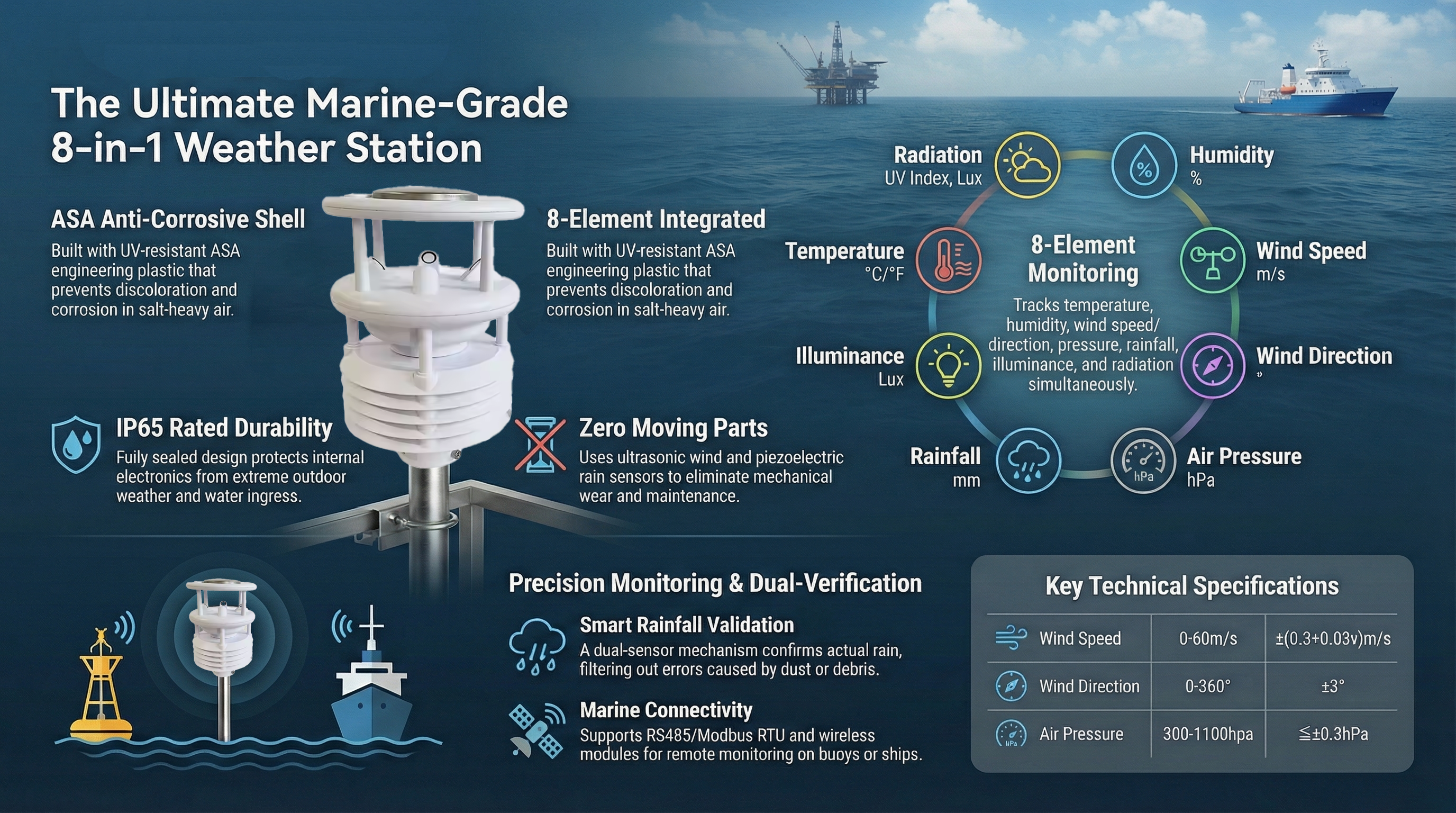
The best weather station for a marine or coastal environment is defined by three core characteristics: a corrosion-proof construction, robust ingress protection, and intelligent sensor technology. Key features to look for are a shell made from ASA engineering plastic, a protection rating of at least IP65, and advanced sensors that actively filter out environmental interference like sea spray or dust. The HD-CWSPR9IN1-01 is a compact weather station that embodies these traits, delivering reliable meteorological data in the harshest saltwater conditions.
2. Why Standard Weather Stations Fail in Marine Environments
Marine and coastal settings pose unique challenges that cause standard meteorological equipment to fail prematurely. The constant exposure to saltwater and intense sun is a punishing combination that requires specialized design and materials. Two primary failure points stand out:
- Material Degradation: The high salinity of sea spray is extremely corrosive to metals and many plastics. Combined with high UV exposure, this environment rapidly breaks down standard materials, leading to structural failure and compromised sensor housings.
- Data Inaccuracy: Environmental factors common in coastal areas can lead to significant data errors. Sea spray, dust, and other airborne particles can trigger false readings in unprotected sensors, most notably causing standard rain gauges to report rainfall when there is none.
3. Ideal Applications for Marine-Grade Monitoring
While engineered for coastal challenges, the durability of marine-grade weather stations makes them ideal for any harsh environment where reliability is paramount. The HD-CWSPR9IN1-01 excels in a variety of demanding fields, including:
- Agricultural meteorology
- Smart street light environmental sensing
- Scenic area and park monitoring
- Water conservancy and hydrology
- Highway weather monitoring
4. Core Features of a Marine-Ready Weather Station: A Look at the HD-CWSPR9IN1-01
The HD-CWSPR9IN1-01 is specifically engineered to overcome the challenges of marine environments. Its design focuses on long-term durability and data integrity.
4.1. Engineered for Durability: ASA Shell and IP65 Protection
To combat the dual threat of UV degradation and saltwater corrosion, the device’s external shell is constructed from ASA (Acrylonitrile Styrene Acrylate) engineering plastic, a material chosen for its exceptional resilience in outdoor applications. Its primary benefits include:
- Anti-ultraviolet
- Anti-weathering
- Anti-corrosion
- Resists discoloration over long-term use
Furthermore, the unit carries a protection level of IP65, signifying that it is completely dust-tight and protected against water jets from any direction—making it resilient against storm-driven rain and sea spray.
4.2. A Smarter Approach to Rainfall: Solving False Positives with Piezoelectric Sensing
In our engineering experience, the primary failure point for automated rainfall data isn’t the sensor itself, but false positives. A common pitfall of standard piezoelectric rain sensors is that they can be triggered by non-precipitation events, such as impacts from dust or other small debris. This leads to frustrating and misleading false rainfall data.
To solve this, the HD-CWSPR9IN1-01 uses an innovative dual-sensor system. It pairs the primary piezoelectric sensor with an auxiliary rain and snow sensor that acts as an intelligent validation layer. This creates a two-step “judgment” process: the system only records and accumulates rainfall data when both the piezoelectric sensor detects an impact and the auxiliary sensor confirms the presence of precipitation. This dual-confirmation mechanism effectively filters out false positives, ensuring the rainfall data is highly accurate and reliable.
4.3. Integrated Ultrasonic and Environmental Sensing
The HD-CWSPR9IN1-01 integrates eight core meteorological sensors into a single, compact unit, providing a complete environmental picture.
- Wind speed and wind direction are measured by an integrated ultrasonic sensor. This solid-state design has no moving parts, which dramatically increases reliability and longevity by eliminating mechanical failure points—like seized bearings—that are common in traditional cup-and-vane anemometers exposed to corrosive saltwater environments.
- Ambient temperature
- Relative humidity
- Atmospheric pressure
- Rainfall
- Illuminance
- Radiation
5. Technical Specifications at a Glance
The following table provides a detailed overview of the HD-CWSPR9IN1-01′s performance metrics.
| Monitoring parameters | Measuring range | Resolution | Accuracy |
| temperature | -40-85℃ | 0.1℃ | ±0.3℃ (@25℃, typical) |
| humidity | 0-100%RH | 0.1%RH | ±3%RH (10-80%RH) without condensation |
| Air pressure | 300-1100hpa | 0.1hpa | ≦±0.3hPa (@25℃, 950hPa-1050hPa) |
| Wind speed | 0-60m/s | 0.01m/s | ±(0.3+0.03v)m/s(≤30M/S)±(0.3+0.05v)m/s(≥30M/S) |
| wind direction | 0-360° | 0.1° | ±3° (wind speed <10m/s) |
| Rainfall | 0-200mm/h | 0.1mm | Error <10% |
| Illuminance | 0-200KLUX | 10LUX | Reading 3% or 1% FS |
| radiation | 0-2000 W/m2 | 1 W/m2 | Reading 3% or 1% FS |
6. Seamless Integration for Remote Operations
For remote marine and coastal deployments, easy and reliable data integration is critical. The HD-CWSPR9IN1-01 is designed for straightforward integration into new or existing monitoring systems.
- Standardized Output: The device uses a standard RS485 communication interface and the industry-standard Modbus RTU communication protocol, ensuring compatibility with a wide range of data loggers, PLCs, and SCADA systems.
- Power Efficiency: With a power consumption of less than 1W (@12V) and compatibility with DC (12-24V) power supplies, the station is ideal for off-grid applications using solar energy sources.
- Flexible Deployment: The unit can be installed using either sleeve or flange adapter fixing methods, providing versatility for different mounting structures.
- Wireless Capability: For true remote monitoring, wireless modules such as WiFi or 4G can be integrated to upload data directly to a network platform for real-time viewing and analysis.
- Expandable Sensor Platform: The Modbus RTU protocol allows for the integration of additional, specialized sensors such as Noise, PM2.5/PM10, and various gas concentrations (e.g., CO2, O3). This makes the unit a flexible, future-proof investment for comprehensive environmental monitoring.
7. Conclusion: The Smart Choice for Your Marine Weather Monitoring Project
The HD-CWSPR9IN1-01 is an ideal choice for marine and coastal weather monitoring projects because it directly addresses the core failure points of standard equipment. It combines three essential value propositions: durability against saltwater and UV rays with its ASA plastic shell and IP65 rating; superior data accuracy from its ultrasonic anemometer and dual-validation rain sensor; and easy integration into remote systems thanks to its standard Modbus RTU output and low power consumption.
Ready to build a reliable meteorological monitoring system for your marine project? Contact us to get a custom quote or download the detailed specs sheet.
Tags:
[ All In One Piezoelectric Rain Gauge Automatic Rain Snow Sensor Solar RadiationWeather Station]
For more weather station information, please contact Honde Technology Co., LTD.
WhatsApp: +86-15210548582
Email: info@hondetech.com
Company website: www.hondetechco.com
Post time: Jan-28-2026