

Meta Title: Residual Chlorine Sensor for Wastewater Disinfection Control
Meta Description: Discover how online residual chlorine and pH/ORP sensors help wastewater treatment plants monitor disinfection performance, optimize sodium hypochlorite dosing and manage effluent quality.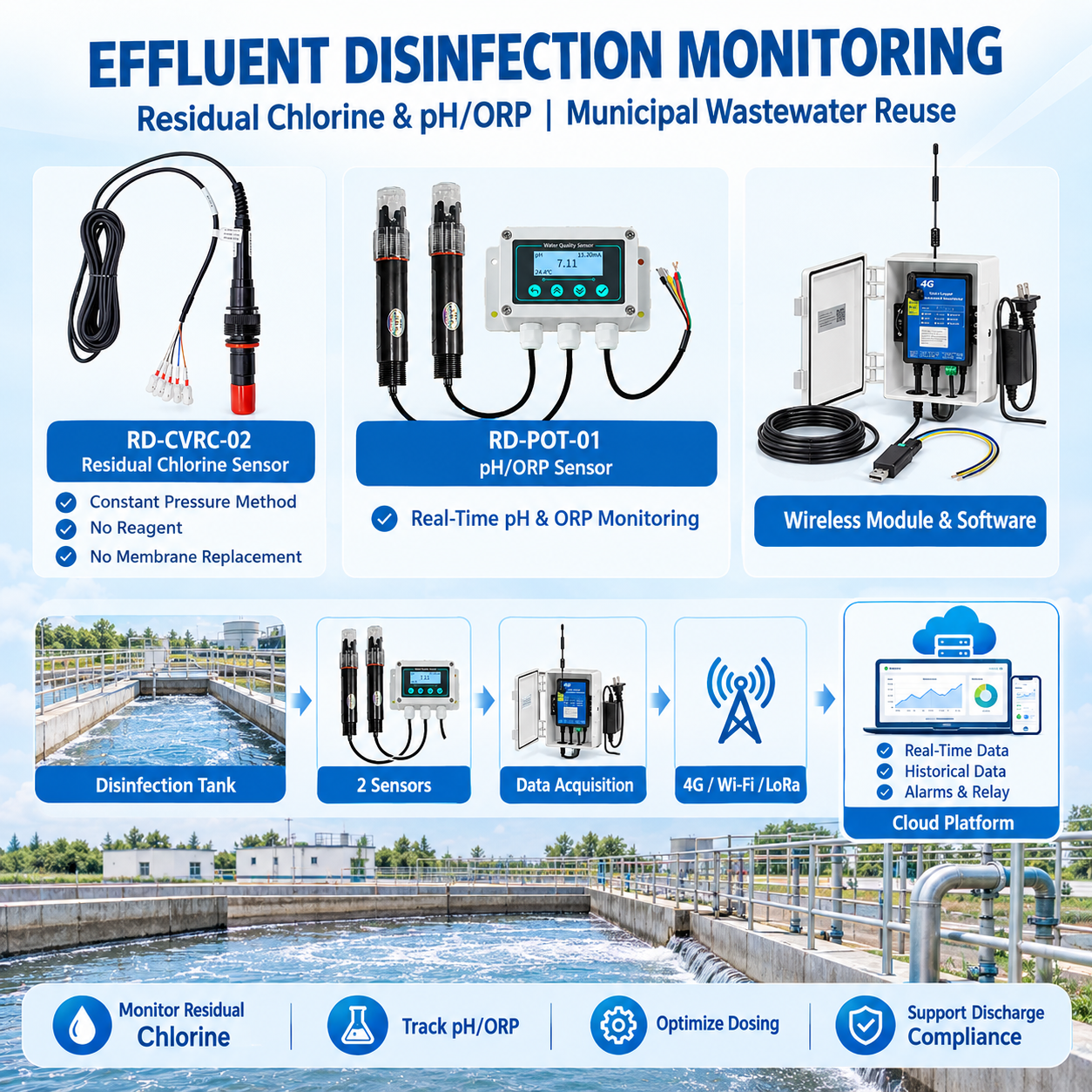
Primary Keyword: residual chlorine sensor for wastewater treatment
Secondary Keywords: online residual chlorine monitor, wastewater disinfection control, sodium hypochlorite dosing system, pH ORP sensor, effluent water quality monitoring, chlorine dosing optimization, reclaimed water disinfection
1. Why Monitor Residual Chlorine at the Wastewater Outlet?
At the final disinfection stage of a municipal wastewater treatment plant, operators need to ensure that treated water meets the required microbiological and discharge standards without adding more disinfectant than necessary.
Sodium hypochlorite is commonly used for wastewater chlorination. However, the required dose can change with wastewater quality, flow rate, chlorine demand and contact time. A fixed dosing rate may therefore result in insufficient residual chlorine during some operating periods and excessive residual chlorine during others.
Continuous residual chlorine monitoring gives operators direct information about the disinfectant remaining in the treated water. Monitoring pH alongside chlorine residual provides additional context because pH affects chlorine speciation and disinfection effectiveness. The U.S. Environmental Protection Agency identifies both residual disinfectant concentration and pH as important monitoring parameters in chlorination processes.
For municipal wastewater plants and reclaimed water facilities, a practical monitoring solution can start with two key instruments: a residual chlorine sensor and a combined pH/ORP sensor.
Honde Technology Co., Ltd. proposes the following configuration for this application:
- RD-CVRC-02: Constant-pressure residual chlorine sensor, specified as reagent-free and without a replaceable membrane head.
- RD-POT-01: Combined pH/ORP sensor for monitoring water acidity/alkalinity and oxidation-reduction potential.
Together, these instruments can provide useful process data for disinfection monitoring and dosing management.
2. Application Scenario: Tailwater Disinfection and Reclaimed Water Reuse
After biological treatment and clarification, wastewater may pass through a final disinfection stage before discharge or reuse. Depending on the facility design, disinfection may use sodium hypochlorite, ultraviolet treatment or another approved process.
The monitoring requirements differ according to the selected disinfection method.
Municipal wastewater discharge
For chlorination systems, operators need to verify that the residual chlorine level is appropriate for the treatment process and applicable discharge requirements. Excess residual chlorine may also need to be controlled before discharge, depending on the receiving environment and local regulations.
A residual chlorine sensor installed at a suitable monitoring point can help identify changes in the remaining disinfectant concentration and support timely operational adjustments.
Reclaimed water treatment
Reclaimed water used for landscaping, industrial applications or other approved purposes must meet the relevant quality requirements for its intended use.
Online chlorine residual monitoring can help operators observe disinfection performance as water quality and flow conditions change. The appropriate residual target should be established according to local regulations, the intended reuse application and the validated treatment process.
Disinfection system operation
Monitoring pH and ORP alongside residual chlorine gives operators additional information about water chemistry and oxidation conditions.
These measurements are complementary rather than interchangeable: residual chlorine directly measures the target disinfectant parameter, pH indicates acidity or alkalinity, and ORP provides an indication of the water’s oxidation-reduction condition.
3. Recommended Two-Sensor Configuration
For a project focused on tailwater disinfection, the proposed configuration keeps the monitoring system straightforward.
| Product model | Main measurement | Role in the disinfection process |
|---|---|---|
| RD-CVRC-02 | Residual chlorine | Monitors the remaining chlorine concentration |
| RD-POT-01 | pH and ORP | Provides additional information on water chemistry and oxidation conditions |
RD-CVRC-02: Constant-Pressure Residual Chlorine Sensor
Residual chlorine is the primary measurement when the objective is to monitor chlorine remaining after chemical disinfection.
The RD-CVRC-02 is specified for constant-pressure measurement and is described as requiring no added reagents and no replaceable membrane head. These design characteristics may help simplify routine operation compared with systems that require regular reagent replenishment or membrane replacement.
Before selecting the sensor, the engineering team should confirm the applicable chlorine measurement type, measuring range, accuracy, pressure requirements and compatibility with the actual wastewater matrix.
For example, free chlorine and total chlorine are not identical measurements. The selected instrument must measure the parameter required by the project’s process specification and regulatory monitoring plan.
RD-POT-01: Combined pH/ORP Sensor
The RD-POT-01 measures pH and oxidation-reduction potential.
pH matters because it influences the balance between hypochlorous acid and hypochlorite ions in chlorinated water. Hypochlorous acid generally has stronger disinfecting action, so a change in pH can affect the effectiveness of a given chlorine residual.
ORP provides a supplementary indicator of oxidation-reduction conditions, but it should not be used as a direct substitute for residual chlorine measurement unless a site-specific correlation has been established and validated.
For this reason, measuring residual chlorine and pH/ORP together provides more useful information than relying on a single parameter.
4. How Online Monitoring Supports Chemical Dosing Control
The objective of an online monitoring system is to help operators maintain the required disinfection conditions while avoiding unnecessary chemical consumption.
A typical chlorination control workflow can be organized into four stages.
Step 1: Measure the treated water
Install the RD-CVRC-02 and RD-POT-01 at suitable sampling or measurement points, following the manufacturer’s installation requirements.
The residual chlorine sensor tracks the remaining disinfectant concentration, while the pH/ORP sensor provides complementary water chemistry information.
Step 2: Compare measurements with process targets
The controller compares the measured values with the plant’s configured operating limits.
The residual chlorine target should be determined from the applicable discharge or reuse requirements, disinfection contact time and validated operating conditions. It should not be selected using a universal value for every wastewater plant.
Step 3: Adjust the dosing system where appropriate
When integrated with a compatible PLC, dosing pump and control logic, the residual chlorine measurement can be used as feedback for adjusting sodium hypochlorite dosing.
If residual chlorine falls below the required operating range, the controller may increase dosing according to the approved control strategy. If residual chlorine exceeds the target range, the system may reduce dosing.
Actual control logic must account for flow variation, mixing, transport delay, chlorine demand and contact time. A sensor alone does not automatically adjust a dosing pump without the necessary control equipment and integration.
Step 4: Record and review operating data
With a compatible data logger, communication module and monitoring platform, operators can review real-time readings and historical trends.
These records help identify recurring changes in chlorine demand, investigate alarms and evaluate whether the dosing strategy maintains the required water quality.
5. Honde IoT Water Quality Monitoring Solution
For projects that require remote monitoring, Honde’s proposed solution can combine the two sensors with data acquisition, wireless communication and cloud software.
| Component | Function |
|---|---|
| RD-CVRC-02 residual chlorine sensor | Monitors chlorine residual |
| RD-POT-01 pH/ORP sensor | Monitors pH and ORP |
| Handheld meter or data logger with screen | Supports local readings and data viewing, subject to compatibility |
| GPRS / 4G / Wi-Fi / LoRa / LoRaWAN module | Provides communication options for remote monitoring |
| Cloud server and monitoring software | Supports real-time data viewing and historical records |
| Alarm relay and external control interface | Supports configured alarms and compatible external control equipment |
The proposed system architecture is:
Residual Chlorine Sensor + pH/ORP Sensor → Data Logger/Controller → Communication Module → Cloud Platform → Alarm Review and Dosing Management
The communication options include GPRS, 4G, Wi-Fi, LoRa and LoRaWAN, with MQTT/JSON data transmission where supported by the selected configuration.
For projects that require automatic chemical dosing, the control system should also include a compatible dosing pump, PLC or controller, and suitable interlocks. Cloud monitoring provides remote visibility, while closed-loop dosing control depends on the local control architecture and verified process settings.
6. Important Considerations Before Installation
Select the correct chlorine measurement
Confirm whether the project requires free chlorine, total residual chlorine or another specified chlorine parameter. The sensor’s measurement principle and performance must match that requirement.
Install the sensor at a representative location
The monitoring point should provide a representative reading of treated water. Consider mixing conditions, sampling arrangements, flow changes and the location of the chlorine injection point.
Establish the correct operating target
Do not use a generic residual chlorine target without checking the applicable regulations and intended reuse or discharge requirements. Contact time, water quality and microbiological performance must also be considered.
Check pH and ORP measurement requirements
pH and ORP provide useful supporting information, but neither replaces a direct residual chlorine measurement. Confirm the required measuring ranges, calibration procedures and maintenance intervals.
Test the alarm and dosing response
During commissioning, verify that the sensor readings, controller displays, alarm functions and communication links work correctly. If automatic dosing is included, test the response under controlled conditions and confirm the appropriate fault-handling procedure.
Evaluate chemical consumption using operating records
To assess whether dosing optimization is effective, compare chemical usage with treated water volume, influent conditions, residual chlorine trends and relevant water quality results. This provides a more reliable evaluation than assuming a fixed percentage of chemical savings.
7. Frequently Asked Questions
Why monitor residual chlorine after wastewater disinfection?
Residual chlorine monitoring helps operators understand how much disinfectant remains after treatment and supports adjustments to the dosing process. It should be evaluated alongside contact time, microbiological performance and applicable water quality requirements.
Why measure pH together with residual chlorine?
pH affects the chemical forms of chlorine present in water and can influence disinfection effectiveness. Measuring pH alongside residual chlorine helps operators interpret the process conditions more accurately.
Can ORP replace a residual chlorine sensor?
No. ORP is a supplementary indicator of oxidation-reduction conditions and is not a direct measurement of chlorine concentration. Where residual chlorine compliance must be demonstrated, use a suitable sensor or analytical method for the specified chlorine parameter.
Does the RD-CVRC-02 require reagents or a replaceable membrane head?
The RD-CVRC-02 is specified for this application as a constant-pressure residual chlorine sensor that requires no added reagents and no replaceable membrane head. Buyers should confirm the detailed maintenance and operating requirements against the final product datasheet.
Can the system automatically control sodium hypochlorite dosing?
It can support automatic dosing when integrated with a compatible controller, dosing pump and validated control strategy. The sensor provides the measurement feedback; the complete control system is responsible for adjusting the chemical feed.
Can the monitoring system send data to a cloud platform?
Remote monitoring can be implemented using compatible communication and cloud components. Available functions depend on the selected configuration, network conditions and software interface.
8. A Practical Approach to More Consistent Disinfection Control
For municipal wastewater treatment and reclaimed water projects, the aim of online monitoring is to maintain the required disinfection conditions while giving operators better visibility into changing process conditions.
The RD-CVRC-02 residual chlorine sensor and RD-POT-01 pH/ORP sensor provide a proposed two-instrument configuration for monitoring chlorine residual and supporting water chemistry assessment. When connected to a compatible data logger, communication module and control system, the measurements can support remote monitoring and more informed dosing decisions.
Honde Technology Co., Ltd. provides water quality monitoring products and integration options for environmental and wastewater applications. Final sensor selection should be based on the required chlorine parameter, process conditions, applicable standards and system compatibility.
Contact Honde Technology Co., Ltd.
- Website: https://www.hondetechco.com/
- Email: info@hondetech.com
- WhatsApp: +86-15210548582
Post time: Oct-19-2026