

As climate volatility increasingly impacts crop yields across the Deccan Plateau and the Northern plains, real-time environmental intelligence is no longer optional for the modern Indian agribusiness. Honde Technology’s 4G/WiFi Agriculture Weather Station and 6-in-1 Soil Sensor offer a robust, integrated solution for remote monitoring. By synchronizing 11 critical weather parameters with deep soil intelligence via a dual 4G/2.4GHz WiFi wireless module, this system ensures uninterrupted data transmission, enabling farmers to optimize irrigation and maximize productivity in the face of shifting monsoon patterns.
Why Rugged IoT Solutions are Critical for Indian Agribusiness
For Indian commercial farms and ag-tech startups, the primary challenge isn’t just data collection—it is equipment survival. Local environments present harsh realities: extreme heat, high humidity, and remote locations where technical support is miles away. In these contexts, “maintenance-free” is a requirement, not a luxury.
The Honde system is engineered for longevity with a specialized “anti-bird” design. This design prevents avian interference and debris buildup on sensitive sensors, which is a common cause of data inaccuracy in rural installations. Furthermore, the inclusion of a comprehensive kit of spare cables and parts directly in the box addresses the logistical hurdles of sourcing components in remote regions, ensuring that your data stream remains continuous even when field wear occurs.
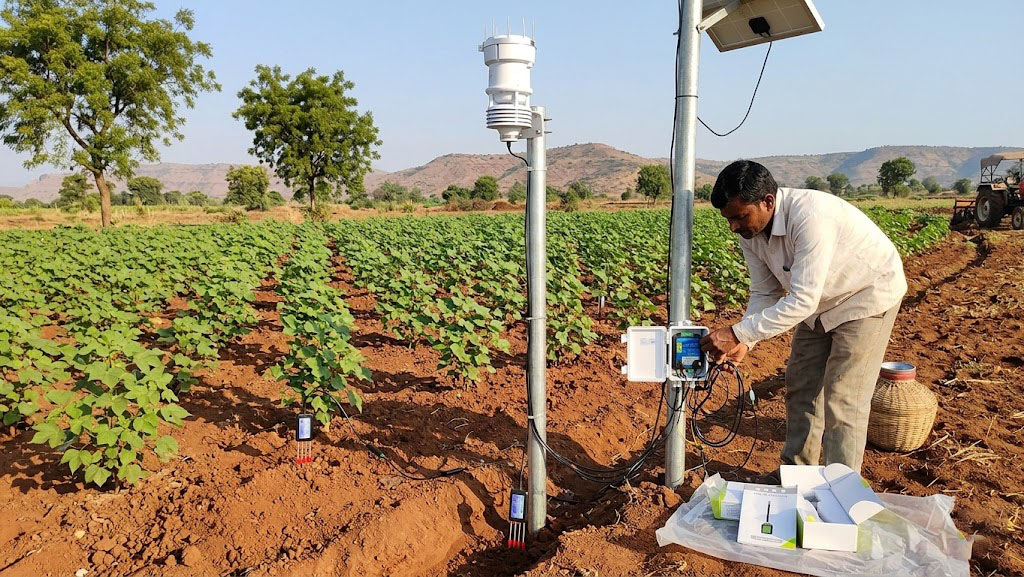
Technical Breakdown: The 11-Parameter Compact Weather Station
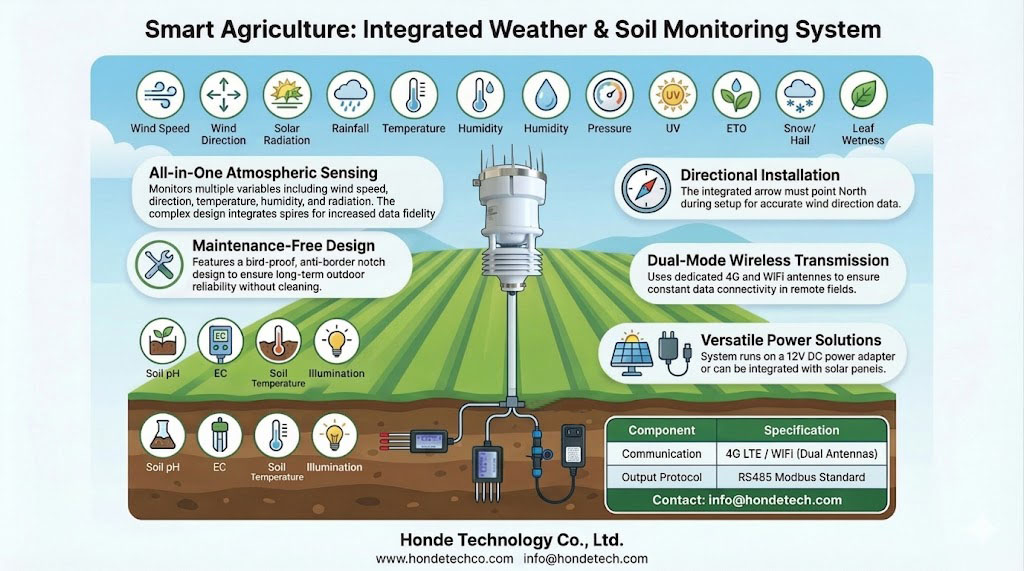
The core of the system is the compact weather station, which streamlines complex climate monitoring into a single, high-durability unit. This station is capable of monitoring a full suite of 11 parameters to provide a 360-degree view of the farm’s microclimate:
- Air Temperature: For tracking heat units and thermal stress.
- Humidity: To predict fungal outbreaks and pest activity.
- Air Pressure: Essential for localized barometric forecasting.
- Dew Point: Critical for understanding condensation and frost risks.
- Wind Speed: Direct input for spray window management.
- Wind Direction: Must be calibrated via the unit’s north arrow to ensure accurate tracking of monsoon wind shifts.
- Illumination: Measuring light intensity for photosynthesis modeling.
- Radiation: Tracking solar energy and potential heat scorch.
- ET0 (Evapotranspiration): Calculated data to determine precise crop water requirements.
- Sunshine Hours: For recording the total duration of active growth light.
- Customizable Parameter (Rainfall/Noise): The system architecture allows for an 11th specialized sensor to meet specific project needs.
Installation Excellence: Precision starts with placement. The unit features a tip-up bracket ring for secure mounting. It is vital that the “north arrow” on the sensor housing is aligned with geographic North; this ensures that wind direction data—critical for managing airborne pathogens during the monsoon—is accurate.
Advanced Connectivity: Dual 4G and 2.4GHz WiFi Systems
Reliable data transmission is the backbone of any IoT strategy. The Honde system utilizes a dual-antenna configuration supporting both 4G and 2.4GHz WiFi—the latter being the global standard for long-range, stable agricultural connectivity.
4G SIM Card Installation and Localized APN Configuration
The communication module is housed in a rainproof case and features a user-friendly physical interface:
- SIM Access: Press the dedicated yellow button on the module. This mechanism causes the SIM card slot to punch out for easy insertion.
- APN Localization: For the hardware to communicate with Indian carriers like Jio or Airtel, the Access Point Name (APN) must be configured. This is done via the provided RS485-to-USB converter and specialized software, allowing you to “localize” the device to your specific network provider.
Power Autonomy: To accommodate off-grid Indian farms, the system is designed for power flexibility. It can operate via a standard power adapter or be integrated with a 12V DC solar panel system, making it a truly “set-and-forget” solution for remote acreage.
Deep Soil Intelligence: The Soil Sensor
Subterranean data is the final piece of the precision farming puzzle. The Soil sensor is a versatile tool designed for both permanent monitoring and rapid field assessment. It captures six essential data points: pH Levels, Electrical Conductivity (EC), Soil Moisture/Humidity, NPK, Salinity .
Dual-Purpose Connectivity:
- Type-C Port: Ideal for “instant field testing.” Agronomists can connect the sensor directly to a laptop or portable battery for a plug-and-play soil profile during field walks.
- RS485 Modbus: Used for “permanent monitoring.” The sensor connects via a waterproof connector to the central 4G/WiFi station, feeding real-time data into your central dashboard for long-term trend analysis.
Comparison Table: Weather Station vs. Soil Sensor Capabilities
| Feature | Compact Weather Station | Soil Sensor |
| Primary Parameters | Temp, Wind, Pressure, Radiation, ET0 | pH, EC, Soil Moisture, Temp, Salinity, NPK |
| Output Type | RS485 / Modbus RTU | RS485 / Modbus RTU |
| Connectivity | Integrated 4G / 2.4GHz WiFi Module | Type-C (PC/Portable) or RS485 |
| Unique Features | Anti-bird design, ET0 calculation | integrated soil profile |
| Power Supply | 12V DC (Solar Compatible) | Battery (Portable) or 12V DC (System) |
About Honde Technology Co., Ltd.
With extensive experience in agricultural sensor manufacturing, Honde Technology Co., Ltd. provides robust, field-tested solutions designed for precision irrigation and climate monitoring. Our products are engineered to withstand the rigors of commercial farming while delivering the high-accuracy data required for modern agritech applications and large-scale Indian agribusiness projects.
- Website: www.hondetechco.com
- Email: info@hondetech.com
Conclusion: Data-Driven Yield Optimization
Integrating professional-grade weather and soil sensors allows Indian producers to eliminate guesswork, significantly reducing water waste through precise ET0 calculations and maintaining soil health via EC and pH monitoring. By deploying a system that bridges the gap between the field and the cloud via 4G and WiFi, you ensure your farm’s data infrastructure is as resilient as the crops you grow.
Ready to upgrade your farm’s data infrastructure with field-proven IoT hardware? Contact our technical team today to get a custom quote or download the detailed specification sheets for your project.
Post time: Apr-02-2026