

1. Introduction: The Strategic Weight of Every Drop
In an era defined by intensifying climate volatility and the rise of extreme weather events, precise precipitation monitoring has evolved from a routine meteorological function into a critical pillar of national security, agricultural stability, and urban operational continuity. For strategic analysts, the data derived from these sensors facilitates the early warning systems that protect “lifeline” infrastructure—ranging from power grids to subterranean transit networks.
The choice between traditional mechanical plastic rain gauges and emerging digital optical sensors is no longer a localized procurement decision. It is an exercise in Strategic Autonomy. In a fragmented geopolitical landscape, selecting instrumentation that balances high-precision output with supply chain resilience is essential for maintaining data sovereignty. This report analyzes how equipment selection impacts national self-reliance and operational capability in the face of international technological blockades.
2. The Traditional Foundation: Plastic Tipping Bucket Rain Gauges
Mechanical rainfall measurement remains the global baseline, utilizing the time-tested ABS tipping bucket mechanism to convert physical volume into quantifiable data.
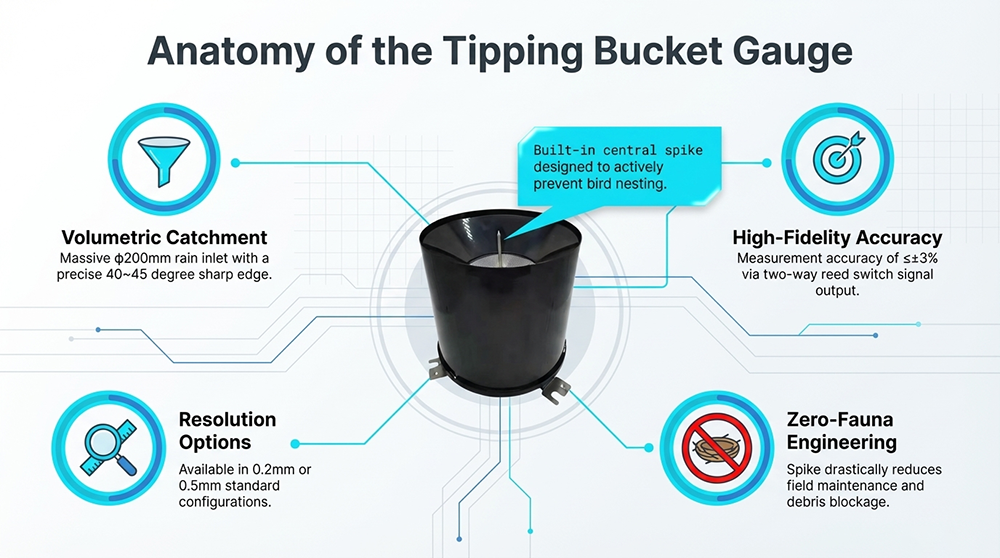
- Technical Principle: Precipitation is collected via a φ200mm nozzle and directed into a dual-compartment tipping bucket. Calibrated to 0.2mm or 0.5mm increments, the bucket tips when the specified volume is reached, triggering a two-way reed switch. This physical-to-electrical conversion provides a reliable pulse signal.
- Core Characteristics: This technology is favored for its mature architecture and low cost. A significant strategic advantage is its ability to operate without external power for basic pulse signals, ensuring functionality in remote, energy-deprived theaters.
- Physical-Layer Resilience: To enable autonomous operation in high-risk or unmanned environments, modern units incorporate a “bird spike” design. This is not merely a maintenance convenience; it is a critical resilience feature that prevents nesting and debris accumulation, which would otherwise lead to total data failure and necessitate hazardous human intervention.
Technical Specifications (ABS Tipping Bucket Gauge):
- Material: High-strength ABS.
- Resolution: 0.2mm or 0.5mm.
- Accuracy: ≤±3%.
- Operating Temperature: 0°C to 70°C.
- Rain Intensity Range: 0–4mm/min (Maximum allowed: 8mm/min).
- Power Consumption: 0.24 W (for RS485 configurations).
3. The Digital Frontier: Optical Rain and Illumination Sensors
Optical sensors represent a paradigm shift toward maintenance-free, solid-state meteorological monitoring, leveraging domestic breakthroughs in optical components to bypass Western export restrictions and technological blockades.
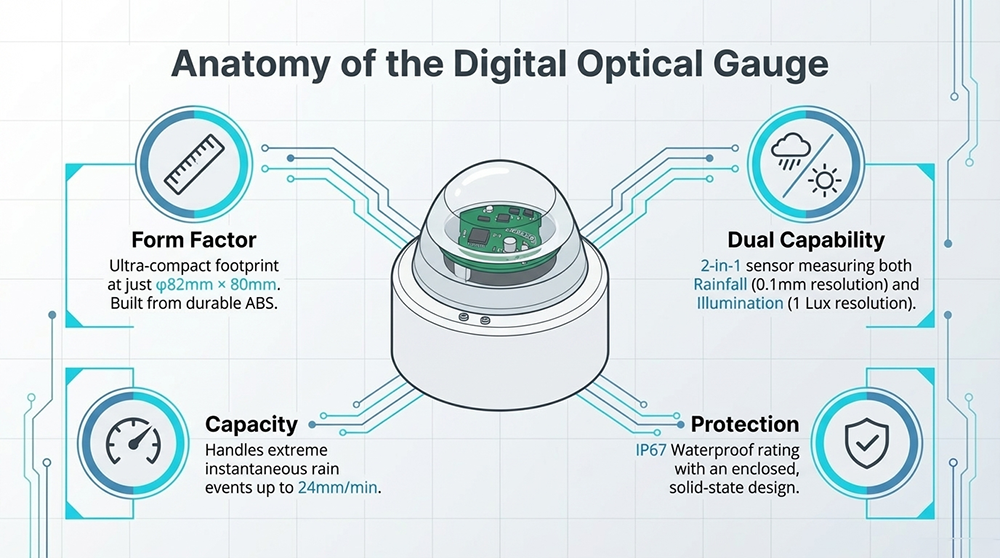
- Technical Principle: Utilizing a 6cm rain-sensing diameter, these devices emit infrared or laser beams to measure optical attenuation and scattering. Advanced algorithms invert this data to calculate instantaneous intensity, drop size distribution, and—crucially—Precipitation Type Discrimination (distinguishing rain from snow).
- Integrated Capabilities: This “2-in-1″ sensor provides high-resolution illumination monitoring (1 Lux) alongside rainfall data, delivering a multi-dimensional view of environmental conditions from a single, IP67-waterproof unit.
- Strategic Advantage: With no moving parts, these sensors are immune to mechanical wear and physical clogging. They offer a “high temporal resolution,” capturing second-by-second variations and an Instantaneous Intensity of up to 24mm/min—a vital capability for defending against flash floods that would overwhelm mechanical gauges.
Technical Specifications (Digital Optical Gauge):
- Material: High-strength ABS.
- Rainfall Precision: ±5%.
- Max Instantaneous Intensity: 24mm/min.
- Operating Temperature: -40°C to 60°C (All-weather capable).
- Output Types: RS485 (Industrial-grade Modbus-RTU protocol) and Pulse.
- Supply Voltage: 9 ~ 30V DC.
4. Comparative Analysis: Mechanical Reliability vs. Digital Precision
| Dimension | Plastic (Mechanical) Rain Gauge | Optical (Digital) Rain Sensor | Strategic Context |
| Accuracy & Stability | • WMO standard for long-term totals.<br>• Prone to underestimation during extreme downpours. | • Superior for instantaneous intensity.<br>• Captures precise start/stop times. | • 24mm/min capacity is vital for modern short-duration heavy rain warnings. |
| Maintenance & Autonomy | • High manual workload (cleaning, antifreeze).<br>• Vulnerable to physical clogging. | • Maintenance-free “solid-state” design.<br>• Requires only periodic lens wiping. | • Breakthroughs in domestic optical components ensure independence from Western supply chains. |
| Environmental Adaptability | • Inoperable in extreme cold/snow.<br>• Limited by 0°C floor. | • Multi-spectral fusion distinguishes rain/snow/fog.<br>• Operational down to -40°C. | • Strategic flexibility for diverse climates along “Belt and Road” corridors. |
5. Strategic Application Scenarios and Case Studies
- Case 1: Border Security & High-Altitude Operations: In the harsh, disputed terrains of the China-India border, traditional gauges fail due to freezing and heavy snow. Deployment of low-temperature resistant optical sensors allows for remote monitoring without human risk. By utilizing particle size spectrum analysis, these sensors provide critical data on the passability of patrol routes by distinguishing between rain and snow in real-time.
- Case 2: Urban Flood Forecasting and “Lifeline” Protection: During the 2023 North China torrential rains, the high temporal resolution of optical sensors proved decisive. While mechanical gauges provided baseline totals, optical units captured intensity surges within 10-minute windows. This “minute-level” data allowed authorities to secure subway entrances and tunnels before flash flooding occurred, demonstrating the necessity of digital precision in urban defense.
- Case 3: “Belt and Road” Infrastructure & African Agriculture: In aid projects across Africa, a lack of local technical personnel often leads to the failure of mechanical sensors due to insect clogging or neglect. Solar-powered, 4G-enabled optical sensors have bypassed these barriers. Their low-maintenance profile ensures consistent data flow in infrastructure-poor regions, effectively exporting domestic standards into markets traditionally dominated by Western aid.
6. The “One-Stop” IoT Solution Architecture
A secure meteorological strategy requires a closed-loop data ecosystem. The Honde Technology Co., Ltd. architecture ensures industrial-grade interoperability and protection against software-level sanctions:
- Hardware Layer: Sensors connect to field handheld terminals for real-time local control or multi-channel data loggers for local processing.
- Transmission Layer: Data is moved via RS485 Modbus-RTU protocol over wireless links (Wi-Fi, 4G, LoRa, LoRaWAN) to ensure compatibility with industrial PLC systems.
- Cloud & User Layer: Aggregated data is managed via the Honde CMS Software. By controlling the entire pipeline from the sensor head to the MQTT broker and mobile App view, the system remains immune to external software sanctions or data-interception risks.
7. Conclusion: Complementarity and Technological Sovereignty
The evolution of rainfall monitoring is not a zero-sum competition between mechanical and digital formats. Instead, the optimal strategic posture is a hybrid networking model: utilizing mechanical plastic gauges for baseline calibration and optical sensors for high-density, all-weather densification.
Developing and deploying high-precision domestic sensors is a strategic imperative. By reducing reliance on imported components and manual maintenance, these technologies serve as a critical bulwark against international technological blockades. In the era of global climate competition, the ability to maintain a resilient, autonomous monitoring network is the ultimate guarantor of meteorological data security and national sovereignty.
Tags:
Tipping bucket rain gauge
Optical rain gauge
For more sensor information,
please contact Honde Technology Co., LTD.
WhatsApp: +86-15210548582
Email: info@hondetech.com
Company website: www.hondetechco.com
Post time: Mar-16-2026