

1. Introduction: Overcoming the Failure Points of Traditional Monitoring
Monitoring discharge is a high-stakes operational environment where sensor failure leads directly to regulatory non-compliance and substantial financial penalties. In wastewater treatment plant (WWTP) infrastructure, the primary challenge is the rapid degradation of instrumentation caused by the aggressive nature of the medium. Achieving “refined management” requires a shift from high-maintenance submersible hardware to an integrated digital architecture. By fusing non-contact radar technology with robust in-situ water quality sensing, operators can eliminate the blind spots inherent in legacy monitoring systems.
2. Non-Contact Flow Monitoring: The Radar 3-in-1 Advantage
Traditional flow measurement frequently fails in wastewater applications due to transducer fouling, grease accumulation, and physical damage from debris. The Radar Flowmeter eliminates these failure points by remaining physically isolated from the flow. This 3-in-1 system integrates velocity sensing, liquid level tracking, and flow calculation into a single digital unit, providing high-precision data without the maintenance burden of submersible sensors.
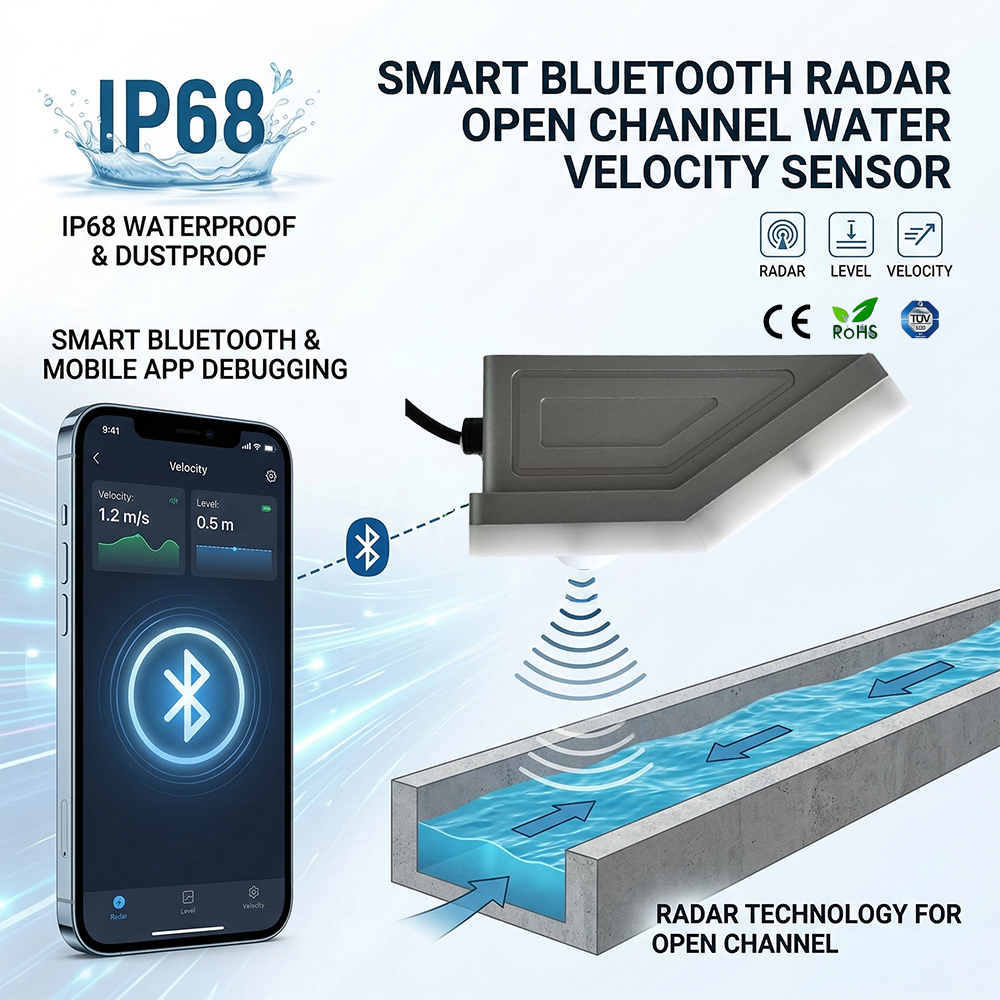
Core Capabilities of the 3-in-1 Radar System
- Integrated Velocity Measurement: Utilizes high-frequency radar to monitor surface flow speeds with millimeter precision.
- Liquid Level Sensing: Continuous tracking of water height to determine the hydraulic cross-section.
- Automatic Flow Calculation: On-board algorithms synthesize velocity and level data to output instantaneous and cumulative flow volume in real-time.
Maintenance Analysis The non-contact principle is the definitive solution for high-concentration sewage and corrosive industrial discharge. By avoiding physical immersion, the sensors are protected from surfactants, corrosive chemical agents, and floating solids that typically entangle and destroy contact-based transducers. This streamlined, non-obstructing design significantly reduces the Total Cost of Ownership (TCO) by eliminating the need for frequent manual cleaning and sensor recalibration.
Deployment Strategy: The Mathematical Necessity of Multi-Array Systems For discharge outlets exceeding standard widths or channels characterized by complex flow states, single-point measurement is mathematically insufficient. A “Multi-Array Deployment” is required to achieve comprehensive coverage of the flow velocity cross-section. By deploying multiple radar units across the channel, the system accounts for non-uniform velocity profiles, ensuring that total volume calculations reflect the actual hydraulic reality of the site rather than an estimated average.
3. Comprehensive Water Quality Sensing: In-Situ Accuracy in Aggressive Media
Beyond volume monitoring, real-time chemical analysis is critical for assessing treatment efficacy. Our sensor array is designed for direct in-situ monitoring, utilizing digital signal processing to maintain data integrity over long distances.
| Sensor Type | Key Parameters | Unique Technical Feature |
| pH Sensor | Acidity and Alkalinity | Monitors acid-base fluctuations essential for neutralization control and process stability. |
| 4-in-1 Water Quality Sensor | EC, Temperature, TDS, Salinity | Constructed with high-strength PTFE (Polytetrafluoroethylene) housing to resist aggressive surfactants and acidic agents. |
| Turbidity Sensor | Water Clarity / Suspended Solids | Features an integrated self-cleaning brush to prevent biofouling and maintain optical path clarity in high-solids environments. |
| 5-in-1 Organic Monitor | COD, BOD, TOC, Temp, Turbidity | Highly integrated reagent-free sensing for comprehensive, real-time assessment of organic pollutant loads. |
| ORP Sensor | Oxidation-Reduction Potential | Tracks redox potential to optimize chemical process efficiency and aeration control. |
Operational Benefits
- RS485/Modbus Architecture: Digital signal output prevents the attenuation and interference issues common with analog 4-20mA signals over long cable runs.
- Bus-Type Wiring: Supports simplified installation with a reduced physical footprint compared to individual analog cable runs.
- Zero Secondary Pollution: In-situ monitoring eliminates the need for chemical reagents or waste-generating sampling systems.
- Plug-and-Play Maintenance: Standardized digital interfaces allow for rapid sensor swapping and field calibration without complex rewiring.
4. The “Sense, Transmit, Know, Use” Ecosystem: Cloud Integration
The integration of rugged hardware with the Smart Water Cloud Platform transforms raw data into actionable operational intelligence. Data is transmitted via 5G or NB-IoT, creating a secure, closed-loop management system.
Functionality Breakdown
- Real-time Map Visualization: Provides a centralized diagnostic overview of the entire pipe network and discharge outlet status on a unified geospatial interface.
- Intelligent Alerting and Process Response: Automated notifications allow for immediate “load-shunting” or process adjustments. For instance, real-time COD spikes trigger alerts that prevent toxic industrial discharge from “shocking” the biological treatment stages of the plant.
Competitive Edge The system minimizes deployment costs through automatic self-networking upon startup. For organizations with strict data sovereignty requirements, private deployment options are available to ensure full compliance with municipal security standards while maintaining high-speed data access.
5. Practical Application Scenarios
This technology is optimized for environments where data precision and hardware durability are non-negotiable. Stakeholders can identify deployment needs via the following checklist:
- WWTP Inlets and Outlets: Critical for verifying treatment efficiency and final discharge compliance.
- Industrial Park Main Discharge Outlets: Essential for monitoring collective organic loads from diverse industrial sources.
- Environmentally Monitored Enterprise Channels: Designed for high-frequency reporting to environmental regulatory bodies.
6. Conclusion: Shaping the Future of Ecological Guardianship
The transition to refined wastewater management is a technical necessity. By leveraging the synergy of non-contact radar and in-situ digital sensors, Honde Technology provides the precision required to manage wastewater assets effectively. This integrated approach ensures that every discharge event is monitored, recorded, and managed with scientific rigor.
Call to Action
To discuss technical specifications or request a site-specific deployment plan, contact our engineering team:
Website: www.hondetechco.com
Email: info@hondetech.com
Post time: Apr-08-2026