

In modern facility agriculture and the seedling industry, the early development quality of seedlings directly determines their potential for subsequent growth and the final yield. Traditional seedling management relies on manual experience observation and lacks quantitative control over the “micro-environment” of the substrate inside the seedling box. In response to this pain point in refined management, HONDE Company innovatively combined a micro short probe soil sensor with an intelligent handheld data logger, providing an unprecedented data-driven and precise solution for the management of greenhouse seedling boxes (trays).
I. Technical Solution: Equipping Micro-spaces with “Data Eyes” and “Mobile Brains”
HONDE Micro Short Probe soil Sensor: Non-destructive implantation, precise perception
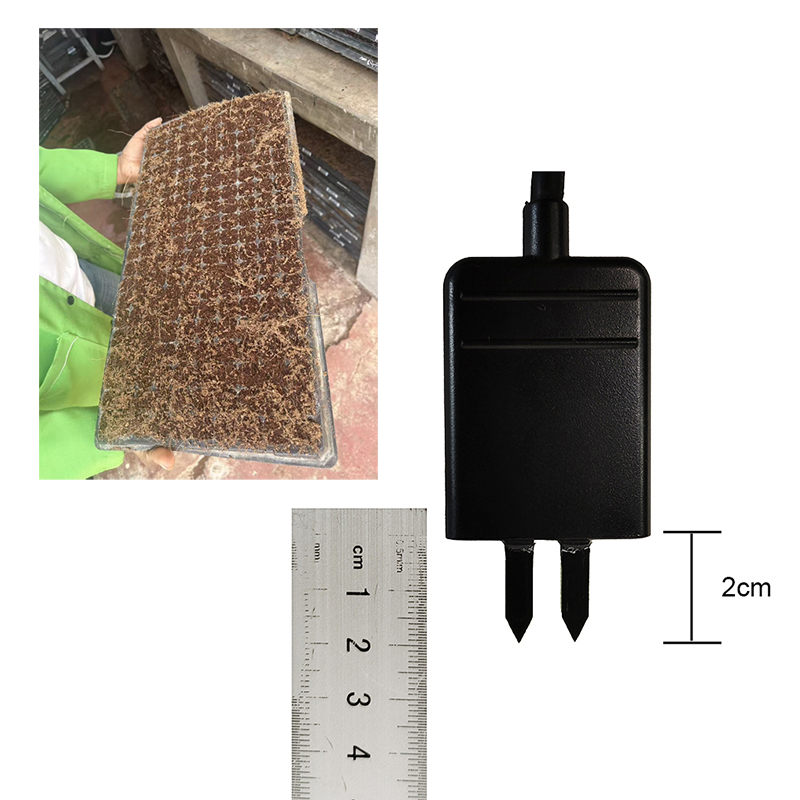
Exquisite design: The probe is 2 centimeters in length and only a few millimeters in diameter, allowing it to be easily and non-destructively inserted into the substrate of standard seedling cells, perfectly adapting to their limited space and enabling direct monitoring of the core growth area of the root system.
Synchronous monitoring of core parameters
Substrate volume moisture content: Real-time monitoring of the dryness and wetness of each cell tray to prevent uneven germination, poor root development or damping-off caused by local excessive dryness or wetness.
Substrate temperature: Accurately grasp the ground temperature for seed germination and seedling growth, providing direct basis for the start and stop of the heating pad and the environmental control of the greenhouse, ensuring the optimal biological temperature.
Substrate conductivity (EC) : Dynamically monitor the concentration of nutrient solution to prevent “burning of seedlings” caused by excessively high EC values or nutrient deficiency due to excessively low EC values.
HONDE Smart Handheld Data Logger: Mobile inspection, instant decision-making
Portable and efficient: The device is lightweight and sturdy, allowing staff to hold it and conduct quick inspections between seedling beds. Insert the sensor probe into the representative tray, and with one click, the data of that point can be read and recorded.
Spatial variation mapping: In combination with simple marking or positioning functions, it can systematically map the spatial distribution of moisture, temperature, and EC in the entire seedling area, quickly identifying environmental “cold and hot spots” or “dry and wet spots” caused by uneven irrigation, heating differences, or the position of air outlets.
Intelligent analysis and reminder: Built-in cultivation expert model can immediately determine whether the current data deviates from the optimal range of target crop seedlings (such as tomatoes, peppers, flowers, etc.), and provide intuitive suggestions such as “replenish water”, “suspend irrigation” or “check the supply of liquid”.
Ii. Core Application Value in Greenhouse Seedling Boxes
Achieve precise water and heat management during the germination and emergence stages
Water control: Based on the moisture content data of the substrate, implement precise spraying or bottom water supply of “when the soil is dry and when it is wet” to promote uniform seed germination and root penetration, significantly improving the emergence rate and uniformity.
Temperature control: The heating system is automatically regulated based on real-time substrate temperature (rather than air temperature) to create a stable ground temperature environment for warm-loving crops and shorten the emergence time.
Optimize the water and fertilizer supply during the growth period of seedlings
Irrigation on demand: Avoid the uneven dryness and wetness between holes caused by traditional timed irrigation. Driven by data, the dry areas are only replenished when necessary to enhance water efficiency and maintain the permeability of the substrate.
Nutrition monitoring: Continuously monitor the EC value to ensure that the concentration of the nutrient solution remains stable within the optimal range. After irrigation or on rainy days, the dilution or accumulation trend of EC values can be detected in a timely manner. The nutrient solution formula and supply frequency can be dynamically adjusted to cultivate strong seedlings.
Prevent diseases and improve seedling quality
Reducing disease risk: Persistent high humidity is the main cause of damping-off and damping-off. Through monitoring and early warning, the substrate moisture can be proactively controlled within the safe threshold, reducing the use of fungicides.
Quantitative seedling condition indicators: Correlate and analyze the phenotypic data such as stem thickness and leaf color of seedlings with the corresponding historical data of the substrate environment, establish a “optimal environment – optimal seedling quality” database, and achieve the standardization and replicability of seedling cultivation techniques.
Significantly enhance management efficiency and traceability
Replace subjective experience: New employees can make correct decisions quickly with the help of data tools, reducing their excessive reliance on personal experience.
Electronic records: All inspection data are automatically generated into electronic logs, enabling full-process environmental traceability from sowing to seedling delivery, providing a solid basis for quality assurance and problem review.
Iii. Actual Benefits and Cases
Case Sharing
A large-scale vegetable seedling factory has introduced the HONDE system for one million tomato tray seedlings. By deploying short probe sensors in key areas and combining them with daily handheld inspections, they discovered:
The drying speed of the tray substrate in the area close to the fan is 40% faster than that in the internal area.
During the night heating period, the temperature at the edge of the seedbed is 2 to 3 degrees Celsius lower than that at the center.
Based on the data, they adjusted the dwell time of the spray walking mechanism and strengthened the insulation of the edge seedbeds. After one production cycle, the results were remarkable:
The uniformity of seedling emergence has been improved by 35%, and the labor for replanting has been reduced.
The incidence of cataplexy has decreased by 60%, reducing the cost and loss of drugs.
Overall, water and fertilizer conservation is approximately 25%.
The compliance rate of seedling standards has increased from 88% to 96%, and customer satisfaction has significantly improved.
Conclusion
Seedling raising is the beginning of agricultural production and also the cornerstone that determines success or failure. HONDE’s short probe soil sensor, when combined with a handheld data logger, transforms the originally “invisible and intangible” micro-environment of the seedling tray into a clear and quantifiable data stream, enabling seedling management to move from vague empirical judgment to precise data-driven. This solution not only enhances the quality of seedlings and production efficiency, but also brings direct economic returns and core competitiveness to modern seedling enterprises through resource conservation and risk control. It symbolizes that intensive and factory-based seedling cultivation has entered a new era of wisdom where “quality is defined by data”.
About HONDE: As an innovator in agricultural Internet of Things and precision sensing technology, HONDE is committed to providing reliable digital tools for every refined stage of agricultural production, from the germination of a seed to the harvest of crops, empowering the entire process of agricultural intelligence and sustainable development.
For more soil sensor information, please contact Honde Technology Co., LTD.
WhatsApp: +86-15210548582
Email: info@hondetech.com
Company website: www.hondetechco.com
Post time: Dec-03-2025