

No boats, no wading, no complex setups—just raise, aim, pull the trigger, and the pulse of rivers appears digitally on screen.
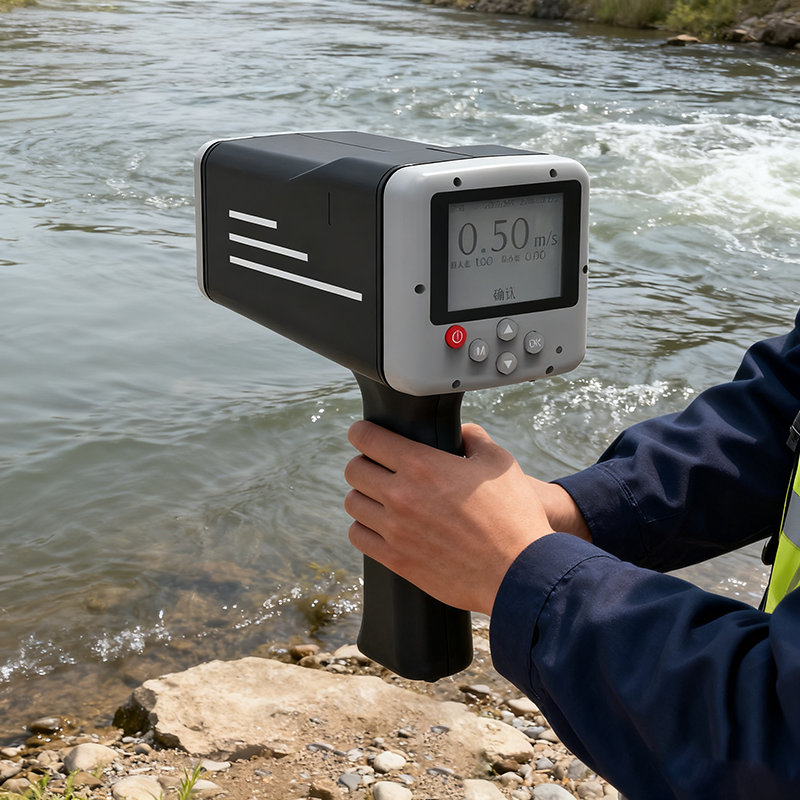
When flash floods roar down, when irrigation canal levels fluctuate abnormally, when environmental agencies need to quickly trace pollution—traditional flow measurement methods often seem cumbersome and slow: requiring the deployment of mechanical current meters, setting up ADCPs, and complex safety protocols with team coordination.
But today, a “digital weapon” has been added to the hydrologist’s toolkit: the handheld radar velocity sensor. It resembles a slightly bulky pistol yet can “hear” the water’s speed from the safety of the riverbank in seconds, without any contact.
Technical Principle: The Miniaturization Miracle of Doppler Radar
At the core of this technology is a miniature Doppler radar hidden inside the “barrel”:
- Transmit & Receive: The sensor emits microwaves (typically K-band or X-band) at an angle toward the water surface.
- Frequency Analysis: Ripples and microscopic particles on the moving water surface reflect the signal back, creating a Doppler frequency shift.
- Intelligent Calculation: A built-in processor analyzes the frequency shift in real-time, precisely calculating surface velocity while using algorithms to filter out interference from wind, rain, etc.
The entire process completes within 0.1 seconds, with a measurement range of up to 100 meters and an accuracy of ±0.01 m/s.
Why It’s Changing the Industry Game
1. Unmatched Safety and Convenience
- During flash floods, surveyors no longer need to risk wading or boating.
- Measurements become feasible and safe along steep canyons, icy river surfaces, or polluted channels.
- Operable by a single person, typically weighing less than 1 kg, with over 10 hours of continuous battery life.
2. Unparalleled Speed of Response
- Traditional cross-section measurements take hours; a radar velocimeter can complete velocity readings at multiple verticals in under 10 minutes.
- Especially suited for emergency monitoring and rapid inspections, such as tracking sudden pollution events or flood prevention patrols.
3. Broad Adaptability
- From trickling streams (0.1 m/s) to raging floods (20 m/s).
- Applicable to channels, rivers, drainage outlets, and even coastal waters with significant waves.
- Unaffected by water quality—murky, polluted, or sediment-laden flows can all be measured.
Field Witness: Three Decision-Changing Moments
Scenario 1: Yellow River Flood Frontline
During the 2023 Yellow River autumn flood, hydrology teams used handheld radar guns to identify the main current and maximum velocity points in heavily silted sections within 5 minutes, providing critical data for flood diversion decisions—nearly 2 hours faster than traditional methods.
Scenario 2: California Agricultural Water Audit
A water resource management company used the device to inspect 200 farm canals in one week—a task that previously took a month—pinpointing leakage sections and assessing annual water savings at over $3 million.
Scenario 3: Norwegian Hydropower Optimization
Plant engineers regularly use radar guns to monitor tailrace velocity distribution, combining the data with AI models to dynamically adjust turbine units, increasing hydropower utilization by 1.8%, equivalent to an additional 1.4 million kWh of clean energy annually.
The Future is Here: When the “Data Gun” Meets Smart Ecosystems
The next generation of handheld radar velocimeters is evolving in three directions:
- Smart Connectivity: Real-time data syncing to mobile apps via Bluetooth, auto-generating reports, and uploading to cloud databases.
- AI Enhancement: Built-in algorithms identify flow patterns (uniform, turbulent) and provide data quality ratings.
- Function Integration: High-end models now incorporate laser rangefinders, enabling simultaneous cross-section area calculation and one-click flow estimation.
Limitations & Challenges: Not a Universal Key
Of course, the technology has its boundaries:
- Measures only surface velocity; requires coefficient conversion or complementary tools to derive average cross-sectional velocity.
- Signal quality may degrade on extremely calm water surfaces (no ripples) or in areas dense with aquatic vegetation.
- Operators need basic hydraulic knowledge to select measurement points and interpret data correctly.
Conclusion: From Complex to Simple, From Hazardous to Safe
The handheld radar velocity sensor, a seemingly simple tool, embodies decades of progress in microwave technology, signal processing, and fluid mechanics. It transforms not just the measurement method but the very philosophy of fieldwork: turning field hydrology from an experience-dependent, high-risk labor into a precise, efficient, and safe data collection science.
Next time you see a surveyor with a “strange device” by the river, know this: the moment they pull the trigger, water that has flowed for millennia is, for the first time, sharing its secrets with humanity in such a graceful way.
Complete set of servers and software wireless module, supports RS485 GPRS /4g/WIFI/LORA/LORAWAN
For more radar level sensor information,
please contact Honde Technology Co., LTD.
Email: info@hondetech.com
Company website: www.hondetechco.com
Tel: +86-15210548582
Post time: Dec-03-2025