

1. Executive Summary
For modern South Korea Road Safety initiatives, the Remote Road Surface State Sensor represents the next generation of winter maintenance technology. The HD-RSC-01 is a non-intrusive, spectroscopic solution that provides real-time monitoring of road conditions without the costly downtime associated with traditional road closures or “slot-cut” sensor installation. By utilizing infrared technology, the sensor identifies water, ice, and snow layers as thin as 30 μm, providing critical Black Ice Detection to prevent multi-vehicle accidents. This high-precision tool generates a Slipperiness Index (Grip) to help transportation authorities make data-driven decisions during hazardous winter weather.
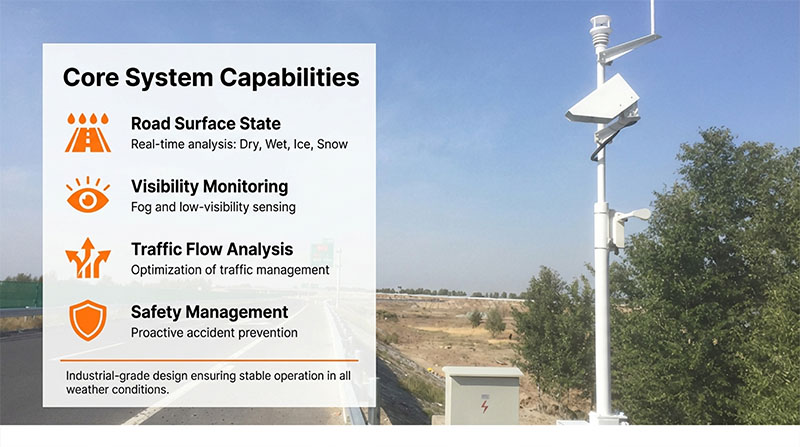
2. The Challenge: Managing Icy Road Conditions in South Korea
South Korea’s unique geography—characterized by steep mountainous regions and high-humidity winters—presents significant challenges for traffic safety. Traditional “slot-cut” sensors, which are embedded directly into the pavement, are increasingly viewed as obsolete due to high maintenance costs and the structural damage caused during installation.
In our decade of global deployment, we have observed that the primary risk isn’t just the presence of ice, but the specific type of ice. For example, road surfaces with soft ice (high water or salt content) provide significantly more traction than surfaces with hard ice. The HD-RSC-01 addresses this by independently detecting water and ice, allowing for a nuanced understanding of road hazards that traditional sensors often miss, particularly in the humid, salt-prone coastal highways of the Korean peninsula.
3. Core Technology: Spectroscopic Measurement & The “Grip” Index
The HD-RSC-01 operates on the principle of spectroscopic short-range remote measurement. The sensor’s infrared transmitter emits specific wavelengths aimed at the road; a detector then integrates the back reflection to distinguish between various substances based on their unique spectral signatures. This method allows the sensor to sense water, snow, and frost (white ice) with extreme precision.
The Slipperiness Index (Grip)
Because the sensor can distinguish water from ice independently, it calculates a “Grip” index. This index is scaled to the friction between a typical car tire and the road surface:
- 0.8 (Dry): Optimal traction.
- Less than 0.1 (Hard Ice/Snow): Critical slipperiness and high accident risk.
Identified Road States:
- Dry: Clean, high-friction surface.
- Moist/Wet: Water film present.
- Snow: White ice accumulation.
- Ice: Transparent, hard ice (Black Ice Detection).
- Mixture (Frost): A combination of ice and water.
- Slushy: High-water content snow/ice mixture (Code 9).
4. Technical Specifications
| Parameter | Specification |
| Measuring Distance | 513 meters (Supports 215m installation range) |
| Measuring Area Diameter | 23 cm (at 10m distance) |
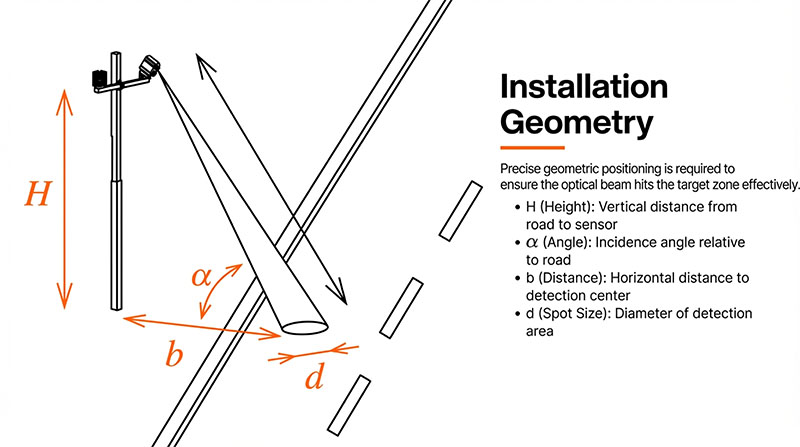
| Installation Angle | 30° – 90° (from horizontal) |
| Installation Height | 3 – 8 meters |
| Operating Temperature | -50℃ to +70℃ |
| Material Compatibility | Concrete and Asphalt |
| Detection Resolution | 0.01mm (Water, Ice, and Snow) |
| Measurement Range | 0.00mm ~ 10mm film thickness |
| Power Consumption | 4W (including lens heating) |
| Communication Protocols | RS485 / RS232 (MODBUS-RTU) |
| Protection Grade | IP65 (Industrial-grade) |
| Accuracy (Grip) | 0.01 resolution (Range: 0.00 ~ 0.82) |
5. South Korea Application Case: Optimizing Traffic Safety
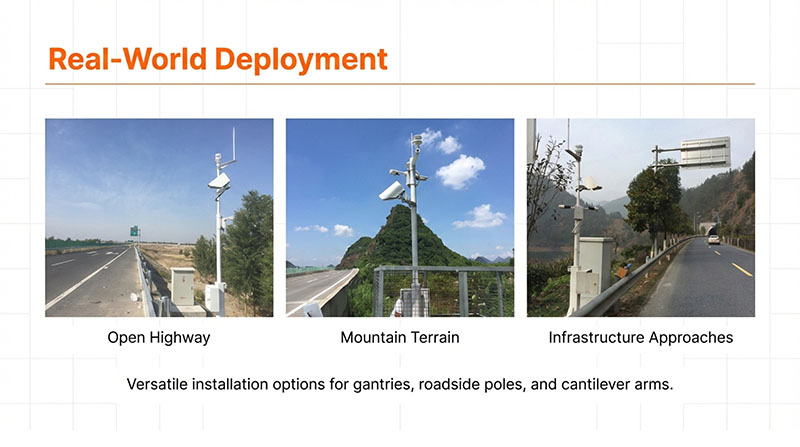
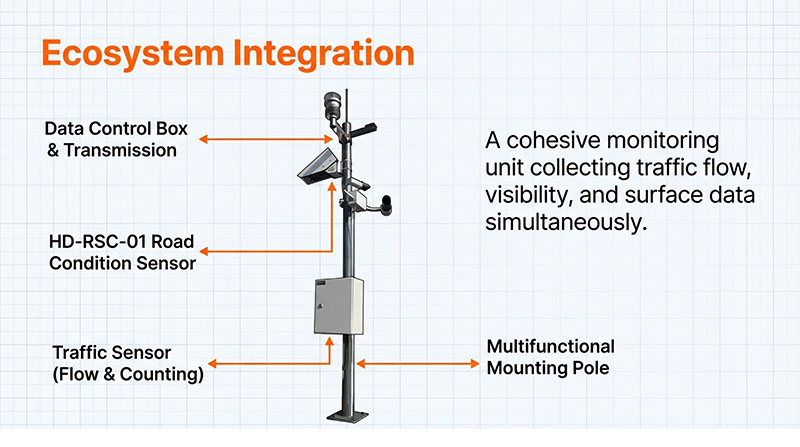
In South Korean ITS deployments, the HD-RSC-01 is typically mounted on multi-functional metal poles alongside visibility sensors and traffic flow monitors. These installations are strategically placed at high-risk zones such as bridge decks, tunnel exits, and steep mountain passes where micro-climates often create localized icing.
Why MODBUS-RTU Integration Matters for South Korean ITS Networks
Local Intelligent Transportation Systems (ITS) require seamless data exchange between remote hardware and central control hubs. The HD-RSC-01 utilizes the MODBUS-RTU protocol, acting as a slave unit on an RS485 network. This ensures that road state data—such as water film thickness and grip levels—is transmitted instantly to traffic management software, enabling automated alerts for salt spreaders or variable message signs (VMS).
6. Implementation Guidance: Expert Best Practices
To ensure the highest level of accuracy and Experience, Expertise, Authoritativeness, and Trustworthiness in your deployment, follow these industrial installation protocols:
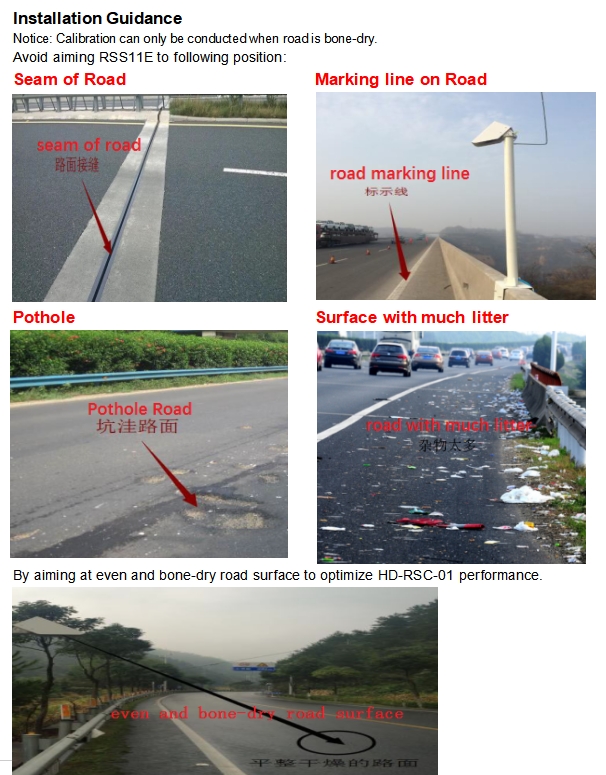
- Select the Surface Carefully: Avoid aiming the sensor at road seams, marking lines, potholes, or surfaces with excessive litter. For optimal performance, the measurement spot must be an even section of asphalt or concrete.
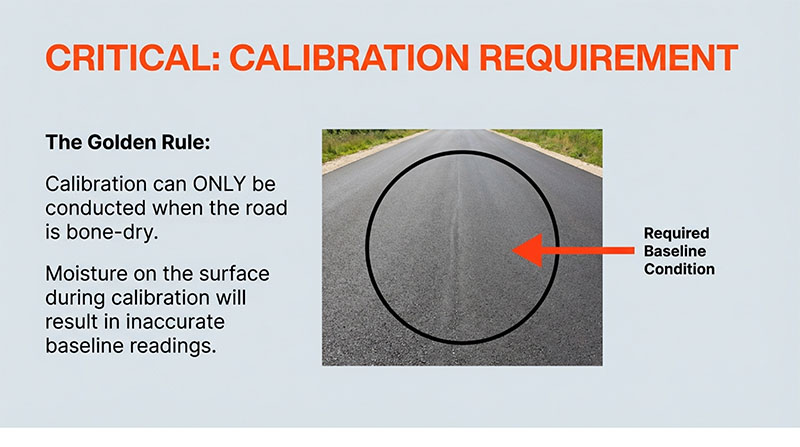
- Conduct Bone-Dry Calibration: Calibration is the most critical step for baseline accuracy. This must only be conducted when the road surface is completely bone-dry.
- Perform Focus Adjustments: Every time the installation height or aiming angle is changed, the focus adjust screw must be tuned to achieve the strongest possible optical signal.
- Verify Optical Strength: In the system software, ensure all three optical signals fall between 100 and 500 during the initial setup. This prevents misidentification of road states and ensures long-term reliability.
7. Maintenance and Long-term Reliability
The HD-RSC-01 is designed for stable operation in extreme outdoor environments with minimal intervention:
- Annual Checks: Conduct a visual inspection of the transmitter and receiver hoods before the winter season to ensure no physical damage to the industrial-grade housing.
- Lens Contamination Detection: The sensor features an internal monitoring system that detects lens dirtiness. It provides automatic internal compensation to maintain data accuracy even if the lens is partially obscured by road salt or dust.
- Industrial Durability: With an IP65 rating and an operating temperature range of -50℃ to +70℃, the hardware is built to withstand the humid, salt-heavy air characteristic of Korean coastal infrastructure.
8. Conclusion & B2B Call to Action
At HONDE TECHNOLOGY CO., LTD, we provide human-centric engineering solutions that translate complex spectroscopic data into actionable safety measures. By implementing high-precision remote sensing, South Korean municipalities can significantly reduce winter transit risks while extending the lifespan of their road infrastructure through targeted maintenance.
- Download the HD-RSC-01 Technical Spec Sheet for your South Korea Project.
- Request a custom quote for Integrated Visibility and Road State Monitoring Systems.
For more information on supporting hardware, visit our pillar pages for Weather Station accessories and RS485 communication modules.
Post time: Mar-03-2026