

In the core of modern facility agriculture – greenhouses, although crops are protected from the changing natural climate, the supply of water, the source of their life – has shifted from relying on rain to being completely determined by human decision-making. For a long time, irrigation has often relied on the growers’ empirical judgment or a fixed schedule. This pattern can easily lead to uneven water supply, causing root stress, nutrient loss and disease risks. The emergence of soil temperature and humidity sensors is bringing greenhouse irrigation from an “experience-driven” era into a “data-driven” era of precision, ensuring that every drop of water is truly “supplied as needed and just right”.
I. The Uniqueness of Greenhouse Environment: Why Soil Data Is So Crucial?
A greenhouse is a controlled yet still complex micro-ecosystem. Compared with open-field production, its characteristics are distinct:
Water is completely artificially regulated: There is no natural precipitation to replenish it, and irrigation is the only water source.
Intense evaporation and transpiration: In a closed or semi-closed insulated environment, especially when there is sufficient sunlight, the rate of crop transpiration and soil surface evaporation is significant.
The root system environment is dense and sensitive: Crops are planted densely, and the activity range of the root system is concentrated. Uneven water distribution or waterlogging can quickly affect overall health.
Highly coordinated water and fertilizer: Irrigation is often carried out simultaneously with fertilization, and water management is directly related to the availability and absorption efficiency of nutrients.
Therefore, real-time and precise monitoring of the moisture and temperature dynamics of the root layer soil has become the cornerstone for greenhouses to achieve intelligent and refined management.
Ii. The Core Role of Sensors: Acting as the “physiological translator” of crops
Soil temperature and humidity sensors installed in the root zone of crops have the core value of converting the physical state of the soil into a continuous and quantifiable data stream, mainly achieving two key monitoring:
Volumetric water content: It directly reflects the proportion of liquid water in the soil that can be directly absorbed by plants and is the golden indicator for judging irrigation needs.
Soil temperature: It profoundly affects root vitality, the rate of water and nutrient absorption, and the activities of soil microorganisms, and is an important basis for optimizing irrigation strategies (such as water temperature and timing).
Iii. Transformative Application Scenarios in Greenhouses
Drive precise irrigation and bid farewell to “timed” and “feeling”
Practice: Set upper and lower limit thresholds for soil moisture content based on different crops and their growth stages. When the sensor monitoring shows that the moisture level is below the lower limit, the system automatically or prompts to start irrigation. It will automatically stop when the upper limit is reached.
Value
Significant water conservation: Avoiding ineffective irrigation and deep seepage, it can save 20% to 40% of water compared to the traditional timed mode.
Enhance crop quality and consistency: Maintain a stable optimal soil moisture level to reduce problems such as fruit cracking and flavor decline caused by water fluctuations.
Promote healthy root development: Avoid root hypoxia caused by excessive moisture, encourage root growth downward, and enhance the plant’s stress resistance.
2. Optimize water and fertilizer integration to achieve “precise feeding”
Practice: The irrigation system automatically triggers and controls the execution of the fertilization program based on real-time soil moisture data. Ensure that the irrigation volume is precisely matched to optimize the concentration and retention time of the nutrient solution in the root zone.
Value: Significantly enhance fertilizer utilization rate, reduce the risk of salt accumulation in the root zone, and achieve a win-win situation of reducing fertilizer use while increasing efficiency and protecting the environment.
3. Warning of environmental stress and acting as a “sentinel” for diseases
Practice: A continuously high-humidity soil environment is an ideal condition for the breeding of many soil-borne diseases, such as damping-off and root rot. The sensor can continuously monitor and warn of long-term high humidity conditions.
Value: Timely remind managers to adjust irrigation plans or take agronomic measures, cut off the chain of disease occurrence from the environmental perspective, and reduce the cost and risk of prevention and control.
4. Empower crop models and scientific decision-making
Practice: Long-term accumulated soil water and heat data, combined with greenhouse meteorological station data, can be used to calibrate and optimize crop growth simulation models.
Value: More accurately predict the growth cycle, yield formation and quality changes of crops, providing forward-looking scientific guidance for production planning, labor arrangement and market supply.
Iv. Key Considerations for Effective Deployment
Representative layout points: They should be set up in different areas inside the greenhouse (such as near the air vents, the middle, and the water source end) as well as in different crop planting areas to truly reflect the spatial differences of the environment.
Monitoring depth matching: The installation depth of the sensor is determined based on the distribution depth of the main root systems of the crops (for example, tomatoes and cucumbers are usually between 15 and 30 centimeters).
Technology and medium compatibility: Select the sensor type that matches the greenhouse cultivation substrate (soil, coconut coir, rock wool, etc.), and ensure that it has good long-term stability, salt tolerance and measurement accuracy.
V. Successful Practice: A Data-Driven Case of High-yield and High-Quality Tomatoes
A large-scale tomato cultivation project in a glass greenhouse has comprehensively deployed a network of soil temperature and humidity sensors. Through systematic data analysis, the management team discovered that:
The original daytime irrigation model led to excessive water consumption when the substrate temperature rose in the afternoon, and the plants faced short-term stress when they needed water the most during the day to synthesize photosynthetic products.
2. By adjusting the irrigation strategy to precise replenishment based on sensor data in the early morning and evening, not only was the midday water stress eliminated, but also the peak air humidity inside the greenhouse during the midday period was effectively reduced.
After a complete production season of verification, this greenhouse not only achieved a 35% water saving but also increased the total tomato output by 18%, and the sugar content and commercial fruit rate of the fruits were also significantly improved. The technical director of the project concluded: “Now we no longer rely on guessing whether the crops need water or not, but directly ‘listen’ to the real feedback from the root system.” Sensors have enabled us to have precise communication with crops, which is the key to achieving a dual breakthrough in yield and quality.
Conclusion
On the path of modern greenhouse agriculture’s pursuit of high yield, high quality, efficient resource utilization and sustainable development, the precise control of the underground hidden world – the root zone environment – has become as important as the regulation of light, water, heat and air on the surface. Soil temperature and humidity sensors, like sensitive antennae penetrating the “core of life” of crops, clearly transform the thirst and satisfaction of the root system into data language. It put an end to the ambiguity and arbitrariness of irrigation and initiated a new model of precise supply centered on the real-time physiological needs of crops. This is far more than just an iteration of production tools; it is a profound transformation in planting philosophy: from “human-led supply” to “crop demand-driven response”. With the deep integration of Internet of Things and artificial intelligence technologies, these “data roots” deeply rooted in the soil will surely be fully linked with the greenhouse environmental control system, jointly painting a new picture of a smarter, more low-carbon and efficient facility agriculture in the future.
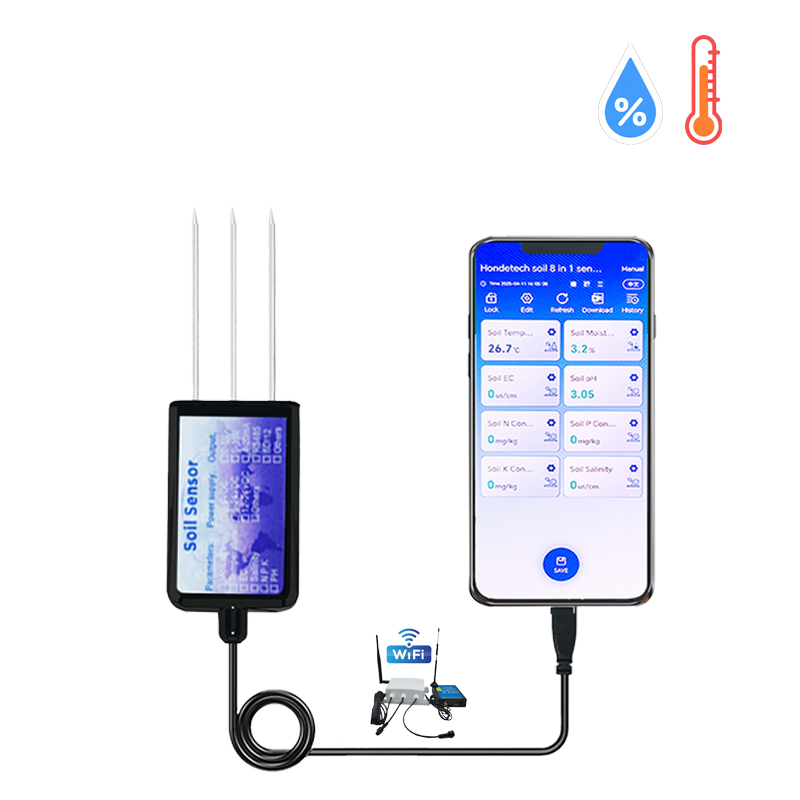
For more soil sensor information, please contact Honde Technology Co., LTD.
WhatsApp: +86-15210548582
Email: info@hondetech.com
Company website: www.hondetechco.com
Post time: Dec-23-2025