

1. Introduction: The Criticality of “Pure” Water Monitoring in Indonesia
As Indonesia undergoes unprecedented urban expansion, the integrity of municipal water and drinking water networks has emerged as the nation’s definitive “Urban Lifeline.” Managing these systems requires a fundamental shift in sensing philosophy. Unlike the monitoring of surface water or industrial effluent, municipal networks demand high-fidelity oversight within relatively “clean” but highly pressurized environments. In the context of Indonesian urban centers—where aging infrastructure and rapid development create unique hydraulic stresses—precision is not merely a technical preference but a prerequisite for public safety. This report outlines the advanced sensing technologies required to mitigate risks, ensure regulatory compliance, and safeguard the delivery of every drop to the Indonesian public.
2. The Rigorous Standards of Drinking Water Sensors
To maintain the safety of a municipal supply, sensors must meet stringent criteria that transcend standard environmental monitoring. In accordance with national drinking water standards (e.g., Permenkes), sensing hardware must prioritize the following:
- Absolute Accuracy: Sensors must achieve ultra-low range detection limits, often precise to 0.01 mg/L. This sensitivity is critical for establishing an accurate baseline in high-purity water, allowing operators to detect minute chemical fluctuations before they escalate into public health crises.
- Extreme Stability: Designed for low drift rates, these instruments provide reliable, long-term continuous monitoring. This stability is vital for reducing recalibration cycles in the decentralized pipe networks characteristic of Indonesian PDAM (Perusahaan Daerah Air Minum) operations.
- Sanitary Safety: To eliminate the risk of secondary contamination, all wetted parts must utilize food-grade, sanitary materials. The use of 316L stainless steel and titanium is mandatory to prevent heavy metal leaching, ensuring the monitoring equipment itself never compromises water chemistry.
3. Deep Dive: High-Precision Sensors for Indonesian Water Infrastructure
The following matrix summarizes the core sensing suite engineered for the rigorous demands of municipal water distribution.
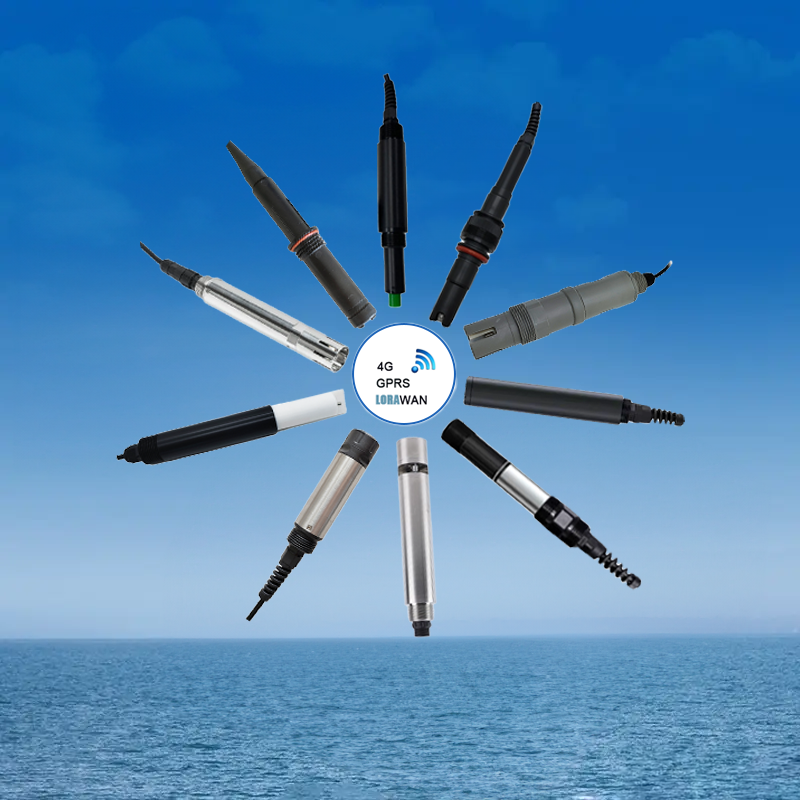
| Sensor Category (Model) | Core Role | Key Technical Feature | Measurement Range/Resolution | Output/Protocol |
| Residual Chlorine (RD-CVRC-02) | Monitors disinfectant to prevent bacterial regrowth. | Constant Voltage (Amperometric) Method. | 0.00–2.00mg/L (up to 20); Res: 0.01 mg/L | RS485 / 4-20mA; IP68 |
| Low-Range Turbidity (RD-SSWT) | Direct indicator of filtration efficacy/pipe integrity. | 90° Scattering; Laser/LED source; Debubbler. | 0.1 ~ 1000.0 NTU (Target: <1 NTU); Res: 0.01 NTU | RS485; Modbus; IP68 |
| High-Precision pH (RD-PH-WE-01) | Assesses corrosivity to prevent metal leaching. | Low-Ion Specialization glass electrode. | 0 ~ 14 pH; Res: 0.01 pH | RS485; Modbus; IP68 |
| 4-in-1 Conductivity (RD-ETTSD-01) | Macro-purity indicator; detects infiltration. | Multi-Parameter Matrix (EC, TDS, Sal, Temp). | 0 ~ 10000 us/cm; Res: 0.1 us/cm | RS485; Modbus; IP68 |
| ORP (ORP-RD-SOR-01) | Cross-verifies macro-disinfection power. | Noble Metal Sensing (Platinum/Gold). | -1999mV ~ +1999mV; Res: 1 mV | RS485; Modbus; 4-20mA |
4. Key Product Highlights and Technological Advantages
Advanced sensing in Indonesian municipal environments relies on three pillars of innovation:
Optical & Chemical Precision
- 90° Light Scattering & Advanced Optics: Utilizing laser or specific-wavelength LED sources, the RD-SSWT meets strict EPA/ISO standards. Crucially, it features an integrated Debubbler. In pressurized Indonesian networks, air bubbles often form during decompression; without a debubbler, these bubbles are frequently misread as turbidity spikes, triggering false alarms.
- Constant Voltage (Amperometric) Method: This allows for reagent-free chlorine monitoring with extreme sensitivity (0.01 mg/L), facilitating real-time disinfectant tracking without the maintenance burden of chemical consumables.
Specialized Material Science
- Low-Ion Specialization: Standard pH electrodes often suffer from signal drift in “pure” water due to low ion counts. Our specialized glass electrodes are specifically engineered for the low-conductivity environment of drinking water to ensure signal stability.
- Noble Metal Electrodes: The use of Platinum (Pt) or Gold (Au) in ORP sensors ensures rapid response times and long-term resistance to chemical oxidation.
Installation Innovation
- Flow Cell Optimization (Bypass Installation): Sensors like Chlorine and pH are highly dependent on stable flow rates. Instead of direct pipe insertion—where turbulence and velocity fluctuations degrade accuracy—we utilize a bypass Flow Cell. This ensures a constant, controlled flow velocity across the sensor interface, which is critical for the Amperometric method to yield precise data.
5. Application Scenarios: From Water Plants to Pipe Networks
Strategic deployment of these sensors addresses specific challenges within the Indonesian urban water cycle:
- Water Plant Filtration & Outflow Monitoring: Beyond basic compliance, ultra-low range turbidity sensing (targeting <1 NTU) validates the performance of filtration membranes, while chlorine sensors ensure the “safety margin” of water entering the city.
- Pressurized Distribution Network Security: In Jakarta and other rapidly expanding cities, aging pipes are susceptible to secondary pollution and ruptures. Sudden spikes in turbidity or conductivity provide immediate warnings of soil or wastewater infiltration caused by pressure drops.
- Disinfectant Validation: By using Chlorine and ORP sensors in a cross-verification matrix, operators can confirm that the water’s sterilization power remains active even at the furthest reaches of the distribution network.
- Pipe Lifespan Preservation: High-precision pH monitoring is essential for mitigating the risk of acidic corrosion. This prevents the leaching of lead or copper from older segments of the infrastructure and guards against internal scaling that reduces hydraulic efficiency.
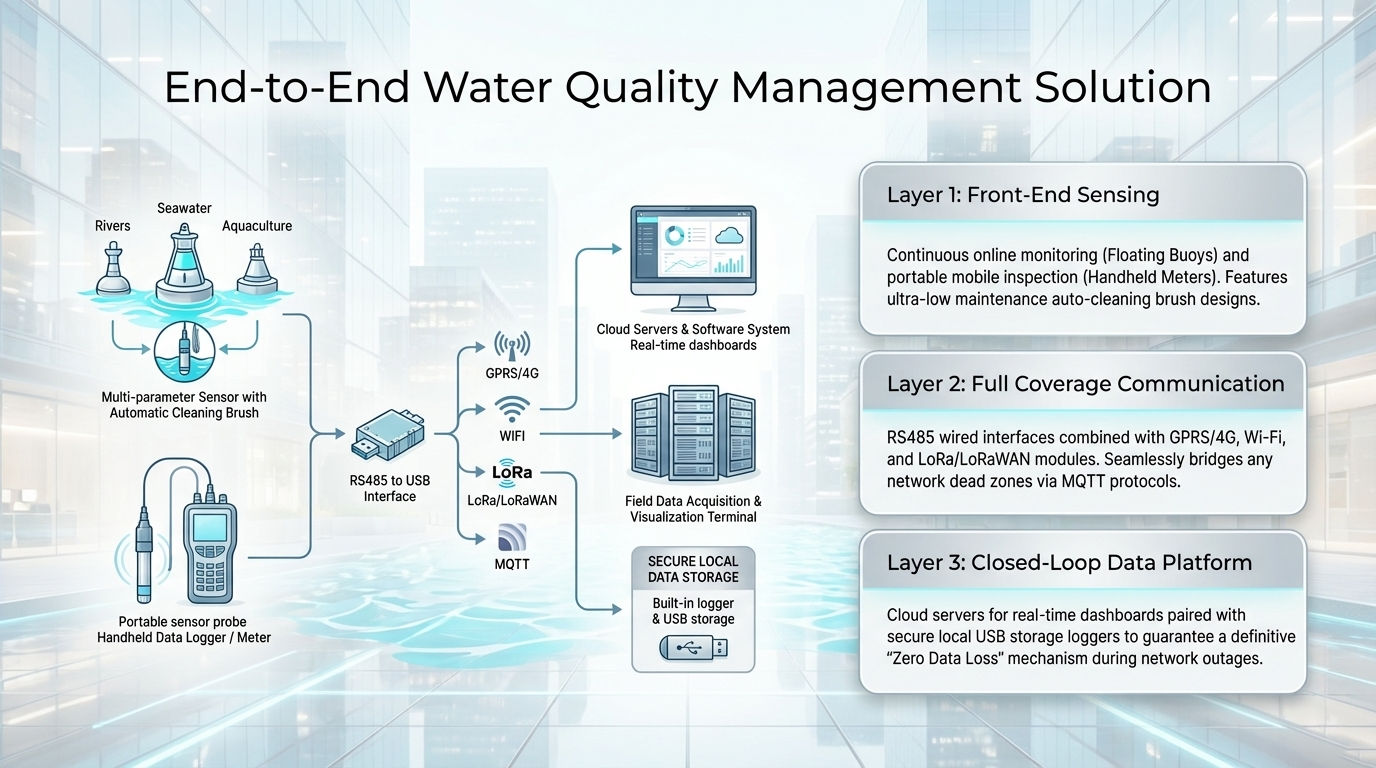
6. The Integrated IoT Solution: A Three-Layer Architecture
To bridge the gap between raw data and actionable intelligence, Honde Technology provides a resilient, three-layer management architecture:
- Front-End Sensing & Acquisition: This layer comprises both continuous online monitoring (via bypass flow cells or floating buoys) and portable mobile inspection units for manual field sampling. Auto-cleaning brush designs ensure ultra-low maintenance requirements.
- Full Coverage Data Communication: Recognizing the reality of urban “dead zones,” the system supports a hybrid of RS485, GPRS/4G, Wi-Fi, and LoRa/LoRaWAN protocols. MQTT bridging ensures seamless data transmission across complex urban topographies.
- Closed-Loop Data Management Platform: Data is synthesized on cloud servers for real-time dashboarding. To counter the threat of network instability—particularly during tropical storm-related outages common in Indonesia—the system utilizes a “Zero Data Loss” mechanism. Built-in loggers and local USB storage ensure that data is captured locally and synced once connectivity is restored.
7. Conclusion: Securing Every Drop
Securing the urban lifeline demands an uncompromising approach to technical precision and material integrity. By integrating high-precision sensors with a resilient IoT framework, Indonesian municipal stakeholders can transition from reactive maintenance to proactive infrastructure management. Whether through standalone sensing nodes or comprehensive cloud-integrated matrices, advanced technology remains the ultimate guardian of public health.
Contact Information Company Name: Honde Technology Co., Ltd.
Website: www.hondetechco.com
Email: info@hondetech.com
We can also provide a variety of solutions for
1.Handmeter, Data logger with screen, Floating Buoy system, Automatic cleaning brush for multi-parameter water sensor;
2.GPRS/4G/WIFI/LORA/LORAWAN wireless module supports MQTT Json format;
3.Cloud server and software with alram relay system support to see the real time data, history data.
Post time: Mar-27-2026