

For South Korean precision farming, the integration of Honde Technology’s LoRaWAN agricultural monitoring system—combining high-capacity gateways with 8-in-1 soil sensors and 11-parameter weather stations—provides a low-power, long-range solution (up to 500m+ depending on topography) for real-time environmental intelligence. Supporting MQTT protocols and 4G/WiFi/LoRa backhaul, this architecture enables seamless data flow and automated relay control, essential for maintaining the rigorous yield standards of the peninsula’s high-tech Smart Farm initiatives.
Transitioning to Smart Greenhouses and Automated Irrigation for Climate Resilience
South Korean agriculture is currently navigating a pivotal transition toward total digital integration. With the nation’s focus on Climate Resilience and the rising costs of manual labor, Smart Greenhouse operators are moving beyond simple data logging toward fully Automated Irrigation and ventilation systems.
In these high-intensity environments, maintaining the delicate balance of EC (Electrical Conductivity), Salinity, and NPK (Nitrogen, Phosphorus, and Potassium) is critical. Precision monitoring ensures that the high-density planting characteristic of Korean greenhouses does not lead to soil degradation or nutrient lockout. By leveraging IoT sensors, farmers can counteract environmental volatility, ensuring that every drop of water and gram of fertilizer contributes to crop quality and economic ROI.
Engineering Precision: High-Sensitivity Sensors for Critical Data
In our engineering tests and large-scale deployments, we have found that the reliability of a smart farm is only as good as its primary sensing layer. Honde’s hardware suite is engineered for the “set-and-forget” durability required in professional agricultural contexts.
Multi-Parameter Soil Monitoring
The backbone of our subterranean intelligence is the 8-in-1 soil sensor. These units feature high-precision stainless steel probes housed in an IP68 waterproof epoxy resin body, ensuring long-term resistance to the corrosive effects of fertilizers and moisture. These sensors utilize the RS485 Modbus-RTU protocol to deliver consistent data on Moisture, Temperature, EC, Salinity, pH, and the NPK triad. For localized verification, our 8-parameter handheld meters allow agronomists to perform spot-checks with Type-C data export functionality, bridging the gap between automated monitoring and manual field inspection.
Advanced Meteorological and Atmospheric Tracking
In the controlled environments of “K-Smart Farms,” air quality is as vital as soil health. Our 11-parameter compact weather station provides a comprehensive data set, including ET0 (Evapotranspiration), Solar Radiation, Sunshine Hours, and Ultrasonic Wind Speed/Direction. Crucially, the system integrates atmospheric sensors for CO2 and TVOC, allowing greenhouse managers to optimize photosynthesis rates and identify potential air-quality issues that could lead to crop stress.
The “Leaf Simulation” Edge
To address disease management, we utilize a specialized Leaf Temperature and Humidity Sensor. This hardware features a unique simulation design that mimics the thermal mass and moisture retention of a biological leaf. By accurately monitoring the dew point on the leaf surface, the system provides early warnings for fungal pathogens, allowing farmers to reduce pesticide application by only treating crops when environmental conditions favor disease outbreaks.
Technical Comparison: Monitoring and Control Tiers
| Feature Category | Parameter Details | Connectivity & Protocol | Use Case |
| Soil Analysis | NPK, pH, EC, Salinity, Moisture, Temp | RS485 (Modbus-RTU) | Permanent crop health and root-zone monitoring. |
| Weather & Air | ET0, CO2, TVOC, Radiation, Ultrasonic Wind, Rainfall | LoRaWAN / 4G / WiFi | Greenhouse climate management and irrigation scheduling. |
| Execution Layer | Relay Output Control (Fans/Pumps) | Switch Signal / MQTT | Automated irrigation, cooling, and ventilation. |
| Field Tools | Handheld Meters (8 parameters, Type-C export) | Local LCD / USB Export | Manual site audits and sensor calibration verification. |
Wireless Connectivity & The LoRaWAN Advantage
The architecture of our 2026 solution is designed to overcome the connectivity hurdles often found in rural South Korean topographies. The system follows a rigorous data-to-action flow:
- Data Collection: Sensors (Soil, Weather, or Leaf) collect high-fidelity signals via RS485.
- Transmission via LoRaWAN Collector: The sensors plug into a LoRaWAN Collector (powered by a 5V DC solar-charged internal battery). This collector makes the wired sensors wireless, transmitting data to the gateway over distances up to 500m.
- Gateway Processing: The LoRa Gateway (requiring 12V DC power) receives the LoRa signals and utilizes 4G, WiFi, or RJ45 Ethernet to push the data to the Honde Cloud Server via MQTT.
- Automated Action: Utilizing the Relay Output Control, the system can automatically trigger irrigation pumps or ventilation fans based on real-time sensor thresholds, significantly reducing the need for manual intervention.
- User Interface: Real-time dashboards are accessible via Web, App, or Tablet, providing historical report analysis and instant alert notifications.
Practical Implementation: Expert Pro-Tips for the Field
To maximize the lifespan of your IoT investment, our engineering team recommends the following best practices for installation:
- pH Sensor Installation: The glass electrodes in pH sensors are fragile. Never force the sensor directly into compacted soil. Always dig a hole first, place the sensor, and then gently backfill and compact the soil to ensure proper contact without damaging the probe.
- Gateway SIM Configuration: When using 4G backhaul, the APN settings must be manually configured to match your South Korean service provider (e.g., SK Telecom, KT, or LG U+).
- The “Yellow Button” Secret: To install or replace your 4G SIM card, locate the small yellow button on the gateway’s SIM slot; clicking this will safely eject the card tray.
- Debugging Protocol: Every order includes a free RS485 to USB converter. Use this for direct PC debugging during initial setup to verify sensor readings before they are deployed to the top of a weather mast or buried in the field.
- Power Management: Ensure the LoRaWAN Collector’s solar panel is positioned for maximum southern exposure. While the internal battery is robust, a 5V DC backup can be used for initial charging in low-light environments.
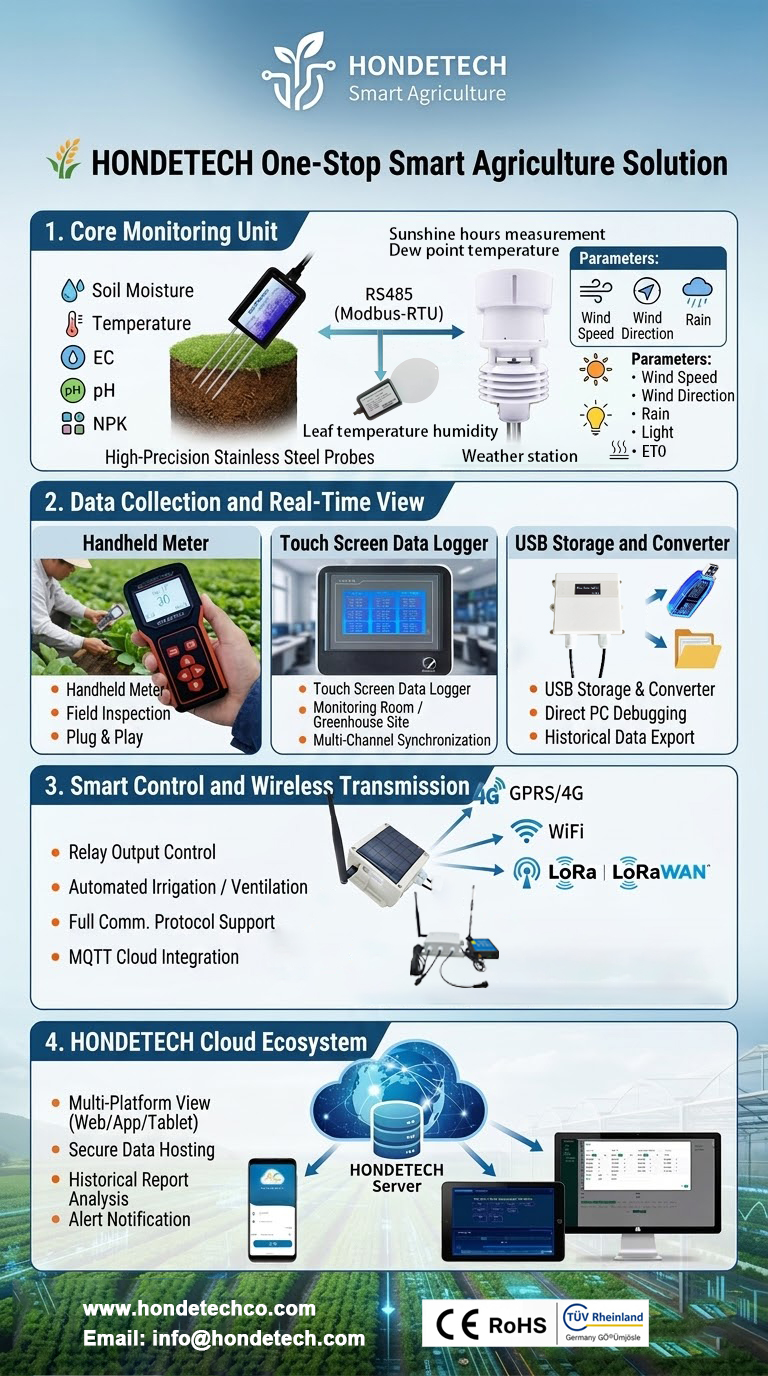
Achieving One-Stop Agricultural Intelligence
The Honde Technology “One-Stop Solution” removes the friction from modernizing South Korean agricultural enterprises. By integrating high-precision sensing with solar-powered LoRaWAN connectivity and actionable relay controls, we provide a path to increased yield stability and operational efficiency.
[Consult with our engineers for a custom Greenhouse configuration] to take control of your environmental data today.
Post time: Mar-11-2026