

In modern agriculture, ecological research and urban management, a wireless data recording system that integrates soil moisture, water level fluctuation and light intensity monitoring is triggering an industry transformation. This highly integrated monitoring solution, through wireless transmission technology, provides an unprecedented comprehensive perspective and decision support for environmental management.
System composition: A three-in-one intelligent monitoring network
This system consists of three core modules: Firstly, the soil monitoring unit, which adopts the principle of high-frequency capacitance and advanced algorithms, can simultaneously monitor the volumetric moisture content, temperature and electrical conductivity at different depths, accurately depicting the water and salt dynamics in the root system area. Secondly, there is the water level monitoring module, equipped with high-precision pressure sensors, which can continuously record the water level changes of groundwater, rivers or reservoirs, with a resolution reaching the millimeter level. The last component is the light monitoring system, which accurately captures the light quantum flux density in the 400-700 nanometer band through a spectrally optimized photosynthetically active radiation sensor.
These sensor data are uniformly collected by low-power data loggers and transmitted in real time to the cloud platform via wireless communication technologies such as 4G/LoRa/NB-IoT. The unique power management system enables the equipment to operate continuously in the wild for several years even when powered solely by solar energy.
Application scenarios: All-round coverage from farmland to cities
In the field of precision agriculture, this system is reshaping the concept of irrigation management. A certain wine estate monitored the soil moisture changes in the root layer of grapes and precisely controlled the irrigation timing in combination with light data. This not only saved 38% of water but also brought the sugar-acid ratio of the grapes to the optimal state. Large-scale farms utilize the water level and soil moisture correlation data generated by the system to scientifically adjust the groundwater extraction plan, effectively alleviating the problem of land subsidence.
In terms of ecological protection, the research team has set up a monitoring network in the wetland reserve to simultaneously record water level fluctuations, soil moisture and changes in light under the forest. These continuous environmental parameters provide crucial evidence for understanding the quality of migratory bird habitats and studying the patterns of vegetation succession, helping management departments formulate more scientific ecological water replenishment plans.
In urban garden management, the smart park project has achieved on-demand allocation of irrigation systems by monitoring soil moisture and light intensity in different areas. On well-lit slopes, the water supply is automatically increased, while in shady areas, irrigation is reduced. This ensures the quality of greening while significantly lowering operation and maintenance costs.
Technical advantage: Breaking through the limitations of traditional monitoring
Compared with traditional manual monitoring, the prominent advantages of this system are reflected in three aspects: Firstly, the continuity of data. The high-frequency data collected once per minute can capture the instantaneous change processes such as sudden rain infiltration and tidal influence. Secondly, there is the integrity of space. Wireless networking technology makes it possible to monitor dozens of points simultaneously, truly reflecting the spatial variation characteristics of environmental elements. The most important thing is the timeliness of decision-making. When the system detects that the soil moisture is below the threshold or the water level is abnormally rising, it will automatically send an alert to the mobile phones of the management personnel, buying precious time to deal with the risks of drought or flood.
Future Outlook: The Data Foundation for Intelligent Decision-making
With the deep integration of Internet of Things (iot) and artificial intelligence (AI) technologies, the soil-water-lighting wireless monitoring system is evolving from a data collection tool to the core of intelligent decision-making. The long-term monitoring data accumulated by the system, through machine learning analysis, can establish a water-light coupling model for a specific area, predict the trend of soil moisture changes in the coming week, and provide forward-looking decision support for agricultural irrigation and ecological protection.
From vast farmlands to urban green Spaces, from nature reserves to water conservancy projects, this wireless monitoring system integrating multiple environmental parameters is building a series of “neural networks” that perceive the earth. They silently record the story of every inch of land, providing increasingly precise scientific guidance for the harmonious coexistence of humans and nature.
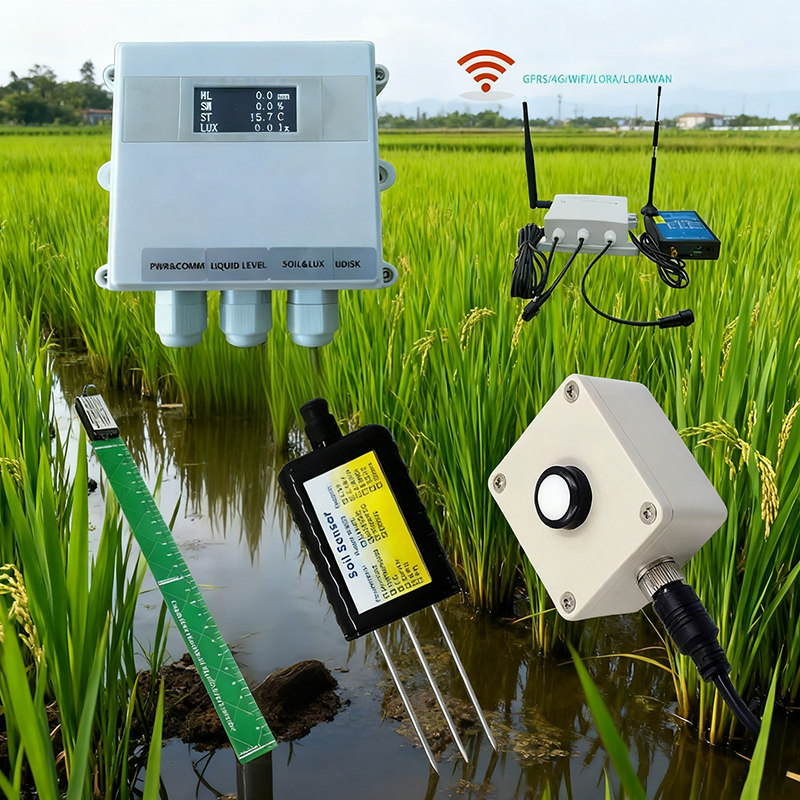
For more agricultural sensor information, please contact Honde Technology Co., LTD.
WhatsApp: +86-15210548582
Email: info@hondetech.com
Company website: www.hondetechco.com
Post time: Nov-06-2025