

1. What Is a Smart Road Weather Monitoring Solution?
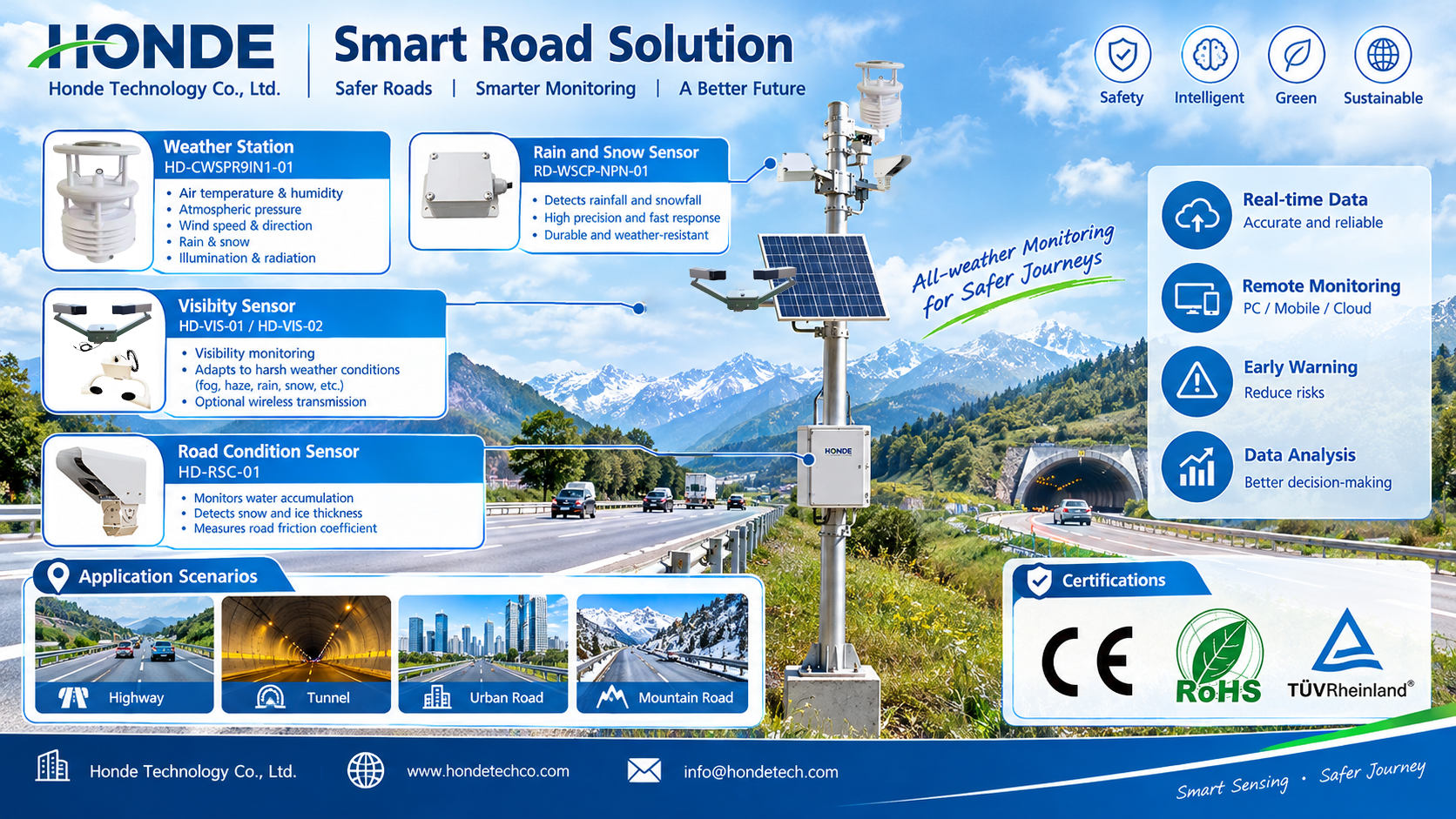
A smart road weather monitoring solution combines visibility sensors, road condition sensors, automatic weather stations, and rain and snow sensors to collect environmental and pavement-related data for transportation safety management. By integrating suitable communication modules and monitoring software, road operators can access real-time measurements, review historical trends, and use the collected information to support traffic management and maintenance decisions.
For highways, tunnels, urban roads, and mountain roads, the main objective is to identify changing environmental conditions that may affect visibility, road traction, and driving safety.
Honde Technology Co., Ltd. provides road and environmental monitoring equipment designed for different outdoor monitoring requirements. Its road solution product portfolio includes four key devices:
- Visibility Sensor HD-VIS-01 / HD-VIS-02: Monitors atmospheric visibility under conditions such as fog, haze, dust, rain, and snowfall.
- Road Condition Sensor HD-RSC-01: Detects road water accumulation, snow accumulation, ice thickness, and road surface slip coefficient.
- Weather Station HD-CWSPR9IN1-01: Measures air temperature and humidity, atmospheric pressure, wind speed and direction, rain and snow, illumination, and solar radiation.
- Rain And Snow Sensor RD-WSCP-NPN-01: Detects precipitation conditions, with features including automatic heating and support for digital communication.
When these products are configured according to project requirements, they can form a road weather monitoring network that supports more informed operational decisions.
2. Why Do Roads Need Integrated Weather And Pavement Monitoring?
Road safety is influenced by more than the condition of the pavement itself. Visibility, precipitation, wind, temperature, and surface water or ice can change the risks faced by drivers.
A single sensor cannot provide every type of environmental information. Integrated monitoring allows transportation operators to evaluate multiple factors instead of relying on one measurement alone.
Low Visibility In Foggy Or Dusty Conditions
Fog, haze, smoke, and airborne dust can reduce the distance at which drivers can see vehicles, signs, and road obstacles.
A visibility monitoring sensor measures atmospheric visibility and provides information that can help road operators assess changing conditions. Depending on the road management system, the information may support variable message signs, traffic warnings, speed management, or other safety procedures.
Water Accumulation And Ice On The Road Surface
Water accumulation, snow, and ice can affect tire traction and increase the risk of skidding.
The HD-RSC-01 road condition sensor uses non-contact remote sensing technology. According to the product catalogue, it can detect water accumulation, snow accumulation, ice thickness, and the slip coefficient of the road surface.
These measurements can help maintenance teams identify sections that may require closer inspection, drainage management, de-icing, or other appropriate action.
Changing Weather Conditions
Strong winds, heavy precipitation, and changing temperatures can affect vehicles and road infrastructure, particularly on bridges, elevated roads, and mountain routes.
A multi-parameter weather station provides additional environmental information for understanding the conditions around a monitored road section.
Combining meteorological data with visibility and pavement measurements gives operators a broader picture of the factors that may influence road safety.
3. Four Essential Products In A Road Weather Monitoring System
3.1 Visibility Sensor HD-VIS-01 And HD-VIS-02
Visibility sensors are used to monitor atmospheric visibility in transportation and outdoor environmental applications.
The Honde catalogue identifies the following features:
- Real-time visibility detection for smoke, dust, haze, fog, rain, and snowfall.
- Integrated construction with a lens protection design.
- Equipment status self-checking.
- All-weather measurement and a geometric design intended to resist icing.
- Compact structure and roadside installation.
- Design features intended to reduce contamination from dust, rain, and snow.
The HD-VIS-02 catalogue entry also specifies optional detection ranges of 0–3 km, 0–5 km, 0–10 km, 0–30 km, and 0–50 km. Actual selection should be based on the required monitoring distance and the confirmed configuration.
For projects that require remote monitoring, communication options should be confirmed for the selected model and system architecture.
Typical applications: Highway visibility monitoring, fog-prone road sections, mountain roads, tunnel approaches, and intelligent transportation infrastructure.
3.2 Road Condition Sensor HD-RSC-01
The HD-RSC-01 is a non-contact road condition sensor designed to measure surface conditions without requiring direct contact with the pavement.
According to the product catalogue, its principal measurement parameters are:
- Water accumulation and water thickness
- Snow accumulation and snow thickness
- Ice thickness
- Road surface slip coefficient
The catalogue also highlights low power consumption of less than 4 W, maintenance-free operation, compact construction, weather resistance, and a corrosion-resistant housing.
Because it uses remote sensing technology, the sensor can be installed without embedding the sensing element directly into the road surface. The installation method and mounting geometry must still follow the manufacturer’s instructions and the project’s site requirements.
Road condition data can help road maintenance departments identify potentially hazardous sections and determine where further inspection or preventive action is appropriate.
Typical applications: Expressways, bridges, tunnels, winter road maintenance, urban roads, and mountain routes exposed to snow or ice.
3.3 Integrated Weather Station HD-CWSPR9IN1-01
The HD-CWSPR9IN1-01 combines several meteorological measurements in one monitoring instrument.
| Monitoring Parameter | Application Value |
|---|---|
| Air temperature | Helps track changes in ambient thermal conditions |
| Relative humidity | Provides information about atmospheric moisture |
| Atmospheric pressure | Supports local meteorological observation |
| Wind speed | Helps identify strong-wind conditions |
| Wind direction | Shows the direction of prevailing or changing winds |
| Rain and snow | Supports precipitation monitoring |
| Illumination | Measures ambient light conditions |
| Solar radiation | Provides solar radiation data for environmental analysis |
The product catalogue states that the weather station uses a piezoelectric rain gauge, incorporates rain and snow sensing, and uses ultrasonic wind measurement. Its ultrasonic wind speed measurement has a stated capability of up to 60 m/s.
The default communication interface is RS485 with the Modbus protocol. Optional data collectors can support GPRS, 4G, Wi-Fi, LoRa, or LoRaWAN, subject to the selected configuration.
The catalogue also describes a 32-bit data acquisition processor and a modular design intended for outdoor environmental monitoring.
Typical applications: Highway meteorology, bridge monitoring, mountain road weather observation, urban transportation, and remote environmental monitoring stations.
3.4 Rain And Snow Sensor RD-WSCP-NPN-01
A dedicated rain and snow sensor adds precipitation-specific information to the monitoring network.
The RD-WSCP-NPN-01 catalogue lists the following features:
- Rainfall and snowfall detection
- Strong anti-interference capability
- Easy installation and detection
- Waterproof cable outlet design
- Automatic heating function
- RS485 communication with Modbus protocol
- Optional wireless transmission through supported system configurations
- Compatibility with cloud server and software solutions
Precipitation data can be useful when assessing changing road weather conditions, particularly when combined with air temperature, visibility, and road surface measurements.
For example, detecting precipitation alone does not prove that a road is icy. Combining precipitation information with temperature and road condition measurements gives operators more relevant information for evaluating the situation.
4. Product Comparison: Which Sensors Do You Need?
The most suitable configuration depends on the main risk to be monitored, the location, the required communication method, and the available power supply.
| Product | Main Measurements | Key Selection Consideration |
|---|---|---|
| HD-VIS-01 / HD-VIS-02 | Atmospheric visibility | Required detection range and visibility risk |
| HD-RSC-01 | Water, snow, ice thickness and slip coefficient | Pavement monitoring requirements and mounting geometry |
| HD-CWSPR9IN1-01 | Multiple meteorological parameters | Required weather measurements and communication |
| RD-WSCP-NPN-01 | Rain and snow | Precipitation detection and communication interface |
For a highway project with frequent fog, visibility monitoring may be the first priority. For roads exposed to freezing conditions, pavement measurements may be particularly important. For a broader monitoring network, combining all four product types can provide more complete environmental information.
Not every project needs every sensor. A site assessment should determine the required parameters before equipment is selected.
5. Solar-Powered Roadside Monitoring: Installation And System Design
Remote highways and mountain roads may not have convenient access to mains electricity or wired communication infrastructure. A solar-powered roadside monitoring pole can be considered for these locations.
A typical installation may include:
- Mounting pole: Provides structural support for the monitoring instruments and solar panel.
- Solar panel and power system: Supplies energy to compatible equipment through a suitably sized battery and power management system.
- Weather station: Measures the required atmospheric parameters at an appropriate installation height.
- Visibility sensor: Installed with a suitable field of view and orientation.
- Rain and snow sensor: Positioned according to the manufacturer’s installation requirements.
- Road condition sensor: Mounted at the appropriate location and angle for its non-contact measurement method.
- Data acquisition and communication: Collects readings and transmits them through the selected wired or wireless interface.
- Monitoring platform: Displays available real-time data, historical trends, and configured alarms.
The exact pole arrangement depends on the equipment dimensions, sensor field of view, environmental exposure, structural loading, and maintenance access.
What Should Be Checked Before Installation?
Solar power sizing: Calculate the total power consumption, daily energy requirement, local solar resource, battery capacity, and expected autonomy during periods of limited sunlight. Do not assume that one panel size will suit every site.
Sensor positioning: Visibility sensors require a suitable measurement path. Weather sensors need appropriate exposure, while road condition sensors must be installed according to their sensing geometry.
Communication coverage: Confirm cellular signal strength or the availability of the selected Wi-Fi, LoRa, or LoRaWAN network. Wired RS485 connections also require appropriate cable and network design.
Environmental protection: Check temperature limits, moisture exposure, corrosion risk, lightning protection, and mechanical stability.
Maintenance access: Plan safe access for inspection, cleaning, troubleshooting, and replacement without creating unnecessary traffic disruption.
A well-designed installation considers the sensors, power system, communication network, and monitoring software as one complete solution.
6. Road Weather Monitoring Applications
Highways And Expressways
Highways may experience fog, heavy rain, strong winds, and changing road surface conditions over long distances.
Visibility sensors can monitor reduced visibility, weather stations provide meteorological data, and road condition sensors can identify water, snow, or ice conditions. The resulting information can support traffic management and maintenance decisions.
Tunnels And Tunnel Approaches
Tunnel entrances and exits can present changing lighting, weather, and visibility conditions. Sensors positioned around tunnel approaches can provide information about external visibility and weather conditions.
Equipment selection inside a tunnel should account for the specific environmental conditions and any applicable installation or traffic management requirements.
Urban Roads
Urban road monitoring can support road management in locations where precipitation, water accumulation, or poor visibility affects traffic flow.
A suitable combination of precipitation, weather, and pavement sensors can provide data for traffic control and infrastructure maintenance systems.
Mountain Roads And Bridges
Mountain routes and bridges can be exposed to strong winds, rapid temperature changes, fog, snow, and ice.
Weather stations provide information about wind and atmospheric conditions, while visibility and road condition sensors address specific visibility and pavement risks. Site-specific sensor placement is important because conditions can vary considerably over short distances.
7. From Sensor Readings To Actionable Data
A road monitoring system becomes more useful when measurements can be accessed and interpreted by the teams responsible for road operations.
A typical data workflow is:
Environmental Measurement → Data Acquisition → Communication Network → Monitoring Platform → Operator Assessment → Appropriate Response
The Honde product catalogue describes support for multiple communication options, including RS485, GPRS, 4G, Wi-Fi, LoRa, and LoRaWAN across relevant products and configurations. It also describes cloud server and software capabilities for displaying real-time data, historical data curves, downloadable historical records, and alarm settings.
Available functions depend on the selected hardware, communication module, software configuration, and project requirements.
A practical deployment should define which measurements need to be displayed, which thresholds require alarms, who receives alerts, and what actions operators should take when abnormal conditions occur.
Sensor readings support decision-making; they do not replace appropriate road inspections, validated warning procedures, or traffic management protocols.
8. Common Mistakes When Selecting Road Monitoring Sensors
Mistake 1: Choosing Equipment By Price Alone
A low initial equipment price may not reflect the total project cost. Installation, power supply, communications, maintenance access, and software integration also affect the long-term budget.
Better approach: Compare the complete system configuration and the requirements for ongoing operation.
Mistake 2: Treating Visibility And Road Surface Conditions As The Same Measurement
Atmospheric visibility and pavement conditions are different parameters. A visibility sensor cannot replace a road condition sensor when the project needs measurements of water, snow, ice, or slip coefficient.
Better approach: Select each sensor according to the actual measurement requirement.
Mistake 3: Assuming Every Product Supports Every Communication Method
Wireless interfaces and power options may differ by model and configuration.
Better approach: Confirm the available interface, wireless module, data format, power requirement, and software compatibility before ordering.
Mistake 4: Installing Solar Equipment Without An Energy Calculation
Continuous monitoring requires sufficient energy generation and storage, including during cloudy or snowy periods.
Better approach: Calculate the power budget using the actual equipment load and the local climate before specifying the solar panel and battery.
Mistake 5: Ignoring Calibration And Installation Geometry
Incorrect sensor orientation, unsuitable mounting height, obstructions, or inadequate maintenance can affect data quality.
Better approach: Follow the manufacturer’s installation instructions and establish a maintenance and verification plan for the project.
9. Why Work With Honde Technology Co., Ltd.?
Honde Technology Co., Ltd. was founded in 2011 and focuses on the research and development, production, and sales of IoT equipment for smart water, smart agriculture, and smart environmental monitoring, together with related solutions.
According to the company catalogue, Honde products are supplied to customers in more than 70 countries. The catalogue also identifies CE and RoHS certifications and German TÜV-related company credentials.
For road weather monitoring projects, customers can discuss equipment selection based on the required measurement parameters, installation environment, power supply, communication interface, and data access requirements.
The product portfolio includes visibility monitoring, road condition measurement, integrated weather monitoring, rain and snow detection, and compatible data communication options.
To review related equipment and applications, explore these Honde resources:
- Road Condition Sensor — Review road surface monitoring applications and sensor options.
- Dedicated Weather Stations For Expressways — Learn how weather data can support expressway operations.
- Rain And Snow Sensor Applications — Explore precipitation monitoring use cases.
10. Frequently Asked Questions
What Sensors Are Needed For A Road Weather Monitoring System?
The main options include visibility sensors, road condition sensors, weather stations, and rain and snow sensors. The appropriate combination depends on whether the project needs to monitor fog, precipitation, wind, pavement water, snow, ice, or several parameters together.
Can Road Monitoring Sensors Work With Solar Power?
Solar power may be used when the selected devices and power system are compatible. The panel and battery must be sized according to the total energy demand, local sunlight conditions, and required backup duration.
Can The Monitoring Data Be Viewed Remotely?
Remote monitoring is possible when compatible communication hardware and software are configured. Depending on the selected system, interfaces may include RS485, GPRS, 4G, Wi-Fi, LoRa, or LoRaWAN.
What Does The HD-RSC-01 Road Condition Sensor Measure?
According to the product catalogue, the HD-RSC-01 detects water accumulation, snow accumulation, ice thickness, and road surface slip coefficient using non-contact remote sensing technology.
Can The Weather Station Monitor Wind And Precipitation Together?
The HD-CWSPR9IN1-01 catalogue describes integrated monitoring of wind speed and direction, rain and snow, air temperature and humidity, atmospheric pressure, illumination, and solar radiation.
How Can I Select The Right Configuration For My Project?
Start with the road type, environmental risks, required measurement parameters, installation conditions, power availability, communication coverage, and monitoring platform requirements. Honde can discuss a suitable configuration based on the project specifications.
11. Request A Customized Road Monitoring Solution
Selecting the right road monitoring equipment starts with understanding the site and the data required for safe and efficient road operations.
Whether your project involves highways, tunnels, urban roads, mountain roads, or bridges, Honde Technology can help you evaluate suitable combinations of visibility sensors, road condition sensors, weather stations, rain and snow sensors, communication modules, and power systems.
Contact Honde Technology Co., Ltd.
- Company Name: Honde Technology Co., Ltd.
- Website: https://www.hondetechco.com
- Email: info@hondetech.com
Contact us with your project location, required monitoring parameters, power supply conditions, communication preferences, and installation requirements to discuss a suitable road weather monitoring configuration.
Post time: Oct-23-2026