

1. Introduction: The Global Crisis of Urban Water Management
Modern megacities face a dual challenge that threatens both public safety and environmental sustainability: sudden urban inundation from flash flooding and the persistent degradation of “black-odorous” water bodies. At the heart of these crises lies the underground drainage network—the “hidden veins” of the city. For decades, these systems have been managed through reactive maintenance, with crews responding only after a street is submerged or a river is contaminated.
To build truly resilient cities, we must transition to proactive, sensor-driven management. By deploying smart sensing technology, municipal operators can gain visibility into subterranean corridors, transforming once-blind infrastructure into a data-rich environment capable of early warning and precise environmental protection.
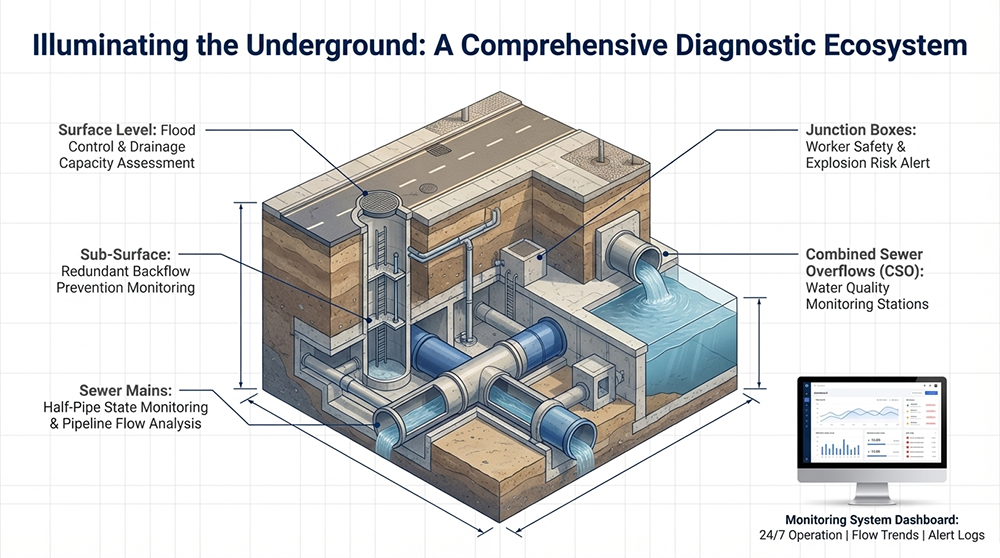
2. Scenario A: Preventing Urban Inundation and Managing Network Load
Preventing city-wide flooding requires high-fidelity data on how water moves through the network before it reaches the surface. Radar-based level and flow sensors are now the industry standard for these high-stakes environments due to their non-contact nature and resilience.
The RD600S 3-in-1 Radar Flow Sensor is specifically engineered for Inflow & Infiltration (I&I) analysis and monitoring sewer mains. Unlike traditional contact sensors, the RD600S features a corrosion-resistant treatment (anti-corrosion spraying) and operates without flow interception, eliminating the risk of debris accumulation.
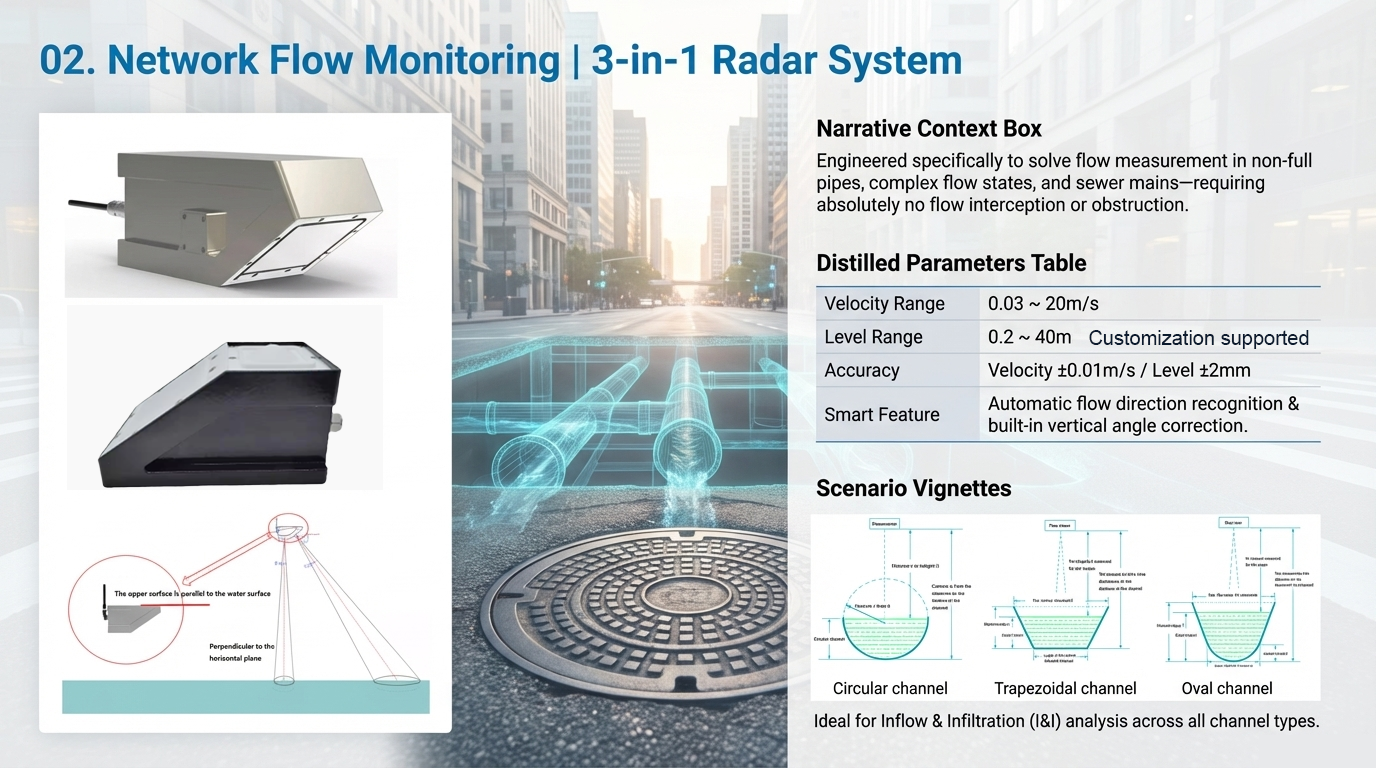
Core Technical Capabilities for Flood Control:
- Precision Monitoring: Tracks non-full pipe states, circular, trapezoidal, or oval channels with a velocity range of 0.03 ~ 20m/s and a level range of 0.2 ~ 40m (customization supported).
- Narrow Beam Technology: Utilizing ultra-high frequency Millimeter-Wave Radar (24GHz/60GHz/76-81GHz options), the sensors employ narrow beam technology to completely bypass wall attachments and debris in tight urban wells.
- Redundant Level Sensing: By integrating the RD-300/HD Series, cities can implement redundant monitoring in deep wells and underpass drainage systems. These units are immune to temperature fluctuations, high humidity, and fog, providing critical warnings to prevent sewage backflow onto street surfaces.
3. Scenario B: Eliminating “Black and Odorous” Water through Illicit Discharge Tracking
Identifying the source of “black-odorous” water is often an exercise in tracing illicit discharges from industrial or commercial actors. Smart sensing creates a synergy between flow and quality data: an abnormal increase in flow during non-rainfall periods, cross-referenced with a spike in pollutants, allows operators to immediately pinpoint the source.
The RD-ETTSD 4-in-1 Water Quality Sensor provides in-situ monitoring without the need for chemical reagents, ensuring zero secondary pollution. This digital, plug-and-play sensor integrates seamlessly into dashboards via RS485 (Modbus-RTU) or 4-20mA outputs.
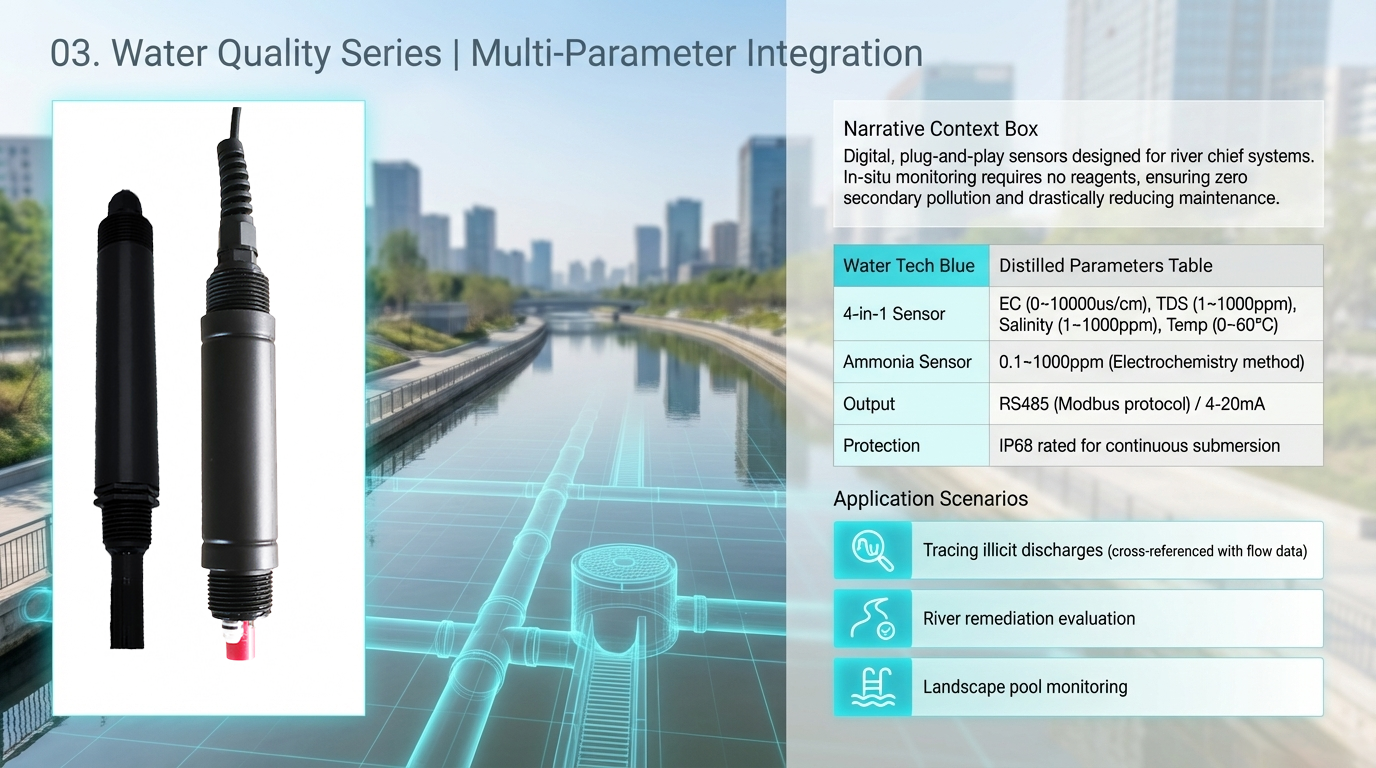 Monitoring Parameters:
- Conductivity (EC): 0-10000us/cm
- TDS: 1-1000ppm
- Salinity: 1-1000ppm
- Ammonia Nitrogen Sensor: 0.1-1000ppm (utilizing the Electrochemistry method for high accuracy).
4. Scenario C: Ensuring Personnel Safety and Infrastructure Integrity
Underground networks naturally accumulate hazardous biogases, creating risks of personnel toxicity and catastrophic explosions. The RD-EPGD Explosion-Proof Gas Detector is a site-level warning system essential for protecting maintenance crews and infrastructure.
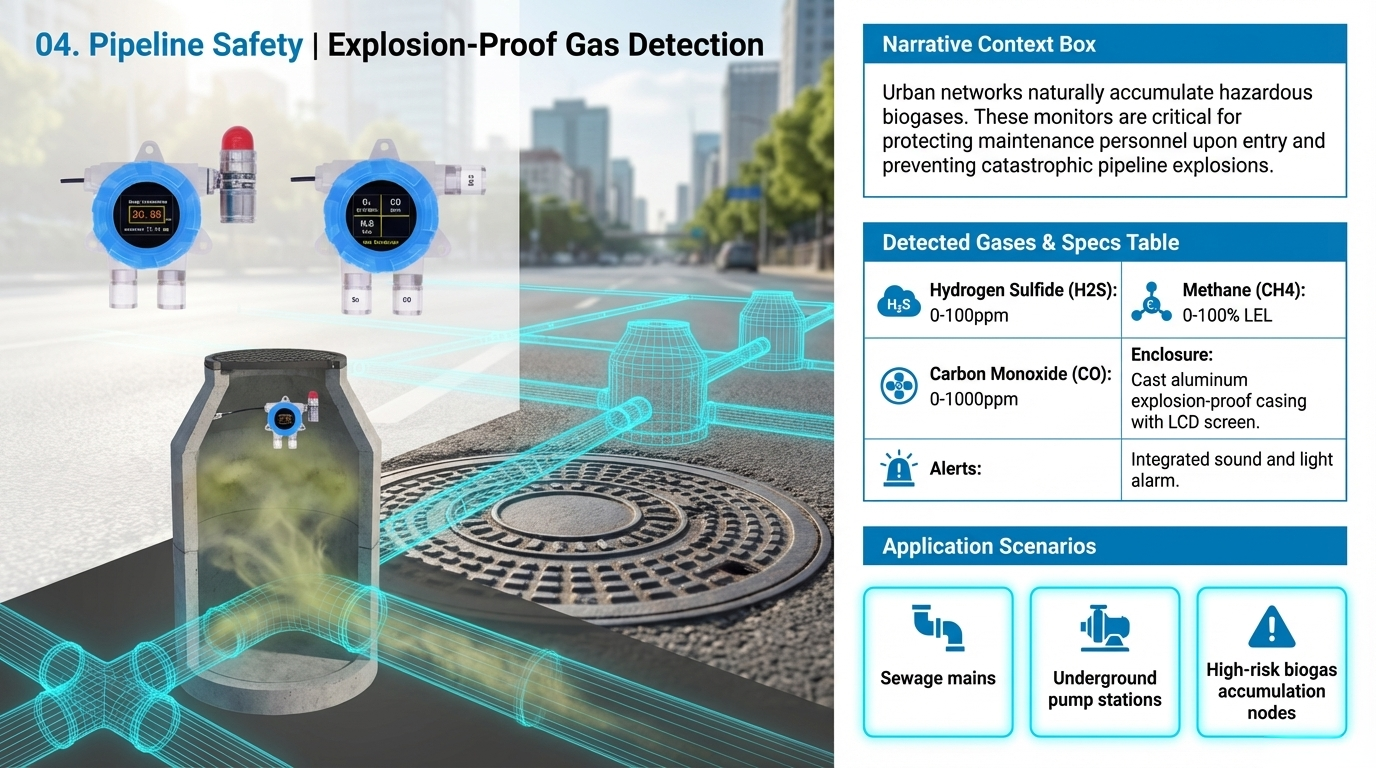
Housed in a cast aluminum explosion-proof casing with an integrated LCD screen, the RD-EPGD provides real-time sound and light alarms.
| Gas Type | Detection Range | Primary Risk |
| Hydrogen Sulfide (H2S) | 0-100ppm | Personnel Toxicity |
| Methane (CH4) | 0-100% LEL | Explosion Risk |
| Carbon Monoxide (CO) | 0-1000ppm | Personnel Toxicity |
5. Strategic Sensor Selection Matrix
To assist municipal buyers in infrastructure scaling, the following matrix outlines the recommended technology for various urban environments.
| Technology | Ideal Environment | Core Advantage | Recommended Series |
| High-Precision Ultrasonic | Standard inspection wells, shallow drainage | Cost-effective, zero-contact, 3-5 years battery life | RD-UWL Series |
| Millimeter-Wave Radar | Deep wells, reservoirs, harsh/humid sites | Immune to fog/temp, redundant backflow warning | RD-300 / HD Series |
| 3-in-1 Radar Flow | Non-full pipes, sewer mains, complex flow | I&I analysis, measures velocity without interception | RD-600 Series |
6. The Integrated Ecosystem: From Manhole to Cloud
Honde Technology offers a “Comprehensive Urban Water Management Ecosystem” that bridges the gap between hardware in the ground and strategic decision-making.
Connectivity & Protocol Support: The system features full communication protocol support, including 4G GPRS, WiFi, LoRa, and LoRaWAN. Crucially, it supports MQTT Cloud Integration, allowing for seamless data ingestion into third-party smart city platforms.
Data Consumption & Management:
- Field Inspection: Handheld meters provide plug-and-play spot checks for maintenance teams.
- Station Monitoring: Touch Screen Data Loggers support multi-channel synchronization for monitoring rooms or pump stations.
- HONDETECH Cloud Ecosystem: A secure platform for multi-platform viewing (Web/App/Tablet) featuring historical report analysis and automated alert notifications.
- Data Portability: Includes USB Storage & Converters for direct PC debugging and historical data export for offline auditing.
7. Conclusion: Partnering for a Sustainable Water Cycle
Honde Technology Co., Ltd. is a global leader in water environment monitoring. Our solutions are designed to withstand the most demanding municipal conditions, backed by CE, RoHS, and TUV Rheinland certifications. By partnering with us, municipal operators and global distributors gain access to high-precision equipment that meets international standards for reliability and safety.
Contact Us for Customized Solutions:
- Email: info@hondetech.com
- Website: www.hondetechco.com
Post time: Apr-02-2026