

1. Introduction: The Unique Demands of Surface Water Monitoring
In the world of water quality monitoring, there is a vast chasm between controlled industrial environments and the unpredictable reality of natural surface water. In an industrial plant, sensors often reside in protected pipes with predictable flow and chemistry. In contrast, monitoring rivers, lakes, reservoirs, and estuaries requires deploying instrumentation into dynamic ecosystems teeming with life and physical debris. From a deployment perspective, we aren’t just measuring water; we are battling the environment itself. Natural waters are rich in microbes, algae, and silt, often requiring hardware to be installed in remote regions via solar-powered buoys or poles where human intervention is rare.
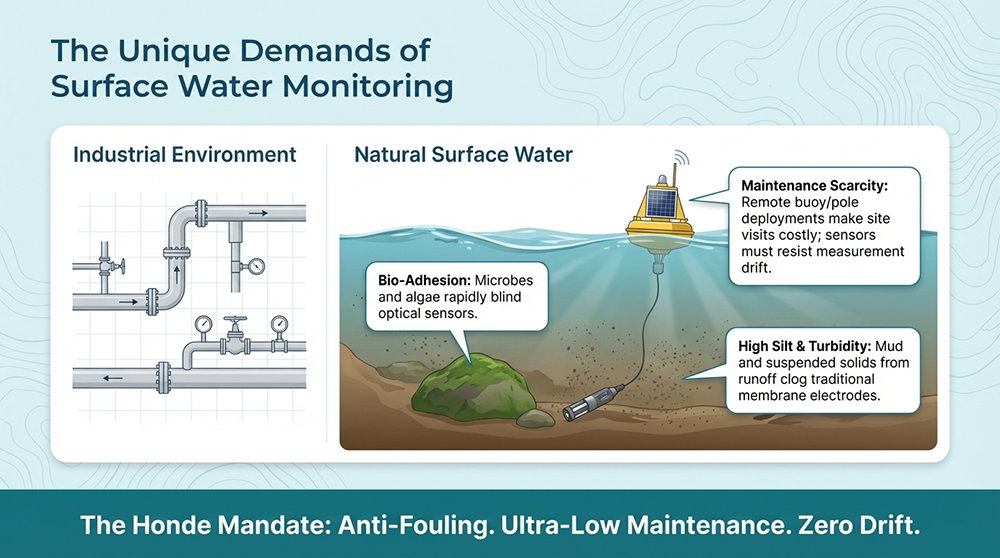
To succeed in these environments, any robust solution must address four Unique Demands:
- Bio-Adhesion: Microbes and algae in natural water bodies rapidly accumulate on surfaces, “blinding” optical sensors within days if not properly mitigated.
- High Silt & Turbidity: Runoff introduces mud and suspended solids that can clog traditional membrane electrodes and disrupt optical paths.
- Remote Deployment: Without access to a power grid, equipment must rely on solar energy, necessitating ultra-low power consumption for 24/7 operation.
- Maintenance Scarcity: Because site visits to remote watersheds are logistically difficult and expensive, sensors must be designed to resist measurement drift for months at a time.
2. The Core Mandate: Designing for Reliability in the Wild
For any international monitoring project to move from a pilot phase to a permanent national asset, it must adhere to what we call the “Honde Mandate”: Anti-Fouling, Ultra-Low Maintenance, and Zero Drift.
These three pillars are the non-negotiables of remote field operations. We achieve “Zero Drift” not through luck, but through the integration of stable sensing materials—such as high-grade marine steels—and sophisticated internal compensation algorithms. By combining these with physical anti-fouling mechanisms like automatic brushes and wipers, we ensure that the data collected on Day 1 is just as reliable as the data collected on Day 100, even in high-turbidity tropical rivers or nutrient-rich estuaries.
3. Solution Component I: The “Foundation Basic 5″ Sensors
The backbone of any national monitoring station or floating buoy is the “Foundation Basic 5″ configuration. These sensors provide the essential baseline data required for hydrological assessment.
| Sensor Type | Key Technology/Feature | Application Value |
| Optical Fluorescence DO | Non-consumption of oxygen; 316L housing; anti-fish and shrimp bite design; automatic cleaning brush. | Primary indicator of ecosystem health; prevents “blinding” by bio-films; maintenance-free for months in aquaculture and rivers. |
| Stainless Steel Turbidity | 316L corrosion-resistant shell; integrated auto-cleaning wiper; no light blocking required. | Evaluates sediment inflow and stormwater runoff; can be tested directly under light without interference. |
| Industrial pH | PTFE/double salt bridge design with large annular liquid junction; 3-point calibration. | Prevents reference electrode clogging; monitors acid rain impacts and diurnal cycles caused by photosynthesis. |
| 4-in-1 EC | Four-electrode structure; anti-polarization and anti-fouling design; multi-parameter output. | Measures EC, TDS, Salinity, and Temp; critical for tracking seawater intrusion and macro-salt diagnostics. |
| Precision Water Temp | Fully sealed in 316S stainless steel for indefinite submersion; 0.1°C accuracy. | The “Baseline Metric”; provides essential data for matrix compensation of DO, pH, and ISE sensors. |
4. Solution Component II: Ecological & Nutrient Monitoring for Specialized Contexts
When the mission shifts toward tracking eutrophication or agricultural runoff, we scale the payload to include specialized ecological and chemical sensors.
- Algae Monitoring: Using In-Situ Fluorescence, these sensors (constructed with SUS316L bodies) excite Chlorophyll-a or Blue-Green Algae (BGA) pigments to provide real-time biomass data. This enables early warning for toxic cyanobacteria blooms, replacing the slow turnaround of laboratory extraction.
- Nutrient Tracking: We utilize Ion Selective Electrodes (ISE) for high-precision tracking of Nitrate (NO3-) and Ammonia Nitrogen (NH4-N). The NH4-N probe acts as a high-toxicity pollutant tracer, utilizing auto-integration of K+, pH, and Temperature for cross-interference compensation. The Nitrate sensor features a solid-state membrane, ensuring high sensitivity to fertilizer runoff without the need for chemical reagents.
- Organic Load: For 24-hour high-frequency monitoring of COD and TOC, we employ the UV254 Spectral method. This is a “reagent-free” solution that measures the absorption of 254nm UV light, offering a secondary-pollution-free way to monitor organic flux in rivers.
5. Strategic Deployment: The Payload Architecture Matrix
The modularity of our solutions is driven by a standardized RS485/Modbus architecture. This allows architects to scale payloads up or down based on specific watershed regulations or environmental risks.
Surface Water Sensor Deployment Matrix
| Environment | Foundation (Basic 5) | Ecological Package | Nutrient/Organic Package |
| Rivers & Streams (High flow, sediment risk) | ✓ | ✓ | |
| Lakes & Reservoirs (Slow flow, algal risk) | ✓ | ✓ | |
| Estuaries & Coasts (Tidal mixing, salinity) | ✓ | ✓ |
Note: The modular RS485 architecture is the “glue” of the system, enabling seamless integration of additional sensors as monitoring requirements evolve.
6. System Architecture: From Front-End Sensing to Cloud Management
To guarantee a “Zero Data Loss” workflow in remote field conditions, we utilize a three-layer intelligent architecture:
- Layer 1: Front-End Sensing & Acquisition: This includes continuous monitoring via Floating Buoy Stations equipped with automatic cleaning sensors, or Portable Mobile Inspection tools (handheld meters and loggers) for targeted field sampling.
- Layer 2: Full Coverage Data Communication: Our modules adapt to any field condition using GPRS/4G, LoRa/LoRaWAN, NB-IoT, or MQTT protocols, effectively eliminating “data dead zones” in remote valleys or coastal reaches.
- Layer 3: Closed-Loop Management & Analysis: Data is aggregated on cloud servers with real-time dashboards. Crucially, the system includes a field acquisition terminal with a built-in logger and USB storage, providing a secure local backup to ensure data integrity even during communication outages.
7. Conclusion: The Competitive Advantage of Integrated Solutions
The global standard for water resource management has moved beyond simple data collection. Today, the competitive advantage lies in integrated solutions that offer full scene coverage—from handheld spot-checks to permanent floating stations. By prioritizing automatic cleaning technology to reduce maintenance and utilizing a “No Dead Zone” communication strategy, we provide stakeholders with a transparent, real-time view of their water assets.
We invite global environmental agencies and commercial partners to join us in our commitment to “Making Our Planet Better.” Through precision monitoring and superior IoT architecture, we can protect the world’s most vital resources for generations to come.
Smart Multi-Parameter Water Quality Monitoring Solutions by Honde Technology
Honde Technology Co., Ltd. is proud to offer a complete suite of intelligent multi-parameter water quality monitoring solutions designed to meet diverse environmental needs
. From portable field sampling to continuous online monitoring, our systems are built for precision, ultra-low maintenance, and seamless data transmission
.Our Comprehensive Hardware Solutions Include:
Handheld Meters & Data Loggers: Equipped with intuitive screens for portable mobile inspection and quick field sampling
.Floating Buoy Systems: Engineered for continuous, remote online monitoring in various water environments
.Smart Sensors with Automatic Cleaning Brushes: Specifically designed with anti-fouling technology to resist bio-adhesion, ensuring zero drift and significantly reducing manual maintenance frequency
.Seamless Data & Cloud Integration:
Versatile Wireless Modules: We ensure no communication dead zones with full support for RS485, GPRS, 4G, WIFI, LoRa, and LoRaWAN
. Our modules fully support the MQTT JSON format for easy integration.
Advanced Cloud Server & Software: Our closed-loop data management platform features real-time dashboards, historical data tracking, and an integrated alarm relay system to keep you informed 24/7
.Make Our Planet Better with Precision Monitoring.
For more sensor information and tailored solutions, please contact Honde Technology Co., LTD.
WhatsApp: +86-15210548582
Email: info@hondetech.com
Company Website: www.hondetechco.com
Post time: Mar-26-2026