

1. Introduction: The Critical Shift in Urban Water Safety
As urban populations expand, the pressure on municipal water systems has reached a critical tipping point. Traditional methods of water quality management—relying on periodic manual sampling and retrospective laboratory analysis—are no longer sufficient to protect public health against sudden contamination or infrastructure failure. We are currently witnessing a global transition from reactive maintenance to proactive, real-time digital surveillance. By integrating high-precision IoT sensors directly into the drinking water network, municipalities can now detect microscopic changes in water chemistry instantly, moving away from “detect and repair” toward a “monitor and prevent” model of urban safety.
2. The Core Hardware: High-Precision Sensors for 24/7 Surveillance
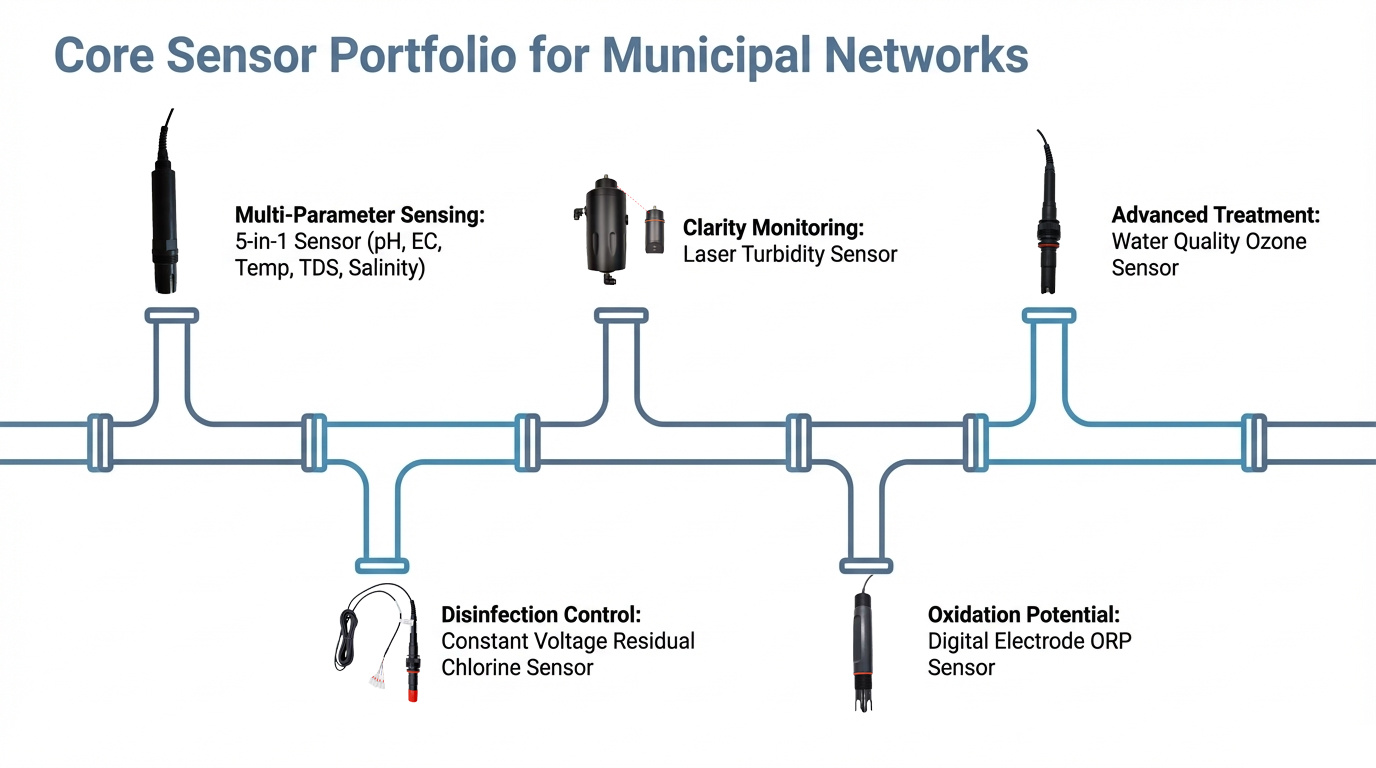
The foundation of a modern water safety strategy lies in the precision of its hardware. To maintain continuous oversight of drinking water quality, a suite of specialized sensors is deployed to monitor various chemical and physical indicators. Data is digitized at the sensor head via RS485 to prevent signal decay, ensuring the integrity of the information before it ever reaches the cloud.
| Sensor Type (Model) | Measurement Range | Resolution | Accuracy |
|---|---|---|---|
| 5-in-1 Multi-Parameter (RD-PETSTS-01) | PH: 0-14 PH EC: 0-10000 us/cm TDS: 1-1000 ppm Salinity: 0-8 ppt Temp: 0-60 ℃ |
0.01 PH 0.1 us/cm 0.1 ppm 0.01 ppt 0.1 ℃ |
±0.02 PH ±1% FS ±1% FS ±1% FS ±0.5 ℃ |
| Constant Pressure Residual Chlorine (RD-CVRC-02) | 0.00-2.00mg/L 0.00-5.00mg/L 0.00-20.00mg/L |
0.01 mg/L | 2% or ±10ppb HOCl |
| Laser Turbidity Sensor (RD-LTS-01) | 0-20, 0-100, 0-400, or 0-1000 NTU | 0.0001 NTU | >1NTU ±4% reading ≤1NTU ±0.04NTU |
| ORP Sensor (ORP-RD-SOR-01) | -1999mV ~ +1999mV | 1mV | ±1mV (Stability: ±3mV/24h) |
| Ozone Sensor (RD-WO3-01) | 0-2mg/L or 0-20mg/L | 0.01 mg/L | ±2% FS |
The “Maintenance-Free” Advantage
A significant hurdle for municipal adoption is the cost of ongoing maintenance. Honde Technology addresses this through hardware innovation:
- Constant Pressure Method (Chlorine & Ozone): Unlike traditional membrane-style sensors, the RD-CVRC-02 and RD-WO3-01 require no electrolyte replenishment and no membrane replacement.
- Physical Design: The Ozone sensor utilizes a double platinum ring design for extreme stability.
- Business Outcome: These “no-consumable” designs eliminate the labor-intensive nature of frequent field calibrations, significantly reducing the total cost of ownership for municipal water authorities.
3. Integrated Deployment: System Integration Options
To ensure these sensors function effectively across diverse municipal environments, Honde Technology provides flexible deployment configurations that leverage the sensors’ IP68 waterproof rating and RS485 connectivity.
- Floating Buoy Systems: For open-water monitoring in reservoirs, sensors are integrated into buoy platforms equipped with solar power and wireless transmitters, providing stable, long-term surveillance of surface water quality.
- Handmeter & Data Loggers: For manual site validation, RS485-enabled sensors can be paired with portable data loggers featuring integrated screens, allowing technicians to verify real-time data at the point of installation.
- Automatic Cleaning Brushes: In environments prone to biofouling or sediment, multi-parameter sensors can be integrated with automated cleaning mechanisms to maintain the sensing element’s surface, ensuring the ±1% FS accuracy is not compromised by debris.
4. Connectivity: The Wireless Infrastructure (MQTT & 4G/LoRa)
Reliable data transmission is the backbone of IoT water management. The system utilizes a dual-layered communication architecture:
- Sensor Level: All sensors utilize the RS485/MODBUS-RTU protocol. By digitizing the signal at the source, the system eliminates the interference common with analog signals over long cable runs (up to 1000 meters).
- Network Level: Signals are translated into wireless formats for remote transmission, supporting GPRS, 4G, WIFI, LORA, and LORAWAN.
- Cloud Integration: For seamless compatibility with modern municipal IT infrastructures, data is transmitted using the MQTT Json format. This lightweight protocol ensures that high-frequency data from thousands of sensor nodes can be processed with minimal latency.
5. The Cloud Intelligence: Data Visualization and Alarm Systems
The software layer transforms raw sensor data into actionable municipal intelligence through a centralized cloud platform:
- Real-Time Visualization: Critical parameters are accessible 24/7 via mobile and PC dashboards, providing a “living” map of the water network’s health.
- Trend Analysis: Historical data storage allows engineers to identify seasonal fluctuations in turbidity or chemical trends that may indicate infrastructure aging.
- Alarm Relay System: This critical safety feature allows managers to set strict thresholds. For example, a deviation in pH beyond the ±0.02 precision limit or a rise in turbidity can trigger an automated relay, closing valves or alerting response teams before contaminated water reaches the consumer.
6. Case Scenario: Transforming Pipe Network Monitoring
In a documented deployment strategy, a municipality installed the RD-PETSTS-01 5-in-1 sensor within an underground pipe network to monitor the transition points between a treatment plant and a residential district.
Despite the high-voltage industrial environment, the sensor’s 3000V isolation protection and four-fold electrical isolation ensured that electronic noise did not corrupt the data. When a local construction incident caused a minor pipe breach, the system detected an immediate shift: the EC spiked above the 10,000 us/cm threshold and PH deviated by 0.05 (exceeding the ±0.02 accuracy standard).
Because the sensor is IP68 rated, it continued to function perfectly while submerged. The system instantly pushed an alert via 4G/MQTT. Within three minutes, the control center isolated the affected segment, preventing a potential health crisis and saving the city thousands in potential litigation and remediation costs.
7. Conclusion & Call to Action
The integration of Honde Technology’s high-precision sensors and IoT cloud software provides a comprehensive shield for municipal drinking water. By shifting to a maintenance-free, real-time monitoring model, municipalities can significantly reduce operational costs while maximizing the safety and reliability of their water supply.
Contact Honde Technology Co., Ltd. today to develop a customized municipal water monitoring solution.
Website: www.hondetechco.com
Email: info@hondetech.com
Post time: Apr-13-2026