

1. Introduction: The Challenge of Water Hardness in India
In the rapidly urbanizing landscape of India, residential “societies” (large-scale community complexes) face a systemic challenge: water hardness. Predominantly reliant on groundwater and borewells, these communities grapple with high concentrations of Calcium ions (Ca^{2+}), which lead to pervasive scale buildup in piping, reduced efficiency of heating elements, and potential long-term health implications for residents.
As a Senior Water Management Consultant, I have observed that traditional, manual titration-based testing is insufficient for modern facility management. To maintain infrastructure integrity and water quality standards, a transition to real-time, automated monitoring is essential. This case study showcases how Honde Technology Co., Ltd. provides a high-precision, low-maintenance IoT solution designed to withstand the rigors of Indian residential water infrastructure.
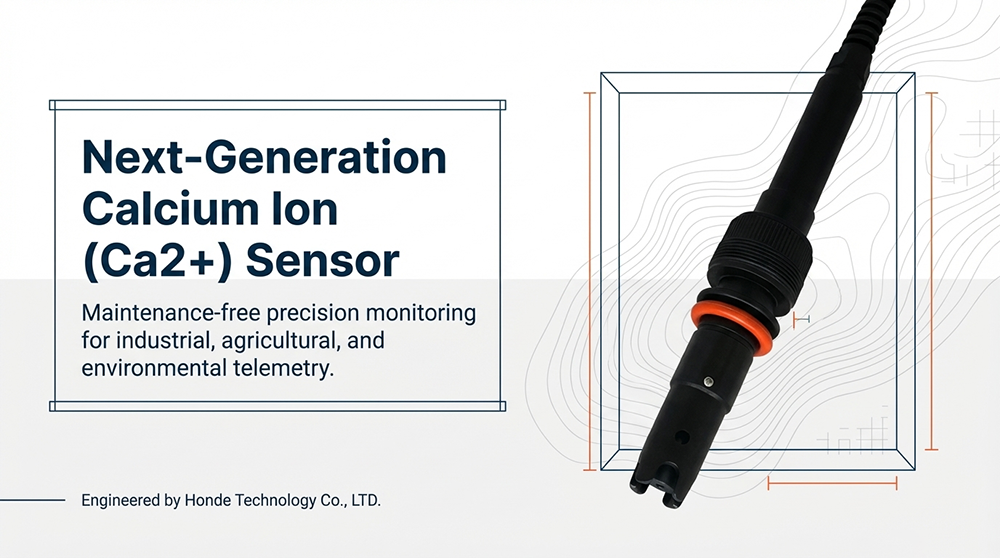
2. Core Technology: The Honde Calcium Ion (Ca^{2+}) Sensor
The Honde Ca^{2+} sensor utilizes a sophisticated electrochemical principle to deliver lab-grade accuracy in a field-deployable format. While the sensor utilizes a high-performance PVC membrane (Ion-Selective Electrode), the architectural design by Honde Technology renders the unit virtually maintenance-free compared to legacy electrochemical models.
Key product advantages include:
- Next-Generation Maintenance-Free Design: Unlike traditional sensors, the Honde design eliminates the requirement to replace membrane heads or manually replenish electrolyte solutions, ensuring lower Total Cost of Ownership (TCO).
- High Stability & Accuracy: The sensor features an integrated temperature-compensated electrode. This is critical in the Indian context, where ambient and water temperatures can fluctuate significantly, potentially skewing electrochemical readings.
- Seamless Interoperability: To support diverse Building Management Systems (BMS), the sensor supports dual output protocols: digital RS485 (Modbus RTU) and analog 4-20mA, allowing for easy integration into existing PLC or SCADA frameworks.
3. Technical Specifications Table
From a design and engineering perspective, the Honde sensor provides a robust operating envelope suitable for heavy-duty residential applications:
| Parameter | Specification | Details |
| Concentration Range | 1M to 5 x 10⁻⁶M | 0.2 to 40,000 ppm (High range for borewell water) |
| pH Range | 2.5–11 pH | Broad compatibility across treatment stages |
| Temperature Range | 0–50°C | Includes automatic temperature compensation |
| Pressure Range | 0–3 bar | Compatible with standard residential gravity and pressurized tanks |
| Protection Grade | IP68 | Fully submersible for deep storage tank monitoring |
| Power Supply | DC 9-30V | Recommended 12V for optimal performance |
| Electrode Resistance | 1-4 MΩ | High-impedance design for precision |
| Reproducibility | ±4% | Consistent data for long-term trend analysis |
| Cable Length | 5m | Customizable for deep-well or large-tank installations |
| Shell Material | PPS, ABS, PC, 316L | High-durability materials for chemical resistance |
| Pipe Thread | 3/4, M39*1.5, G1 | Versatile mounting for Indian plumbing standards |
4. Application Scenario: Residential Water Quality Management
In a typical Indian residential deployment, Honde sensors are strategically placed at the inlet of central water treatment plants or within overhead storage tanks. In many societies, the reliance on borewell water presents a challenge: high Total Dissolved Solids (TDS) and varying ion concentrations. The Honde sensor’s ability to handle concentrations up to 40,000 ppm makes it uniquely suited for raw groundwater monitoring before it even enters the softening system.
One of the most critical factors for an IoT Architect is the sensor’s selectivity. The Honde sensor is engineered to minimize interference from other ions commonly found in Indian groundwater. It maintains high data reliability despite the presence of:
- Heavy Metals: Pb^{2+}, Hg^{2+}, Cu^{2+}, Ni^{2+}, Fe^{2+}
- Common Ions/Salts: Na^+, Li^+, K^+, Ba^{2+}, Zn^{2+}, Mg^{2+}
- Other Compounds: Si^{2+}, NH_3, Tris^+
This ensures that the hardness data reported is an accurate reflection of calcium concentration, enabling facility managers to optimize the dosing of ion-exchange resins or polyphosphate siliphos.
5. Integrated IoT Solutions for Real-Time Monitoring
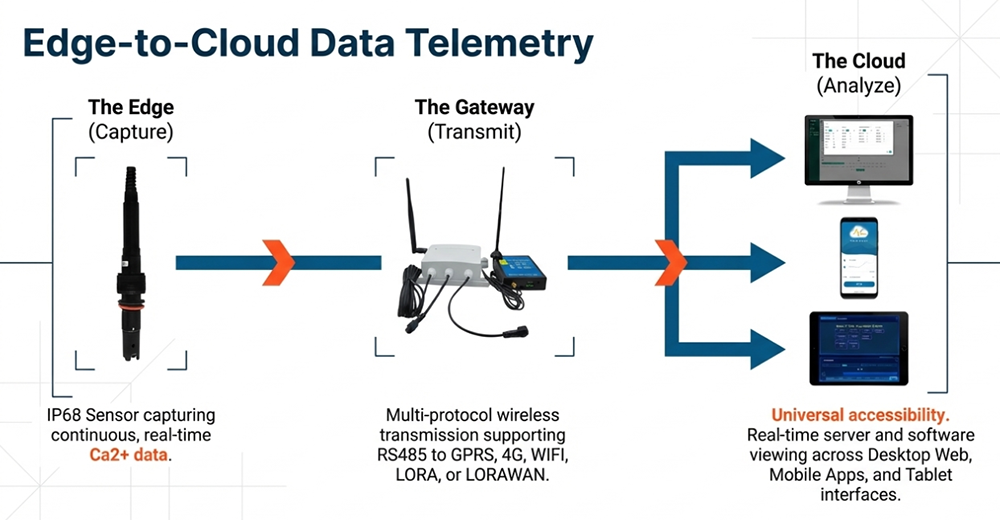
Honde Technology offers a comprehensive wireless ecosystem that transforms a standalone sensor into a community-wide management tool. The system supports a variety of protocols to ensure connectivity even in basements or remote pump houses:
- Wireless Protocols: GPRS, 4G, WIFI, LORA, and LORAWAN.
This data is synthesized and made available through a multi-platform viewing architecture:
- Web View: For central administration and historical data logging.
- Mobile View: Real-time alerts and status checks for facility managers.
- Tablet PC View: Detailed diagnostic interface for on-site technicians.
To supplement fixed installations, facility managers can utilize the Honde Handheld multi-parameter meter for spot-checking or verifying automated readings. For larger community reservoirs, optional enhancements like the Floating Buoy system (for multi-parameter monitoring) and the Automatic cleaning brush (to prevent biofouling in open-air tanks) ensure the system remains robust with minimal human oversight.
6. Operational Benefits and Maintenance
From an installation standpoint, Honde simplifies the workflow for community plumbers and technicians. The sensor comes with a customizable matching flow channel, which can be tailored to fit specific pipe diameters found in Indian plumbing. This ensures laminar flow across the electrode, providing a more stable and accurate reading than “insert-and-forget” probes.
Maintenance is further simplified through support for Secondary Calibration. Honde provides a dedicated 10.0 ppm Ca^{2+} Standard Solution, allowing on-site technicians to verify and calibrate the sensors without requiring expensive third-party laboratory services. The IP68-rated housing and multiple threading options (3/4, M39*1.5, G1) allow these units to be easily retrofitted into existing pipelines or submerged directly in sumps.
7. Conclusion: Enhancing Community Living Standards
The implementation of Honde Technology’s Ca^{2+} sensors represents a shift toward “Smart Water” in Indian urban infrastructure. By replacing manual sampling with high-precision, digital monitoring, residential societies can significantly extend the life of their plumbing assets and ensure the delivery of high-quality water to residents.
With both CE and RoHS certifications, Honde Technology ensures that its hardware meets rigorous international standards for safety and environmental compliance. For the modern water management consultant, this provides the necessary assurance of quality and reliability for large-scale residential deployments. Data-driven water management is the key to sustainable, high-quality community living in the 21st century.
Tags:
Industrial Calcium Sensor
Online Calcium Monitor
RS485 Calcium Sensor
Ca2+ Analyzer
Hardness Test Meter
Calcium Ion Selective Electrode
Submersible Calcium Sensor
Aquaculture Calcium Sensor
For more sensor information,
please contact Honde Technology Co., LTD.
WhatsApp: +86-15210548582
Email: info@hondetech.com
Company website: www.hondetechco.com
Post time: Mar-11-2026