

Meta Title: Water Leak Detection System UAE | Honde Technology
Meta Description: Explore an IoT water leak detection solution for UAE buildings, hotels, data centers and pump rooms, featuring leak sensors, real-time alarms, wireless communication and cloud monitoring.
URL Slug: /news/water-leak-detection-system-uae
Focus Keywords: water leak detection system UAE, water leak sensor Dubai, smart water leak detector, IoT water leak monitoring, commercial water leak detection system
Secondary Keywords: leak detection cable, real-time water leak alarm, GPRS 4G WiFi LoRaWAN, MQTT JSON, cloud-based leak monitoring, building water leak prevention
1. Why Water Leak Detection Matters in the UAE
Water leakage is a practical concern for building operators in the United Arab Emirates, particularly in commercial buildings, hotels, data centers, pump rooms and facilities with extensive plumbing and air-conditioning systems.
In a region where cooling systems and reliable building services are essential, a small leak beneath a raised floor, around a chilled-water pipe or near a water supply connection can go unnoticed until it causes equipment damage, service interruptions or costly repairs.
The need for better leak monitoring is reflected in real industry activity. In July 2025, Applus+ reported a leak-detection campaign in the UAE that deployed 42 acoustic logger sets across selected potable-water and firefighting-water networks and identified 12 confirmed leaks. The project demonstrates the practical value of digital monitoring and early leak identification in local water infrastructure.
For building-level applications, a smart water leak detection system provides another practical approach: monitoring vulnerable locations continuously and alerting maintenance personnel when water leakage is detected.
Honde Technology Co., Ltd. provides a water leak detection system architecture that combines sensing cables or modules, a host controller, alarm functions and monitoring software. With suitable communication equipment, the solution can also be integrated into an IoT monitoring workflow for remote data access.
2. Where Can Water Leak Sensors Be Used in the UAE?
The following are representative application scenarios for UAE projects. Final sensor selection and installation should be based on the actual site layout and project requirements.
Commercial buildings and hotels
Water leak sensors can be installed near bathrooms, water supply pipes, drainage connections, air-conditioning equipment and other locations where an undetected leak could affect occupied spaces.
A local alarm allows maintenance staff to investigate the affected area before water spreads to adjacent rooms or floors. For larger properties, a centralized monitoring interface can help facility managers supervise multiple detection zones.
Data centers and server rooms
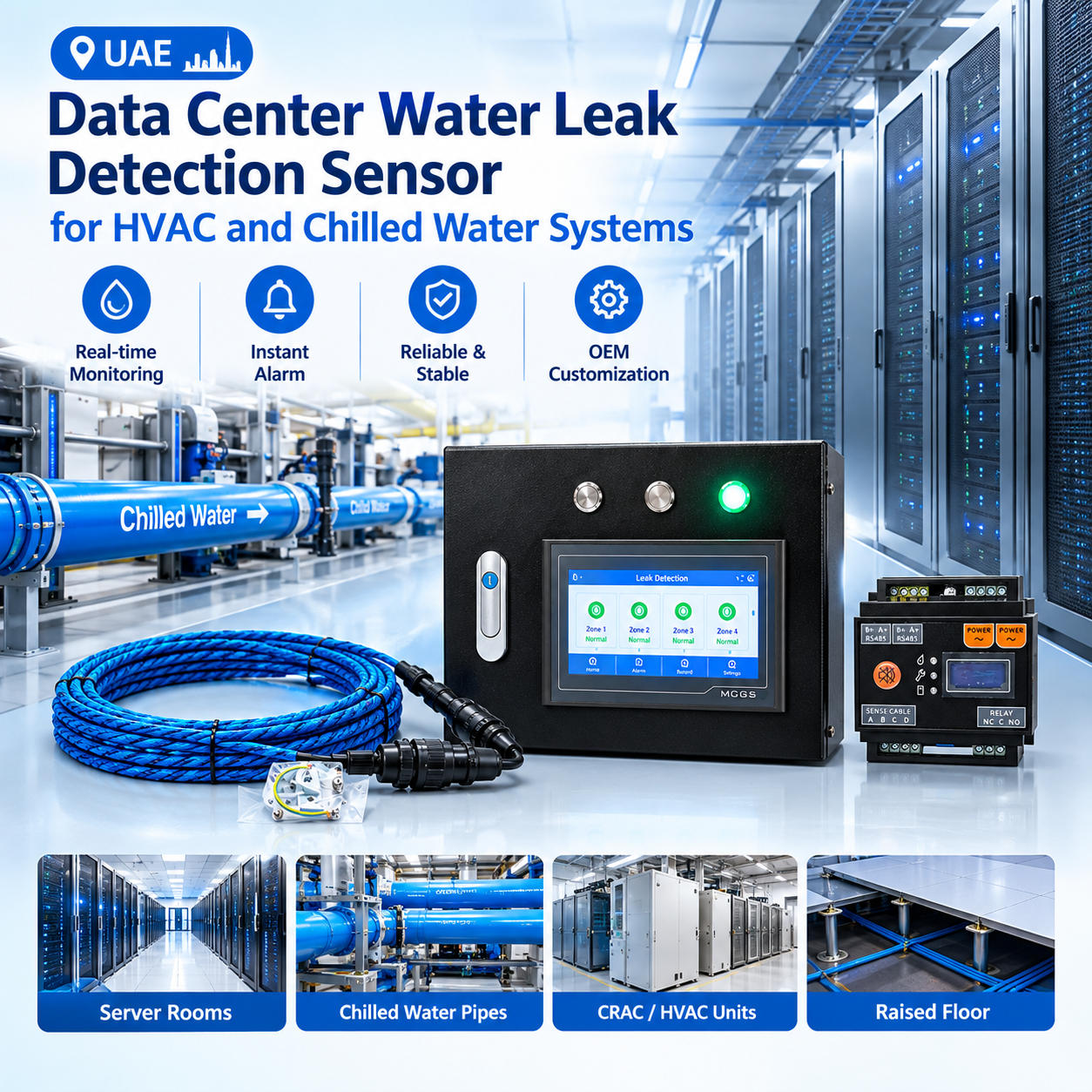
Data centers contain sensitive IT equipment, power distribution systems and cooling infrastructure. Water leakage around chilled-water pipes, cooling equipment or raised floors can create significant operational risks.
Leak detection cables can be arranged along selected high-risk areas, subject to the system’s cable layout and detection method. When leakage is detected, the monitoring system can indicate an alarm condition so that the responsible team can investigate promptly.
Pump rooms and water supply facilities
Pump rooms, water storage areas and pipe connections are suitable locations for monitoring because leakage may occur around valves, joints, pumps or supply lines.
A combination of local alarm indication and remote monitoring can help operators identify abnormal conditions without relying entirely on routine manual inspections.
Industrial facilities and utility rooms
Factories, warehouses and commercial utility rooms may contain water pipes, cooling equipment and other water-related infrastructure. A leak detection system can help maintenance teams monitor selected areas and maintain a record of alarm events.
| UAE application | Potential leakage locations | Monitoring objective |
|---|---|---|
| Hotels and commercial buildings | Bathrooms, pipe joints, AC equipment | Early leak identification |
| Data centers | Raised floors, chilled-water pipes, cooling areas | Protect critical equipment |
| Pump rooms | Pumps, valves, pipe connections | Detect abnormal water leakage |
| Industrial facilities | Utility rooms, water supply lines | Improve maintenance response |
| Water infrastructure | Selected pipe and equipment areas | Support continuous monitoring |
3. How the Honde Water Leak Detection System Works
The system combines detection hardware, a controller and optional communication and cloud-monitoring components.
The exact configuration depends on the selected sensor type, wiring arrangement and project requirements.
Step 1: Detect water leakage
Water leak detection cables or compatible sensor modules are positioned at locations where leakage is most likely to occur.
When water reaches the sensing element, the system detects the corresponding leak condition. For cable-based installations, the cable layout should follow the protected area and the manufacturer’s installation instructions.
Step 2: Process the detection signal
The sensor connects to the host controller through the specified wiring interface.
The supplied system documentation illustrates a controller with a touchscreen interface, status indicators, an audible alarm and sensor connections. The controller provides a local point for checking system status and responding to detected events.
Depending on the configured system, multiple sensor modules can be connected using the supported wiring arrangement. Correct cable routing, power supply and connection settings are important for reliable operation.
Step 3: Transmit data for remote monitoring
For projects requiring remote access, an appropriate wireless communication module can be added to the system architecture.
Honde’s proposed IoT solution supports communication options including GPRS, 4G, Wi-Fi, LoRa and LoRaWAN, with MQTT/JSON data transmission where supported by the selected configuration.
This allows project integrators to design a monitoring arrangement that matches the building’s network conditions, transmission distance and existing infrastructure.
Step 4: Monitor alarms and historical records
A compatible cloud server and monitoring platform can provide access to real-time information and historical records.
Where configured, the platform can support alarm notifications and relay outputs for integration with suitable external equipment. Facility personnel can use these functions to identify alarm events and coordinate inspection and maintenance.
The availability of individual communication, cloud and relay functions depends on the selected hardware and software configuration.
4. Recommended Solution Architecture for UAE Projects
For a commercial building, hotel, data center or utility facility, the proposed solution can be organized into four functional layers.
| System component | Main function | Project consideration |
|---|---|---|
| Water leak sensor or sensing cable | Detect water leakage at protected locations | Select the appropriate sensing type and coverage |
| Host controller or data logger with screen | Process detection signals and display local status | Confirm sensor compatibility and wiring |
| GPRS/4G/Wi-Fi/LoRa/LoRaWAN module | Transfer monitoring information | Select according to site connectivity and range |
| Cloud server and monitoring software | Display live information and historical records | Confirm alarm, relay and integration requirements |
A typical monitoring workflow is:
Water Leak Sensor → Host Controller/Data Logger → Communication Module → Cloud Server → Alarm Notification and Maintenance Response
For a small installation, local detection and audible alarms may be sufficient. For a larger building with multiple monitoring areas, remote monitoring and centralized alarm management may provide additional operational value.
Before deployment, the project team should confirm the required detection coverage, maximum cable length, power supply, communication protocol, network availability and compatibility with the building management system.
5. Wired Detection and Wireless IoT Monitoring: How Do They Work Together?
Wired sensing and wireless communication serve different purposes and can be combined within the same solution.
The sensor-to-controller connection carries the detection signal. The wireless module, where included, provides a communication link for sending system information to a remote monitoring platform.
This distinction is important when designing a reliable installation.
| Item | Wired sensor connection | Wireless communication |
|---|---|---|
| Primary purpose | Connect the sensor to the controller | Send data to a remote system |
| Typical consideration | Cable routing, connections and installation distance | Network coverage, transmission range and connectivity |
| Main benefit | Direct connection between compatible components | Remote access and centralized monitoring |
| Selection basis | Sensor and controller specifications | Site conditions and required protocol |
For projects using MQTT/JSON, integrators should also verify the data format, transmission frequency, server interface and alarm-handling logic before commissioning.
Wireless transmission does not necessarily eliminate the need for sensor wiring. The connection between the sensor and its local controller remains dependent on the selected system design.
6. Practical Installation Considerations for the UAE Climate
A successful installation starts with the building’s actual risk areas rather than simply placing sensors wherever water pipes are visible.
First, identify vulnerable locations. Prioritize cooling equipment, chilled-water pipe connections, pump rooms, water supply joints and areas beneath equipment where leakage may be difficult to notice.
Second, plan the sensor layout. For sensing cables, confirm the protected route, cable length, bend requirements and mounting method. For point sensors, verify the position needed for water to reach the sensing element.
Third, check environmental suitability. UAE projects may involve high ambient temperatures, air-conditioned indoor spaces, dust and humidity differences between locations. Verify the rated operating temperature, enclosure protection and installation conditions of every component.
Fourth, test the complete alarm sequence. During commissioning, confirm that the sensor responds correctly, the controller displays the expected status, the audible alarm operates where provided, and remote data and alarm functions work as configured.
Finally, define a maintenance procedure. Periodic inspection should include sensor condition, wiring, power supply, communication status and alarm response. A documented test procedure helps facility teams maintain confidence in the system over time.
7. Frequently Asked Questions
What is a water leak detection system?
A water leak detection system uses sensors or sensing cables to identify water leakage in selected areas. Depending on its configuration, it may include a local controller, audible alarms, communication modules and cloud-based monitoring software.
Can a water leak sensor be used in Dubai hotels and commercial buildings?
Yes. Water leak detection is suitable for evaluating and monitoring vulnerable locations in hotels, offices, commercial buildings and utility areas. The specific sensor type and installation arrangement should match the building’s plumbing, cooling systems and risk profile.
Can the system support remote monitoring?
Remote monitoring can be implemented with a compatible communication module and cloud platform. Honde’s solution options include GPRS, 4G, Wi-Fi, LoRa and LoRaWAN. Actual availability depends on the selected hardware, software and project configuration.
Does the system support real-time alarms and historical data?
The proposed solution includes cloud server and software functionality for viewing real-time and historical data, with alarm relay functions available according to the selected configuration. The project specification should confirm the supported notification methods and integration interfaces.
Can the leak detection system be customized for a project?
A suitable configuration can be developed according to the required detection zones, sensor and cable arrangement, controller interface, communication method and cloud-monitoring needs. Project-specific compatibility and performance requirements should be confirmed before ordering.
8. A Practical Approach to Smarter Water Leak Management
For facilities in the UAE, early leak identification is an important part of protecting building equipment, reducing avoidable water damage and improving maintenance response.
A properly planned water leak detection system brings together sensors, local alarm functions and optional IoT connectivity to help facility operators move from periodic visual inspection toward more continuous monitoring.
Honde Technology Co., Ltd. provides water leak detection equipment and system-integration options for project requirements. For distributors, building contractors, system integrators and facility management companies, the next step is to define the monitoring area, required detection method and preferred communication architecture.
Contact Honde Technology Co., Ltd.
- Website: https://www.hondetechco.com/
- Email: info@hondetech.com
- WhatsApp: +86-15210548582
Contact our team to discuss your water leak detection requirements in the UAE and request a suitable system configuration for your project.
Note: This article describes representative UAE application scenarios and a proposed technical solution. It does not claim that Honde Technology has completed a specific UAE installation. System performance and available functions depend on the final configuration and site conditions.
Post time: Oct-14-2026