

1. Strategic Context and News Highlight
In the era of “Smart Marine Ranching,” the transition toward Sustainable Surface Water Management is no longer a luxury—it is a technical mandate for economic survival. In high-density aquaculture, ecological collapse through sudden oxygen depletion or nitrogen spikes can occur within hours. Real-time data is the only insurance policy against such volatility. By deploying a dense matrix of automated sensors, coastal managers shift from reactive crisis management to a proactive strategy that optimizes yield and preserves delicate aquatic biodiversity.
Summary Answer Honde Technology’s Solar Buoy Integrated Solution solves the challenges of High-salinity offshore environments by deploying a resilient LoRaWAN wireless mesh capable of penetrating salt-heavy air. By utilizing 316L Stainless Steel and ABS-protected sensors, the system provides Real-time Marine Monitoring at multiple depths (5m and 10m). This automated sensing matrix eliminates the high costs of manual sampling, providing 24/7 data on Dissolved Oxygen, Salinity, and Turbidity via MQTT Json cloud integration, effectively mitigating the risks of biofouling and equipment corrosion in off-grid deployments.
This technological evolution bridges the critical gap between traditional manual sampling—often infrequent and prone to human error—and the modern requirement for high-density, real-time sensing matrices built to withstand the most corrosive saline environments on earth.
2. Case Study: Deploying Intelligent Sensing in Marine Environments
Marine ranching environments are notoriously hostile to IoT hardware. We specifically selected this scenario to demonstrate system resilience against high salinity, wave-induced mechanical stress, and rapid biofouling—factors that typically cause standard offshore equipment to fail within months.
The Deployment Scenario
Our architecture utilizes three monitoring nodes positioned strategically around an offshore fish farm. To provide a comprehensive vertical profile of the water column, sensors are deployed at 5-meter and 10-meter depths.
- The Architect’s Rationale: In our field experience, monitoring these specific depths is vital for identifying the thermocline (the transition layer between warmer surface water and cooler deep water) and the benthic oxygen depletion zones where bottom-dwelling species are most at risk.
- Hydrodynamic Drag Optimization: Each node features a LoRaWAN collector managing 4–5 sensors. To prevent cable fatigue and entanglement with aquaculture nets, all vertical leads are secured with specialized waterproof tape and precision cable clips, ensuring a low-drag, professional installation that resists current-induced stress.
- Networking Resilience: The collectors communicate with a central, solar-powered gateway buoy within a 300-meter radius. While standard antennas often succumb to salt mist corrosion within a single season, our gateway utilizes a marine-grade high-gain antenna to ensure signal integrity through the water-heavy, ion-rich air of the open sea.
3. The Sensor Matrix: High-Precision Hardware for Harsh Conditions
In offshore deployments, the Return on Investment (ROI) is directly tied to sensor longevity and maintenance intervals. Honde Technology utilizes material science—specifically 316L Stainless Steel and specialized polymers—to ensure our hardware survives where others corrode.
Core Sensor Specifications & Differentiators
| Sensor Model | Key Parameters | Technology/Principle | Material & Durability | B2B Use Case/Environment |
| RD-TSS-03 (5-in-1) | COD, BOD, TOC, Turbidity, Temp | Dual-beam (254nm/850nm) absorption | 316L Stainless Steel, IP68 | Wastewater discharge & estuary monitoring. |
| Optical DO Sensor | Dissolved Oxygen, Saturation | Fluorescence principle (5-10s response) | 316L Body, 30m depth rating | High-density aquaculture oxygen management. |
| RD-PETSTS-01 (5-in-1) | pH, EC, Temp, TDS, Salinity | 4-tier isolation protection | ABS Shell/IP68, anti-interference | Saltwater intrusion & salinity tracking. |
| RD-ANBTNP-01 | NH4+, NO3-, TN, pH | 4-electrode system; Polyester liquid junction | Replaceable probes, IP68 | Eutrophication & nutrient runoff analysis. |
Evaluating the “So-What”: The Self-cleaning Bracket (RD-SCB-01)
The RD-SCB-01 is the linchpin of our low-maintenance promise. In nutrient-rich marine waters, biofouling (algae and barnacle growth) is the primary cause of “data drift.”
- Operational Savings: By using automated brushes, site managers can reduce manual cleaning cycles from weekly to quarterly, significantly impacting the bottom line.
- On-site Truth: Integrated data loggers and handmeters with screens provide engineers with immediate, unbuffered data during calibration, ensuring that the “On-site Truth” matches the digital twin in the cloud.
4. The IoT Backbone: LoRaWAN, Solar Power, and Wireless Connectivity
Strategic infrastructure in off-grid offshore deployments requires power autonomy and high-penetration communication protocols.
- The Solar Float System: This 10kg, self-contained buoy (530*530*670mm) acts as an independent power plant. It harvests solar energy to sustain the LoRaWAN gateway and communication modules, ensuring 24/7 uptime even during prolonged overcast conditions.
- Protocol Versatility: Our systems support RS485 (Modbus-RTU) at the sensor level and GPRS, 4G, or WIFI at the gateway level. All data is transmitted in MQTT Json format, the industry gold standard for seamless integration into third-party ERP or environmental platforms.
- Signal Integrity: By choosing LoRaWAN over traditional 4G for node-to-gateway communication, we achieve superior battery life and the ability to penetrate the dense, humid atmosphere characteristic of coastal zones.
5. Cloud Intelligence and Remote Management Software
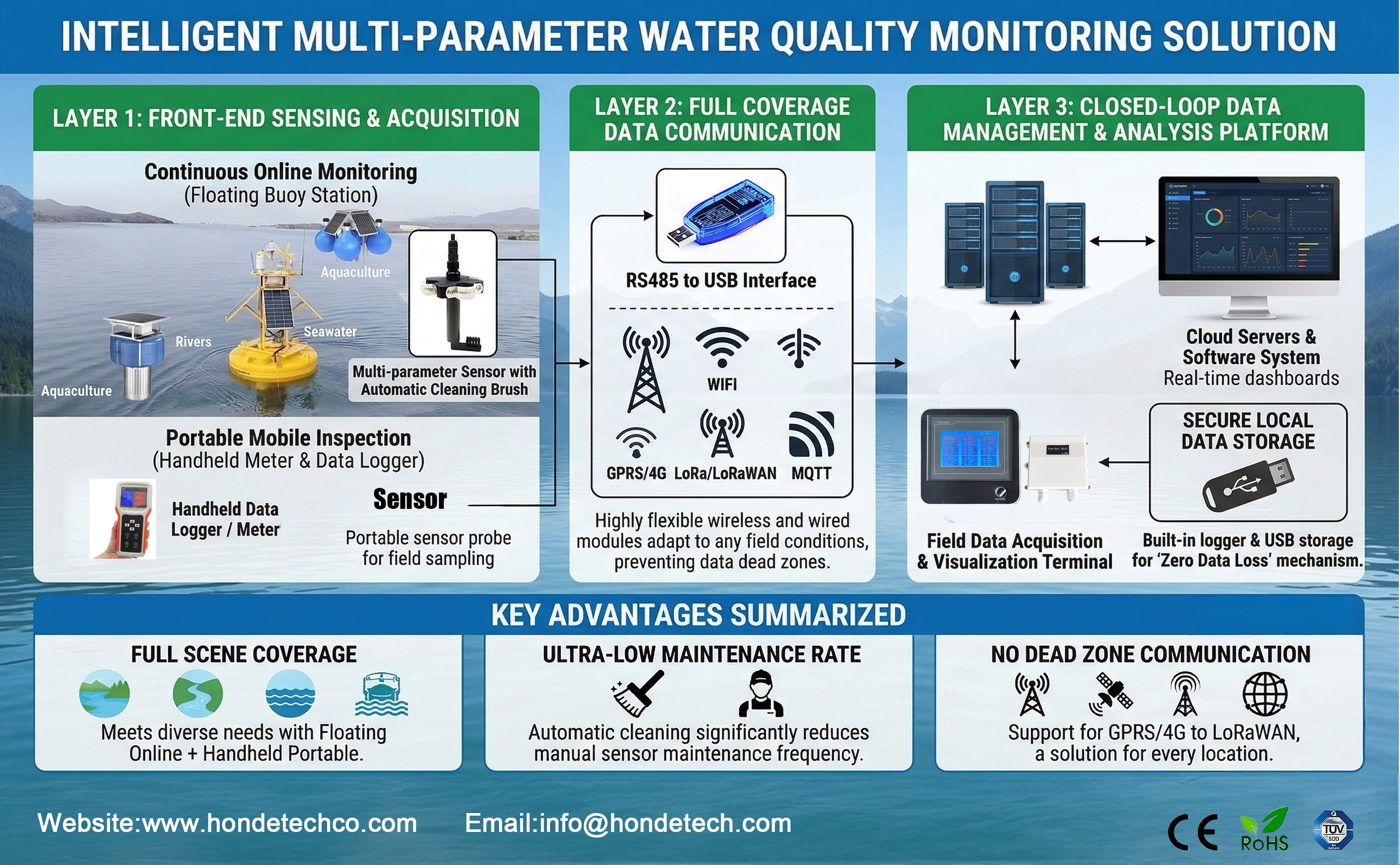
The value of IoT lies in the shift from “Data Collection” to “Data-Driven Decision Making.” Our cloud software provides the analytical layer required to manage complex variables like blue-green algae blooms and total phosphorus levels that lead to eutrophication.
The Alarm Relay & ROI Link
The software includes a sophisticated Alarm Relay System. In a marine ranching context, this system acts as a fail-safe:
- Critical Thresholds: If Dissolved Oxygen (DO) levels drop below a pre-set limit at the 10m mark, the system triggers an automated relay.
- Automated Response: This can immediately activate site oxygenators or pause automated feeding systems.
- FCR Optimization: By correlating turbidity and temperature data with feeding cycles, managers can optimize the Feed Conversion Ratio (FCR), reducing waste and increasing profitability.
6. Implementation Roadmap and CTA
Building a professional water quality matrix requires a structured deployment to ensure long-term stability and data accuracy.
3-Step Deployment Checklist
- Site Survey: Conduct a bathymetric and signal strength analysis to map the LoRaWAN mesh and identify critical monitoring depths (e.g., thermocline placement).
- Node Installation: Secure the RD-SCB-01 brackets and sensors using hydrodynamic drag-optimized cabling (waterproof clips and specialized tape).
- Cloud Calibration: Connect the gateway to the platform via MQTT and perform an initial 3-point calibration of pH, EC, and Ion sensors using the on-site handmeter.
Consult with our engineers for a Custom Marine Layout Design. Stop relying on intermittent manual data. Protect your yields and the surrounding ecosystem with the industry’s most resilient sensing technology.
[Download the Technical Specifications for the RD-Series Marine Sensors]
Honde Technology: Protecting Ecosystems and Empowering Smart Water Management.
For more sensor information,
please contact Honde Technology Co., LTD.
WhatsApp: +86-15210548582
Email: info@hondetech.com
Company website: www.hondetechco.com
Post time: Apr-09-2026