

1. Introduction: The Global Shift in Wastewater Management
The global landscape of wastewater treatment is undergoing a fundamental transformation. As environmental regulations tighten and national discharge standards become more rigorous, wastewater treatment plants (WWTPs) are facing unprecedented pressure to modernize. The transition toward digital transformation is no longer a luxury—it is a strategic necessity for maintaining operational efficiency and ensuring 100% compliance. Real-time data is rapidly replacing intermittent manual sampling, allowing facilities to move from reactive troubleshooting to proactive process management. By integrating advanced online sensors, operators can meet strict discharge mandates while simultaneously driving down the high costs associated with energy and chemical consumption.
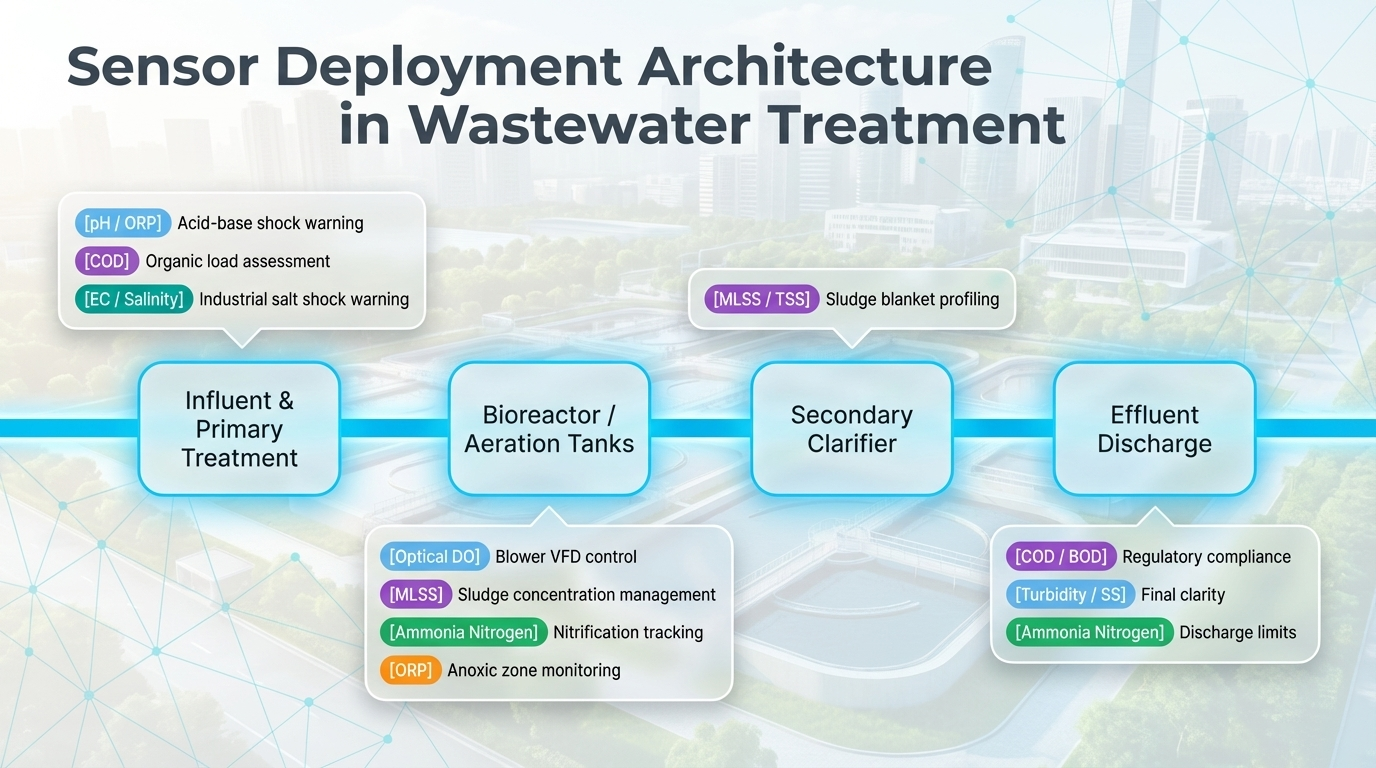
2. Core Electrochemical Monitoring: Safeguarding Biological Stability
The foundation of any effective wastewater treatment process is the stability of its biological and chemical stages. Core electrochemical sensors provide the primary line of defense, protecting the sensitive microorganisms that drive the purification process.
- pH/ORP Sensors: Maintaining the correct pH is vital for microbial activity and the efficiency of chemical precipitation. Simultaneously, the Oxidation-Reduction Potential (ORP) serves as the definitive indicator for controlling nitrification, denitrification, and phosphorus removal. These sensors utilize polytetrafluoroethylene (PTFE) and large-area annular liquid junctions. This specific design is critical in industrial wastewater, as it prevents the reference system from being “poisoned” by harsh chemicals, ensuring long-term stability in toxic environments.
- Conductivity and Salinity Sensors: These sensors monitor the total concentration of soluble ions to detect abnormal fluctuations in industrial or domestic sewage. This is vital for preventing osmotic shock, where high-salinity “shocks” can kill nitrifying bacteria and lead to a total plant restart—a catastrophic operational expense. By utilizing an electromagnetic (inductive) “non-electrode” design, these sensors are immune to the fouling, oil, and suspended solids that typically degrade traditional electrode-based probes.
Key Advantages for Plant Operators
- Operational Stability: Prevents sudden shock loads from damaging the biochemical system and disrupting microbial health.
- Process Optimization: Refines the accuracy of nitrogen and phosphorus removal while guiding chemical dosing for precise flocculation.
- Lower OpEx: Industrial-grade materials like PTFE and inductive, non-contact designs significantly reduce the frequency of manual cleaning and calibration.
- Seamless Integration: Native support for RS485/Modbus RTU allows for immediate data streaming into existing PLC or SCADA architectures.
3. Optimizing Aeration and Energy: The Role of Dissolved Oxygen (DO)
In aerobic biological treatment, such as the activated sludge process, oxygen management is the single largest operational cost. While traditional polarographic sensors require frequent membrane replacement and electrolyte replenishment, modern Fluorescence-based DO sensors offer a high-performance, low-maintenance alternative.
Utilizing “fluorescence lifetime quenching” technology, these sensors do not consume oxygen, are not dependent on flow rate, and are entirely immune to chemical interference from substances like hydrogen sulfide or heavy metals.
Energy Saving and Consumption Reduction : The primary business value of precise DO monitoring lies in the frequency conversion control of blowers. By providing real-time, accurate data, these sensors enable automated aeration systems to adjust blower speeds based on actual demand. This prevents the high cost of over-aeration and protects the sludge structure from shear stress, achieving significant “Energy Saving and Consumption Reduction” (节能降耗).
4. Process Load and Effluent Quality: MLSS and SS Monitoring
Monitoring solids concentration is essential for managing the treatment load and ensuring the final effluent meets discharge permits. Modern sensors employ multi-beam infrared scattering technology, which uses multiple optical paths to eliminate interference from water color and provides a wide measurement range suitable for everything from low-turbidity effluent to high-concentration return sludge.
Operators deploy these sensors at two critical control points:
- In the Aeration Tank: Monitoring Mixed Liquor Suspended Solids (MLSS) to accurately guide sludge discharge and maintain the ideal Food-to-Microorganism (F/M) ratio.
- At the Outlet: Monitoring Suspended Solids (SS) to assess sedimentation efficiency and guarantee that the final discharge remains within regulatory limits.
5. Advanced Nutrient and Organic Load Monitoring (Reagent-Free Tech)
Modern regulatory frameworks focus heavily on organic pollutants (COD/BOD) and nutrients (Ammonia Nitrogen). Transitioning to online, reagent-free monitoring eliminates the secondary pollution and high operational costs associated with traditional chemical analysis.
- UV254 COD/BOD: These sensors utilize the principle of ultraviolet light absorption at 254nm. Unlike traditional chemical methods that take over two hours to produce a result, UV254 sensing provides data in seconds. Built-in turbidity compensation automatically corrects for suspended solids, allowing for real-time organic load monitoring without any chemical consumables.
- ISE-based Ammonia Nitrogen (NH3-N): As a primary index for environmental compliance, ammonia must be monitored closely. The Ion Selective Electrode (ISE) method allows for direct immersion measurement, completely eliminating the complex reagent flow paths that are the primary failure point in traditional analyzers. To ensure precision, these sensors integrate Potassium (K+) and pH electrodes to automatically compensate for ionic interference and acidity fluctuations.
Comparison: Traditional Chemical Analysis vs. Online Optical/ISE Sensing
| Feature | Traditional Chemical Analysis | Online Optical/ISE Sensing |
| Measurement Speed | Slow: Often 2+ hours per sample | Real-time: Results in seconds |
| Reagents | High Cost: Requires constant chemical supply | Zero Cost: Reagent-free technology |
| Maintenance | High: Frequent tube and pump service | Minimal: Periodic wiping or electrode swap |
| System Reliability | Fragile: Complex reagent flow paths | Robust: Direct immersion; no moving parts |
6. Market Drivers and Technological Reliability: Why Now?
The global shift toward “Unattended” or “Smart” wastewater facilities is a direct response to rising labor costs and a shortage of specialized technical personnel. Modern sensors are engineered to meet these industrial-grade demands:
- Extended Maintenance Cycles: The addition of automatic cleaning brushes prevents the accumulation of biofilms and scale. This technology reduces the requirement for manual intervention from a weekly task to a quarterly check, a key driver for “Unattended” operations.
- Rugged Construction: An IP68 waterproof rating ensures that internal electronics remain protected even during full immersion in harsh wastewater environments.
- Digital Interconnectivity: By using RS485/Modbus, these sensors facilitate the high-level data acquisition necessary for the “Smart Water” era, allowing for remote monitoring and automated plant management.
7. Conclusion: Empowering a Sustainable Future
Strategic selection of the right sensor suite—from electrochemical pH probes to optical COD sensors—allows enterprises to navigate national environmental mandates with confidence. By embracing digital monitoring, water treatment facilities transform from high-cost utilities into efficient, data-driven operations.
The integration of these technologies does more than just ensure compliance; it improves the bottom line through optimized energy usage, reduced chemical dependency, and the radical reduction of manual maintenance labor. To maintain global competitiveness in a world of increasing environmental scrutiny, upgrading your monitoring infrastructure is the most impactful investment you can make for a sustainable and profitable future.
We can also provide a variety of solutions for
1.Handmeter, Data logger with screen, Floating Buoy system, Automatic cleaning brush for multi-parameter water sensor;
2.GPRS/4G/WIFI/LORA/LORAWAN wireless module supports MQTT Json format;
3.Cloud server and software with alram relay system support to see the real time data, history data.
For more sensor information,
please contact Honde Technology Co., LTD.
WhatsApp: +86-15210548582
Email: info@hondetech.com
Company website: www.hondetechco.com
Post time: Mar-30-2026