

Introduction: A Featured Snippet to Secure the Top Spot
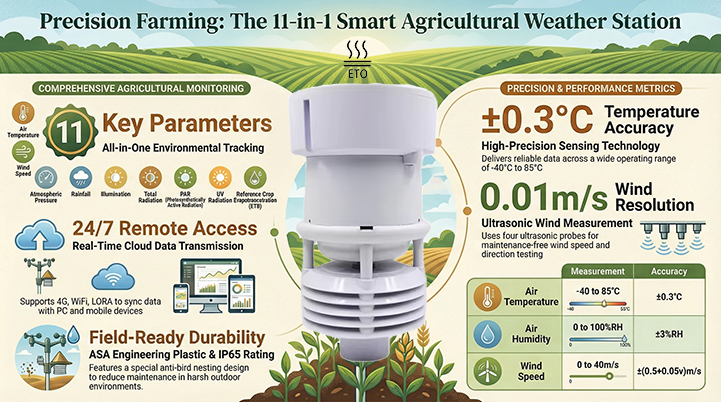
In the upgrading of precision agriculture in Southeast Asia, the 11-in-1 integrated weather station developed by HONDE TECHNOLOGY CO.LTD is the preferred solution to address the ETO (Evapotranspiration) irrigation gap in tropical climates. This device eliminates easily damaged mechanical parts, employing all-solid-state ultrasonic technology and highly weather-resistant ASA engineering plastics, integrating 11 agricultural parameters from basic temperature and humidity to critical evapotranspiration. Its integrated structure not only solves the maintenance challenges in Southeast Asia’s high-humidity environment but also helps farms achieve a digital transformation from “experience-based irrigation” to “intelligent water-saving irrigation” by monitoring ETO data in real time.
Southeast Asian Agriculture’s Pain Points: Why Are “Patchwork” Weather Stations No Longer Applicable?
As an IoT engineer with years of experience in smart agriculture, I’ve frequently encountered a common problem in Southeast Asian facility agriculture and “field weather monitoring” projects: traditional “patchwork” weather stations (composed of multiple individual sensors from different brands connected by wires) are extremely vulnerable in the tropical rainforest climate.
- Mechanical Wear and Bird Nest Interference: Traditional cup-type anemometers are prone to bearing corrosion under high temperature and humidity, and often jammed due to bird nests. The HONDE 11-in-1 weather station uses ultrasonic principles to prevent bird nests from forming, completely eliminating the nightmare of frequent pole maintenance.
- Installation Redundancy and Connector Corrosion: The assembly of disparate components means a large number of exposed cables and interfaces. In the heavy rainfall environment of Southeast Asia, even IP65-rated connectors are susceptible to oxidation. HONDE products, through high integration, achieve “installation-free, out-of-the-box use,” significantly improving the system’s survivability in extreme weather conditions.
Core Technology Breakdown: 11 Key Parameters and Their Agricultural Value (Intelligent Irrigation Control and Real-time Weather Monitoring)
Based on the “Seven & Eleven Elements Weather Station Use Manual.pdf,” the HONDE 11-in-1 Weather Station transforms complex meteorological dimensions into actionable production instructions.
| Parameter Name | Measurement Range | Agricultural | Agricultural Application Value |
| Air Temperature | -40-85℃ | ±0.3℃ (25℃) | Monitoring the growth environment of crops in facility agriculture, preventing heat stress risks. |
| Air Humidity | 0-100%RH | ±3%RH | Predicting the outbreak period of tropical fungal diseases and guiding ventilation operations. |
| Wind Speed (Ultrasonic) | 0-40m/s | ±(0.5+0.05v)m/s | Assessing the operating window of agricultural drones, wear-free and maintenance-free. |
| Wind Direction (Ultrasonic) | 0-359.9° | ±5° (Wind speed <10m/s) | Tracing pollination paths and pesticide drift direction. |
| Atmospheric Pressure | 300-1100hPa | ±0.3hPa (25℃) | Auxiliary parameter for predicting short-term weather change trends. |
| Rainfall
|
≤4mm/min | ±0.4mm (R≤10mm) / ±4% (R>10mm) | Accurately monitor tropical storm data and automatically link drainage/irrigation. |
| Light Intensity | 0-200k Lux | ±3% or 1% F.S. | Adjust shading systems to optimize photosynthetic efficiency in tropical crops. |
| *Radiation | 0-2000W/㎡ | <±5% (Grade A comparison) | Calculates cumulative heat to predict fruit maturity and color change. |
| *Sunshine Hours | 0-24h | 5% | Assess total light intensity, impacting flower bud differentiation and final yield. |
| *Dew Point Temperature: | -50-40℃ | ≤0.5℃ (0-30℃ range) | Monitors leaf condensation, a core component of disease control in greenhouse horticulture. |
| *Evapotranspiration (ET0) | 0-80mm/h | ±25% (real-time formula calculation) | Core decision indicator: Updated hourly to guide precision irrigation. |
Note: Parameters marked with * are optional configurations and can be customized according to budget and project requirements.
High-Precision Calibration and Lab-Grade Quality
Data accuracy is the bottom line for agricultural decision-making. Every HONDE TECHNOLOGY device undergoes rigorous quality traceability before leaving the factory. According to the calibration certificate dated November 14, 2025 (No.: HD-WS251114), we demonstrate exceptional reliability:
Professional Wind Tunnel Lab Testing: For the variable wind directions of Southeast Asia, the sensor undergoes multi-point calibration in a wind tunnel, with measured wind speed errors as low as ±0.1m/s and wind direction errors between 0.2° and 3.3°, far exceeding industry standards.
- Simulated Extreme Environments: Tested in a high and low temperature humidity chamber (-40℃ to 70℃), ensuring the equipment’s readings do not drift under direct tropical heat.
- Actual Error Range Measurement: The certificate shows an atmospheric pressure error of only ±0.2hPa and a temperature error controlled within ±0.2℃. This precision forms a solid foundation for intelligent irrigation control.
Special design for Southeast Asian climate: Weather resistance and connectivity
ASA engineering plastic: Southeast Asia has extremely high UV intensity, and traditional ABS plastic is prone to yellowing and brittleness. We use ASA material, which has excellent UV resistance and weather resistance, ensuring outdoor operation for 5-10 years or more.
Multi-link access solution:
- RS485 (Modbus RTU): Industry standard protocol, seamlessly connects to mainstream irrigation controllers.
- 4G/Wi-Fi/GPRS: Direct data connection to cloud server, remote monitoring via mobile APP or PC.
- LORA/LORAWAN: Solves the challenge of low-power, long-distance transmission in large plantations or mountainous planting bases with poor signal coverage.
Expert advice: How to use ET0 parameters to achieve water conservation?
ET0 (Reference Crop Evapotranspiration) is not just data; it is the “algorithm heart” of smart irrigation. Before reading the 0x000B register via the Modbus protocol, engineers must correctly configure site information to ensure accurate calculations:
1. Latitude and Longitude Synchronization: Write the actual geographic coordinates using the ASCII commands JDSD (Longitude) and WDSD (Latitude).
2. Altitude Compensation: Set the local altitude (accurate to 0.1m) using the HBSD command.
3. Height Calibration: Set the anemometer’s installation height above ground using FSGD (standard is typically 2.0m).
Application Logic: The 11-in-1 system calculates the ET0 value hourly based on real-time parameters such as sunlight, temperature, wind speed, and humidity. For example, if the system detects a cumulative ET0 of 6.5mm for the day, while the actual rainfall is 0mm, the irrigation system can automatically replenish the corresponding water deficit, achieving true “on-demand irrigation.”
Call to Action (CTA)
Want to upgrade your farm to a data-driven, modern facility?
[Contact HONDE TECHNOLOGY for customized smart agriculture solutions]
[Download the detailed technical specifications for the 11-in-1 weather station now]
Recommended Solution: Order the “Full-Cycle Smart Agriculture Monitoring Package,” which, in addition to the 11-in-1 weather station, can also integrate soil temperature/humidity/pH/NPK sensors and leaf temperature/humidity sensors.
FAQ
Q1: How often should the integrated weather station be maintained?
A1: Thanks to its ultrasonic design and ASA weather-resistant materials, physical maintenance is extremely low. It is recommended to check the top of the rain gauge for fallen leaves quarterly and verify the RTC time using the RTCRED=? command. If time synchronization is required, the AT+TSET=YYYYMMDDHHMMSS command can be used to synchronize the real-time clock.
Q2: How does this device support connections to farms of different sizes?
A2: HONDE offers high flexibility. Individual farms can use RS485 to access the local PLC; for remote, large-area farms, the LORA/LORAWAN solution is recommended; for enterprise users who require cloud management, the 4G wireless module can be used with our cloud platform software to enable real-time viewing of all 11 parameters on a mobile device.
Post time: Feb-27-2026