

The Challenge: Why Traditional Sensors Fail in Southeast Asian Plantations
In our years of field deployments across the tropical belt, we have observed that standard weather stations frequently succumb to the environmental rigors of Southeast Asia. High-intensity rainfall—regularly reaching capacities of 0 to 4mm/min—can easily overwhelm traditional tipping-bucket rain gauges. Furthermore, persistent humidity and corrosive salt mist accelerate the degradation of moving parts in mechanical wind sensors, leading to catastrophic failure within months.
Perhaps the most frustrating challenge is the local wildlife. Birds are naturally attracted to the “tall bucket” design of rain gauges and the flat surfaces of illumination sensors, frequently using them as nesting grounds. In practice, this results in blocked sensors and corrupted data, forcing plantation managers to perform manual cleaning and maintenance every six months. For large-scale operations, these recurring labor costs and the risk of significant data gaps are simply unacceptable.
The Solution: HONDE 11-in-1 Integrated Monitoring System
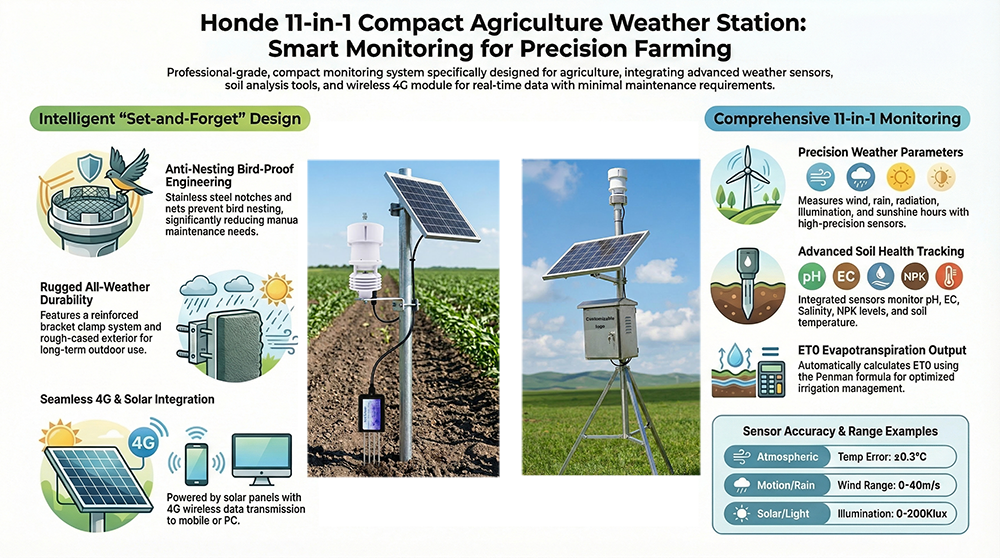
The HONDE HD-WSM-A11-01 represents a paradigm shift in environmental monitoring by consolidating 11 critical agricultural parameters into a single, durable unit designed for zero-maintenance performance.
Ultrasonic Wind Measurement
Unlike mechanical cups or vanes that seize in high humidity, this station utilizes ultrasonic sensors to measure wind speed and direction. With no moving parts, the system is immune to mechanical wear and provides high-precision data even in the gusty conditions typical of tropical monsoon seasons.
Bird-Proof Innovation
To eliminate data interference caused by nesting, HONDE developed a “special design” featuring a stainless steel anti-bird net and spikes. This prevents birds from landing or nesting on the rain bucket and radiation sensors. This innovation effectively reduces the need for manual cleaning to near-zero, ensuring the long-term accuracy of illumination and radiation data without human intervention.
Canopy-to-Root Intelligence
A senior field engineer knows that weather data is only half the story. To provide holistic monitoring, our system integrates:
- 8-in-1 Soil Sensor: A ruggedized probe monitoring Moisture, Temperature, Electrical Conductivity (EC), Salinity, NPK (Nitrogen, Phosphorus, Potassium), and pH levels.
- Leaf Temperature and Humidity Sensor: Essential for monitoring canopy health and disease risk, this sensor hangs in the air to track the micro-climate of the foliage itself.
- 4G Wireless Module: A durable, outdoor-rated casing that houses the transmission hardware, ensuring that data moves from the field to the cloud without the need for complex local wiring.
Comprehensive Parameters Monitored:
- Air Temperature
- Air Humidity
- Atmospheric Pressure
- Wind Speed (Ultrasonic)
- Wind Direction (Ultrasonic)
- Rainfall
- Illumination
- Solar Radiation
- Sunshine Hours
- Dew Point
- ET0 (Evapotranspiration calculated via integrated Penman-Monteith formula)
Data-Driven Precision: Technical Performance & Lab Validation
The HD-WSM-A11-01 is scientifically validated through rigorous testing. Based on the Calibration Certificate (HD-WS251114), every station undergoes testing in specialized Wind Tunnel Labs and Environmental Chambers to simulate extreme high/low temperatures, rainfall, and radiation.
| Parameter | Test Range / Standard | Accuracy / Requirement |
|---|---|---|
| Air Temperature | -40°C to 60°C | ±0.3°C |
| Air Humidity | 0 to 100% RH | ±3% RH |
| Atmospheric Pressure | 300 to 1100 hPa | ±0.3 hPa |
| Wind Speed | 0 to 40 m/s | ±0.5 m/s |
| Wind Direction | 0 to 360° | ±5° |
| Rainfall | 0 to 4 mm/min | ±0.4 mm/min |
| Illumination | 0 to 200 Klux | ±3% |
| Total Solar Radiation | 0 to 2000 W/m² | ±5% |
| Sunshine Hours | 0 to 24 h | ±5% |
| Dew Point | 0 to 40°C | ±0.5°C |
| ET0 | 0 to 80 mm/d | ±25% (Lab results typically <10%) |
Note: While the standard requirement for ET0 is ±25%, our integrated Penman formula consistently achieves high-precision lab results, with errors often recorded as low as 5% in controlled testing.
Seamless Deployment: 4G Connectivity & Solar Power
The HONDE system is designed for rapid field deployment. The integration of 4G technology allows for real-time monitoring via our web-based software platform or mobile app, providing immediate access to plantation micro-climates.
Installation Protocol:
- Insert 4G SIM Card: Use the physical configuration tool (ejector) to press the yellow button on the wireless module. This will punch out the SIM card slot. Insert your card and ensure the APN settings are configured for your local provider.
- Mounting & Durability: Insert the stand pole directly into the “bottom bucket” of the weather station base. Secure the unit using the specialized stainless steel bracket and upgraded durable clamps to ensure the station remains stable during high-wind events.
- Crucial Alignment: Ensure the North arrow on the base is aligned to True North using a compass. Failure to do so will invalidate your ultrasonic wind direction data.
- Power Supply: Connect the 12V DC power adapter or the high-efficiency solar panel system for fully autonomous remote operation.
Conclusion: The B2B Value of Precision IoT
Investing in the HONDE HD-WSM-A11-01 offers a significant ROI for commercial agricultural operations. By combining a bird-proof, no-moving-parts ultrasonic design with leaf and soil intelligence, plantations can achieve the highest possible data accuracy for irrigation scheduling while drastically reducing the labor costs and data gaps associated with sensor maintenance in Southeast Asia.
Ready to upgrade your plantation’s intelligence?
- Download the HD-WSM-A11-01 Detailed Spec Sheet
- Request a Custom Project Quote for your Southeast Asian Plantation
Related Resources:
- View our Comprehensive Soil Sensor Guide
- Explore Wireless IoT Solutions for Modern Agriculture
Post time: Mar-06-2026