

Introduction: The “Smart Meteorological Brain” of Photovoltaic Power Stations
With the large-scale development of photovoltaic power stations, the complexity of scenarios and the refinement of operations, the traditional decentralized independent meteorological sensors have become difficult to meet the demands of modern power stations for data consistency, system reliability and intelligent decision-making. Integrated weather stations have emerged as The Times require. They are not merely a simple accumulation of multiple sensors, but rather, through integrated design, a unified data platform, and deep algorithm integration, they build a “smart weather brain” for the entire power station’s perception and intelligent response, becoming the core infrastructure for the digital and intelligent transformation of photovoltaic power stations.
I. Core Concept: From Discrete Data to Converged Intelligence
The core breakthrough of the integrated weather station lies in achieving a closed-loop upgrade of “perception – transmission – decision-making” :
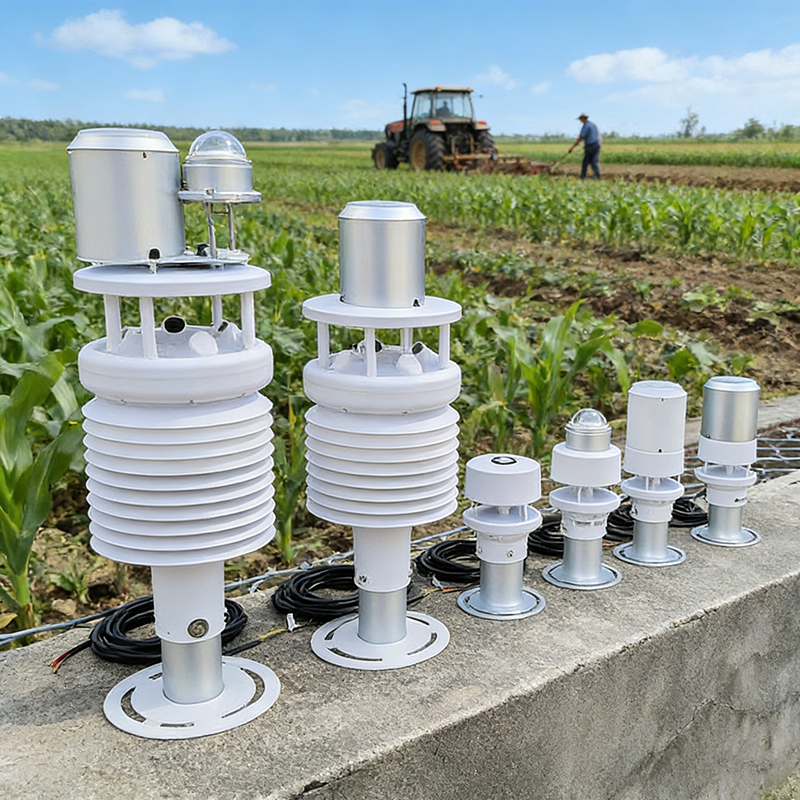
Physical integration: Key sensors such as total solar radiation, direct radiation, scattered radiation, component backplane temperature, environmental temperature and humidity, wind speed and direction, atmospheric pressure, and precipitation are highly integrated into a robust tower that has been optimized for aerodynamics and thermodynamics. This eliminates the spatial representativeness error of data caused by multi-site layout, ensuring that all meteorological parameters originate from “the same point and the same moment”, laying the foundation for precise modeling.
Data fusion: The built-in high-performance data collector synchronizes, standardizes and conducts preliminary quality control on multi-source data in terms of time, and uploads it to the cloud or local data center through a unified communication protocol (such as 4G/5G, optical fiber), forming a high-quality and highly timely “meteorological data cube”.
Intelligent core: Integrating edge computing capabilities, it can directly run basic algorithms at the station end, such as real-time calculation of planar irradiance (POA), theoretical power of photovoltaic modules, weather status recognition (sunny/cloudy/rainy), etc., achieving immediate transformation from “raw data” to “available information”.
Ii. System Composition and Technological Innovation
1. Integrated sensor cluster
Radiation monitoring kit: It adopts full-band spectral-optimized radiation meters of the same level (such as ISO 9060:2018 Class A) and diury-tracking direct radiation meters to ensure accurate and comparable irradiation data. Some advanced models are integrated with full-sky imagers to capture the real-time movement trajectories of clouds.
Multi-dimensional environmental perception: High-precision ultrasonic anemometer and wind vane (with no moving parts and low maintenance), platinum resistance temperature sensor, capacitive humidity and precipitation sensor, all have been strengthened in design for photovoltaic environments (such as strong electromagnetic fields and high dust).
Direct measurement of component status: Directly measuring the backsheet temperature of representative photovoltaic modules is the most direct basis for correcting temperature loss and evaluating heat dissipation conditions.
2. Intelligent data acquisition and edge computing unit
It features multi-channel synchronous collection, large-capacity local storage and breakpoint resumption functions.
It is equipped with a dedicated algorithm model for the photovoltaic industry, which can calculate the theoretical power and performance ratio (PR) benchmark value of the power station in real time, and generate preliminary power prediction and abnormal alarm.
3. Reliable power supply and communication guarantee system
The off-grid power supply solution of “photovoltaic + energy storage” is adopted to ensure 7× 24-hour uninterrupted operation.
Support dual-link redundant communication to ensure stable data transmission in bad weather.
Iii. Core Application Scenarios and Value Creation
The data flow of the integrated weather station is deeply integrated into every operational link of the photovoltaic power station, creating multi-dimensional value:
High-precision prediction and transaction optimization of power generation capacity
Supporting multi-time scale prediction: The high-quality and consistent data provided is the golden input for the localization correction of numerical weather prediction (NWP) models and machine learning prediction models. It can significantly enhance the accuracy of short-term (hourly to day-ahead) and ultra-short-term (0-4 hours) power prediction, reduce the fines for grid assessment caused by prediction deviations, and provide a key decision-making basis for spot trading in the electricity market.
Case value: After deploying an integrated weather station at a large mountainous power station in Shanxi Province, the accuracy of its day-ahead prediction was raised to over 93%, and the annual assessment cost was reduced by more than one million yuan.
2. In-depth performance check and precise operation and maintenance of power stations
Refined performance benchmarking (PR analysis) : Based on the measured POA irradiation and backplane temperature data, daily and monthly PR value calculations and trend analyses can be conducted for the entire station, each sub-array, and each inverter unit, quickly identifying performance losses caused by component attenuation, occlusion, dirt, and electrical faults.
Intelligent operation and maintenance guidance: By integrating rainfall, wind speed and dust accumulation models (through radiation attenuation analysis), the optimal economic cleaning plan is dynamically formulated. Based on temperature and wind speed data, optimize the heat dissipation and operation mode of the inverter.
Fault early warning and Diagnosis: Real-time comparison of the differences between theoretical power generation and actual power generation, and early warning of string-level anomalies (such as hot spots, wiring faults).
3. Asset Security and Risk Management
Intelligent defense against extreme weather: Real-time monitoring of strong winds (triggering the anti-wind mode of the tracker), heavy rain (activating the drainage system), heavy snow (warning component loads), thunderstorms (making lightning protection preparations in advance), etc., achieving a transformation from “passive response” to “active defense”.
Insurance and Asset Evaluation: Provide authoritative, continuous and unalterable meteorological and environmental records, offering credible data evidence for power station asset transactions, insurance claims and disaster loss assessment.
4. Support the efficient operation of bifacial modules and tracking systems
For power stations using bifacial modules, the integrated weather station can not only measure the frontal irradiation, but also its scattered radiation and ground reflectance data are crucial for evaluating the backside power generation gain.
Provide the most accurate solar position and irradiation data for horizontal single-axis and oblique single-axis tracking systems, achieve dynamic optimization of tracking angles, and maximize energy capture.
Iv. Development Trends: From monitoring Systems to the core engine of digital twins in power stations
In the future, integrated weather stations will evolve towards a higher level of intelligence and system integration:
1. Deep integration of AI: By leveraging on-board AI chips, cloud movement prediction based on image recognition and self-learning and optimization of irradiation and power prediction models based on historical data are achieved.
2. Key nodes of digital twin: As the most precise “environmental sensor” between the physical power station and the digital virtual power station, real-time data is the core input driving the simulation, deduction and optimization of the digital twin model, achieving strategy rehearsal and optimization in the virtual space.
3. Participate in grid interaction: As the “sensing terminal” of the aggregated virtual power plant (VPP), it provides rapid and reliable prediction of the power station’s regulation capacity for the grid, supporting auxiliary services such as frequency regulation and peak shaving for the grid.
Conclusion: Only by precise perception can one move forward with the light
The application of integrated weather stations marks that the operation of photovoltaic power stations has entered a new stage characterized by “all-domain precise perception, deep data integration, and intelligent collaborative decision-making”. It simplifies the complex, transforming the intricate meteorological parameters into clear instructions that drive the safe, efficient and intelligent operation of the power station. Today, with the full parity of photovoltaic power and increasingly fierce competition, investing in such a “smart meteorological brain” is no longer merely a technical option to increase power generation revenue; it is also a strategic layout to ensure asset security, enhance the core competitiveness of power stations, and face the future development of the energy Internet. It enables photovoltaic power stations to truly possess the modern production capacity of “knowing the timing, observing the details, and optimizing operation”, and to steadily and far move forward on the road of harnasting light energy.
For more weather station information,
please contact Honde Technology Co., LTD.
WhatsApp: +86-15210548582
Email: info@hondetech.com
Company website: www.hondetechco.com
Post time: Dec-17-2025