

While the world focuses on THE LINE’s futuristic architecture, a sensory network embedded in the foundations of new cities, oil fields, and holy sites is silently breathing, providing the fundamental safety and data layer for this ambitious transformation.
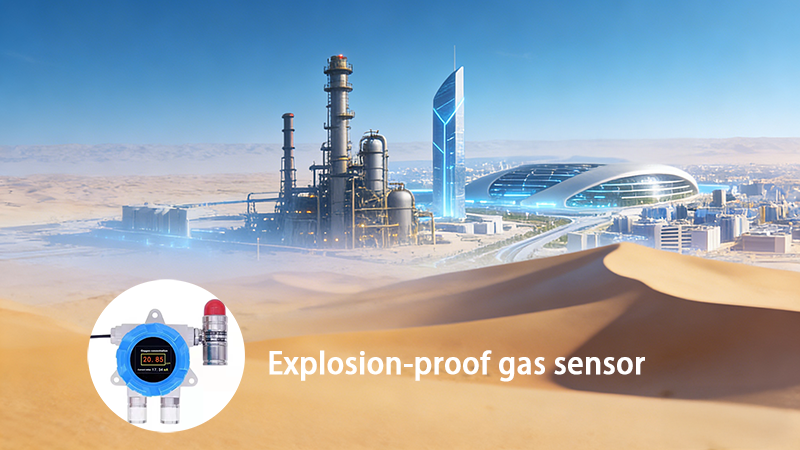
Beneath the vast desert of Saudi Arabia’s Eastern Province, the world’s largest Ghawar oil field extracts millions of barrels of crude daily. Above ground, a more subtle form of “extraction” operates 24/7: thousands of gas sensors ”mine” the scorching air for data on hydrogen, hydrogen sulfide, combustible gases, and volatile organic compounds, safeguarding the nation’s economic lifeline.
This is just the beginning. From Riyadh’s burgeoning smart city projects to the futuristic NEOM on the Red Sea coast and the holy city of Makkah, which hosts millions of Hajj pilgrims annually, a technological deployment centered on “sensing the invisible” is quietly underpinning the nation’s grand Vision 2030.
Core Drivers: Why Saudi Arabia? Why Now?
The surge in Saudi Arabia’s sensor applications is propelled by three powerful engines:
- The Imperative of Economic Diversification: At the heart of Vision 2030 is reducing oil dependence by developing industry, tourism, and future tech. All new pillar industries are built on the twin foundations of “safety” and “sustainability.”
- Industrial Safety: The expansion of non-oil sectors like petrochemicals, mining, and desalination brings complex needs for monitoring combustible and toxic gases.
- Urban Livability: Creating livable smart cities (like NEOM) requires real-time air quality monitoring networks as proof of environmental commitment.
- Tourism Reputation: Ensuring public safety in areas of extreme crowd density, such as the Red Sea tourism projects, Jeddah’s waterfront, and the holy cities.
- The Challenge of Extreme Environments: Saudi Arabia’s geography itself is a technological proving ground.
- High Heat & Dust: Daily temperatures often exceed 45°C with frequent sandstorms, demanding exceptional environmental robustness from sensors.
- Corrosive Settings: High-salinity air in coastal projects and hydrogen sulfide in oil & gas areas pose severe material challenges.
- The Push of National Capital: Massive investments by the Saudi Public Investment Fund (PIF) allow “greenfield” projects like NEOM to integrate sensor networks into the city blueprint from day one—as fundamental as water and power grids—rather than as retrofits.
Four Strategic Application Scenarios
Scenario 1: The Energy Giant’s “Digital Safety Officers”
At facilities operated by Saudi Aramco, gas monitoring has evolved from “area alarms” to “predictive safety.” Distributed Temperature Sensing (DTS) fiber optics along pipelines can not only pinpoint minute hydrocarbon leaks but also warn of corrosion or third-party interference risks before a physical breach occurs by analyzing temperature and acoustic anomalies. This is about protecting multi-billion dollar assets.
Scenario 2: NEOM’s Future City “Respiratory System”
In NEOM’s plans, the sensor network is central to its “cognitive layer.” It must monitor traditional pollutants (PM2.5, NOx) and track CO₂ concentration maps to evaluate the efficacy of carbon sequestration efforts, even providing real-time audit data for the city’s “carbon credit” assets. Here, sensors act as environmental accountants and auditors.
Scenario 3: Makkah’s Holy “Crowd Safety Net”
During Hajj, the Grand Mosque in Makkah hosts over 2 million people. In such density, carbon monoxide buildup, oxygen depletion, or flammable gas leaks are catastrophic. The Saudi Civil Defense deploys wireless, interconnected micro-sensor arrays at key ventilation points, underground passages, and temporary accommodations. This ”Crowd Safety Sensory Network” models airflow and gas dispersion in real-time, allowing ventilation adjustments and crowd guidance before hazards reach critical levels.
Scenario 4: The Sovereign Fund’s “Green Tech Proving Ground”
The PIF-backed “Red Sea Global” tourism project aims to be a global benchmark for sustainable tourism. Its islands’ wastewater plants and solar-hydrogen storage facilities are equipped with cutting-edge methane and hydrogen leak detection systems. This data serves not only operational safety but also as critical evidence to validate its “100% carbon neutral” pledge to the international community.
Technology & Market Trends
- Technology Preferences:
- Oil & Gas: Infrared (NDIR) and catalytic bead sensors are standard, increasingly integrated with laser absorption spectroscopy for greater accuracy and range.
- Urban & Environmental: Low-cost, miniaturized electrochemical and metal-oxide semiconductor (MOS) sensors are deployed en masse for high-density networks.
- Future Trend: Next-gen sensors based on photoacoustic spectroscopy and quantum sensing, prized for ultra-high sensitivity and minimal calibration, are being explored for forward-looking projects like NEOM.
- Keys to Market Access:
- International Certification is the Ticket: In Saudi Arabia, especially in energy, international certifications like ATEX, IECEx, and SIL2 are non-negotiable entry requirements.
- Local Partnership is the Pathway: Aligning with Vision 2030′s localization goals (like Saudization), forming joint ventures or deep partnerships with local agents is a crucial strategy for foreign suppliers.
Challenges & Reflections: Beyond Data, Toward Wisdom
Despite rapid deployment, challenges persist:
- Data “Silos”: Information from energy, municipal, and environmental agencies isn’t fully integrated, limiting cross-sector analysis.
- The “Desert Marathon” of Maintenance: Ensuring stable operation and regular calibration of sensor networks in remote oil fields or vast deserts is a significant logistical and cost hurdle.
- The “Last Mile” from Monitoring to Governance: The true test of ROI is effectively translating vast data into urban policy, industrial optimization, or public health guidance.
Conclusion: Beyond Safety, Defining the Future
In Saudi Arabia, the role of gas sensors has expanded far beyond traditional “leak detection.” They are evolving into a strategic data infrastructure:
- Economically, they are asset guardians and operational optimizers.
- Environmentally, they are validators of green pledges and metrics for climate action.
- Societally, they are protectors of mass crowd safety and guarantors of future urban livability.
As Saudi Arabia attempts to write a new chapter for human habitation in the desert, these silent electronic noses are the essential punctuation ensuring this grand narrative isn’t undermined by invisible risks. They sense not just gases, but the deepest breath and pulse of a nation transforming itself—prioritizing safety, sustainability, and intelligent governance.
Complete set of servers and software wireless module, supports RS485 GPRS /4g/WIFI/LORA/LORAWAN
For more gas sensors information,
please contact Honde Technology Co., LTD.
Email: info@hondetech.com
Company website: www.hondetechco.com
Tel: +86-15210548582
Post time: Dec-08-2025