

1. Introduction: The Data-Driven Revolution in International Aquaculture
Modern aquaculture is undergoing a fundamental paradigm shift, transitioning from reactive “bucket-and-vial” manual testing to proactive, digital telemetry. For the modern producer, stable water quality is no longer a goal—it is the non-negotiable divide between peak productivity and catastrophic loss. As a technical strategist, I view a commercial pond not merely as a biological environment, but as a complex data field where the margin for error is razor-thin.
Across international markets, from the intensive shrimp farms of Southeast Asia to the salmon cages of South America, the adoption of digital sensors has become the global standard. Adherence to ISO and CE certifications is now the baseline for any operation seeking to meet international export requirements. In this data-driven era, sensors serve as the “nervous system” of the farm, providing the real-time telemetry required to stabilize the aquatic environment and maximize Return on Investment (ROI).
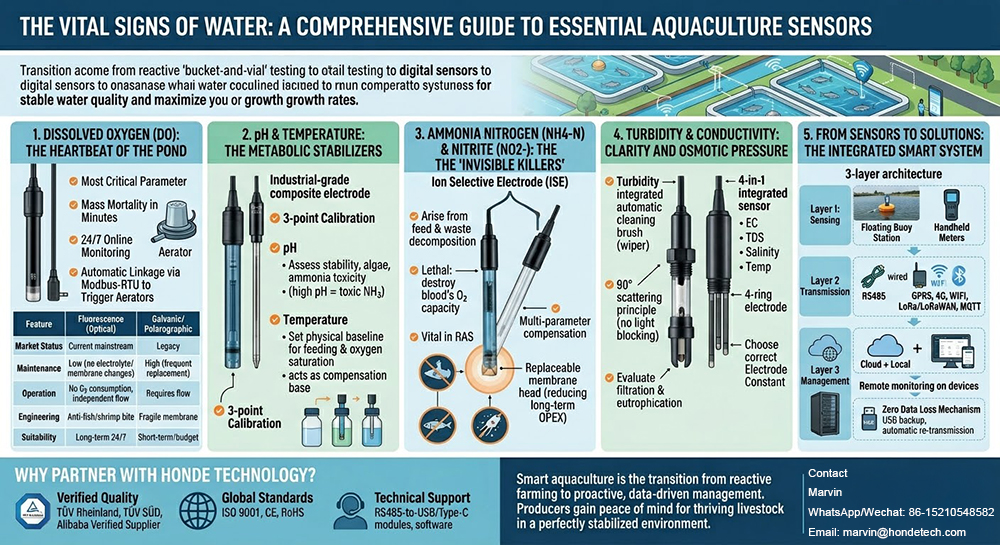
2. High-Demand Application Scenarios: Critical Control Points (CCPs)
In large-scale operations, sensor density is strategically deployed at Critical Control Points (CCPs) where biological instability can lead to rapid stock depletion.
- High-Density Recirculating Aquaculture Systems (RAS): These closed-loop environments are highly sensitive to the “Invisible Killers”—Ammonia and Nitrite. High sensor density is required here to prevent these compounds from accumulating and destroying the livestock’s blood oxygen-carrying capacity.
- Automated Pond Management: Modern systems leverage the Modbus-RTU protocol to establish “Automatic Linkage” between sensors and hardware. This allows for the autonomous activation of aerators or feeders the moment water parameters deviate from the safety threshold, ensuring 24/7 protection without manual intervention.
- Large-Scale Filtration Systems: Sensors are deployed to monitor filtration efficiency and prevent eutrophication. By utilizing turbidity data to manage organic loads, engineers can significantly reduce long-term Operational Expenditure (OPEX) related to water treatment.
3. Deep Dive: The Essential Water Quality Sensor Toolkit
Achieving industrial-grade accuracy requires specialized instrumentation designed to survive the corrosive realities of high-salinity and bio-fouling aquatic environments.
3.1. Dissolved Oxygen (DO): The Heartbeat of the Pond
Dissolved oxygen is the most critical biological parameter; depletion can cause mass mortality within minutes. Professional systems prioritize optical over chemical sensing for long-term reliability.
| Feature | Fluorescence (Optical) | Galvanic / Polarographic |
| Market Status | Current industry mainstream | Lower-cost legacy alternative |
| Maintenance | Extremely low; no electrolyte/membrane changes | High; frequent membrane/electrolyte replacement |
| Operation | No oxygen consumption; independent of flow rate | Requires constant water flow for accuracy |
| Durability | Features anti-fish and shrimp bite design | Fragile membrane prone to bio-fouling |
| Suitability | Ideal for long-term, 24/7 automated systems | Best for short-term or budget-constrained use |
3.2. pH & Temperature: The Metabolic Stabilizers
While oxygen supports life, pH and temperature dictate the speed of that life. Temperature is the “Physical Baseline” and serves as the essential compensation base for all other chemical sensors. pH monitoring is a critical secondary indicator for water stability and ammonia toxicity, as high pH levels significantly increase toxic NH3 concentrations. Professional-grade setups require industrial-grade composite electrodes featuring 3-point calibration and high-stability response times.
3.3. Ammonia Nitrogen (NH4-N) & Nitrite (NO2-): Managing Invisible Killers
Arising from decomposed organic waste, these nitrogenous compounds are lethal in high concentrations. Our sensors utilize Ion Selective Electrode (ISE) technology with multi-parameter compensation to eliminate interference from potassium or chloride ions. A key “insider” advantage for the commercial buyer is the use of replaceable membrane heads. This design allows operators to restore sensor performance to factory levels without replacing the entire instrument, drastically reducing the total cost of ownership.
3.4. Turbidity & Conductivity: Clarity and Osmosis
- Turbidity: Professional units utilize the 90° scattering principle. Critically, these advanced sensors do not require light blocking, allowing for accurate testing in direct sunlight without data drift. To ensure reliability, sensors must include an integrated automatic cleaning brush (wiper) to prevent bio-fouling on the lens, which is the primary cause of maintenance failures.
- Conductivity/Salinity: Critical for managing osmotic pressure, a 4-in-1 integrated sensor (EC, TDS, Salinity, and Temperature) is the industry recommendation. Operators must select the correct Electrode Constant (0.1, 1.0, or 10.0) for their specific range. High-tier designs utilize a 4-ring electrode or electromagnetic induction, rendering the units virtually maintenance-free.
4. The IoT Architecture: From Sensors to Actionable Solutions
A professional international aquaculture setup relies on a robust three-layer architecture to ensure data integrity and zero-loss reporting:
- Layer 1 (Sensing): A hybrid of Floating Buoy Stations for continuous 24/7 online monitoring and Handheld Meters for portable site inspections and laboratory verification.
- Layer 2 (Transmission): Data is moved via wired RS485 or a variety of wireless protocols, including 4G, GPRS, WIFI, LoRa/LoRaWAN, and MQTT. The inclusion of GPRS is vital for maintaining connectivity in remote “dead zones” where 4G signals may be unstable.
- Layer 3 (Management): A “Cloud + Local” architecture. To ensure biological safety, a “Zero Data Loss” mechanism is essential, utilizing local USB backup and automatic data re-transmission to the cloud once network connectivity is restored.
5. Partnering for Global Success: Why Honde Technology?
Selecting a hardware partner is a strategic decision that impacts the long-term viability of the farm. Honde Technology provides industrial-grade solutions backed by field-proven engineering and global certifications:
- Verified Quality: Our facilities and processes have undergone onsite assessments by TÜV Rheinland and TÜV SÜD, and we maintain Alibaba Verified Supplier status.
- Global Standards: All instrumentation is fully compliant with ISO 9001, CE, and RoHS standards, ensuring durability in harsh industrial environments.
- Ease of Integration: We provide dedicated RS485-to-USB and RS485-to-Type-C modules paired with matched software. This “plug-and-play” capability allows for seamless testing and calibration on both PCs and mobile devices, removing integration friction for international engineering teams.
6. Conclusion & Call to Action
The transition to smart aquaculture is the transition from reactive farming to proactive, data-driven management. By integrating precise sensing with secure, zero-loss transmission, producers gain more than just metrics—they gain the peace of mind that their livestock is thriving in a perfectly stabilized environment.
We can also provide a variety of solutions for
1. Handheld meter for multi-parameter water quality
2. Floating Buoy system for multi-parameter water quality
3. Automatic cleaning brush for multi-parameter water sensor
4. Complete set of servers and software wireless module, supports RS485 GPRS /4g/WIFI/LORA/LORAWAN
For more sensor information,
please contact Honde Technology Co., LTD.
WhatsApp: +86-15210548582
Email: info@hondetech.com
Company website: www.hondetechco.com
Post time: Mar-25-2026