

Colorless, odorless, yet capable of suffocating an entire fish tank in hours; quietly present, yet threatening drinking water safety. Today, a real-time monitoring technology is making this invisible threat impossible to hide.
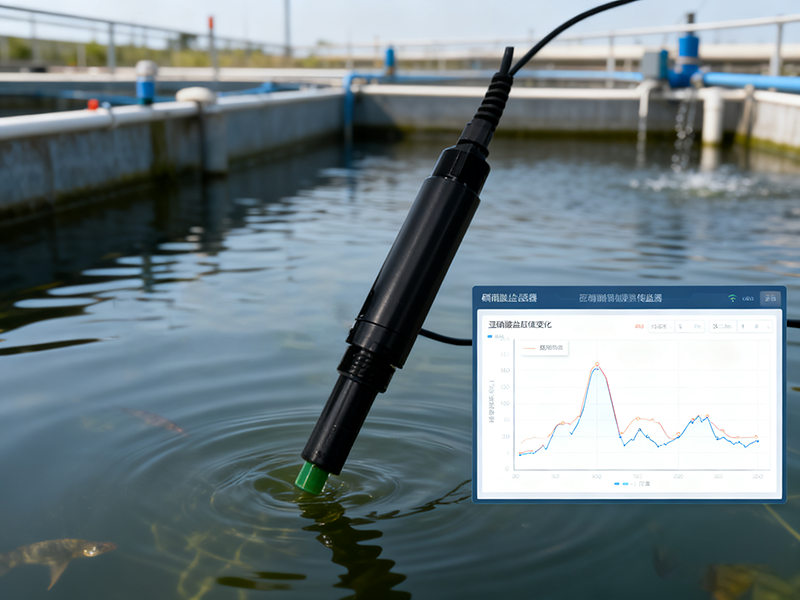
Before a fish gasps for air at the surface, before lab test results arrive at a water plant, even before you turn on the tap—an invisible threat may have already quietly multiplied in the water. It is the nitrite ion, a key intermediate in the aquatic nitrogen cycle and a lurking toxic killer.
Traditional water quality testing is like a “post-mortem”: manual sampling, sending samples to the lab, waiting for results. By the time the data is in, fish may have died en masse, or pollution may have already entered rivers. Today, online nitrite sensors are transforming this passive response into active defense, becoming “digital sentinels” that guard water bodies 24/7, 365 days a year.
Why Is Nitrite So Dangerous?
- Lethality to Aquaculture
Nitrite binds to hemoglobin in fish blood, forming “methemoglobin,” which cannot carry oxygen, causing fish to suffocate even in oxygen-rich water. Concentrations as low as 0.5 mg/L can threaten sensitive species. - Threat to Drinking Water Safety
High nitrite concentrations can induce “Blue Baby Syndrome,” interfering with the oxygen-carrying capacity of human blood. The World Health Organization (WHO) lists it as a key control parameter for drinking water. - Indicator of Environmental Pollution
Abnormal increases in nitrite levels in water often serve as early warning signs of sewage discharge, fertilizer runoff, or ecosystem imbalance.
Technological Breakthrough: From “Periodic Sampling” to “Real-Time Insight”
Modern online nitrite sensors typically employ ion-selective electrode technology or optical sensing technology to achieve:
- Second-Level Response: Real-time capture of concentration fluctuations, eliminating data lag.
- Adaptive Calibration: Built-in temperature compensation and anti-interference algorithms ensure long-term stability in field conditions.
- IoT-Ready: Direct integration into monitoring platforms via 4-20mA, RS485, or wireless protocols.
Application Scenarios: From Fish Tanks to Tap Water
- Smart Aquaculture
At California sea bass farms, sensor networks automatically activate aerators and microbial additive systems when nitrite concentrations exceed 0.3 mg/L, reducing sudden fish mortality incidents by 72% in 2023. - Drinking Water Safety Networks
Singapore’s PUB water authority deploys nitrite monitors at key nodes in the water supply network, combining them with AI algorithms to predict water quality trends, transitioning from “compliance treatment” to “risk预警.” - Wastewater Treatment Optimization
A wastewater treatment plant in Oslo, Norway, uses real-time nitrite monitoring to precisely control denitrification processes, improving nitrogen removal rates to 95% while reducing energy consumption. - Environmental Hotspot Monitoring
The EU’s “Clean Water Initiative” deployed micro-sensor arrays at agricultural runoff inlets, successfully tracing 37% of nitrogen pollution in the Baltic Sea coast to specific fertilization practices.
The Future: When Every Water Body Has a “Chemical Immune System”
With the integration of microelectrode technology, AI algorithms, and low-cost IoT, nitrite monitoring is evolving toward:
- Sensor Arrays: Simultaneous monitoring of pH, dissolved oxygen, ammonia, and other parameters to create a “health profile” of water bodies.
- Predictive Analytics: Learning from historical data to provide 12–24 hour early warnings of nitrite exceedances.
- Blockchain Traceability: Encrypting monitoring data on-chain to provide a “water quality history” for aquatic food products.
Conclusion: From Invisible to Visible, From Treating Disease to Preventing It
The widespread adoption of nitrite sensors marks the dawn of a new era: we no longer need to wait for a disaster to occur before testing; instead, water bodies continuously “speak,” revealing their hidden health status through data streams.
This is not just a technological advancement but a paradigm shift in how we approach water resources—from passive management to active stewardship, from vague experience to precise insight. Under the watch of these “digital sentinels,” every drop of water will enjoy a safer future.
We can also provide a variety of solutions for
1. Handheld meter for multi-parameter water quality
2. Floating Buoy system for multi-parameter water quality
3. Automatic cleaning brush for multi-parameter water sensor
4. Complete set of servers and software wireless module, supports RS485 GPRS /4g/WIFI/LORA/LORAWAN
For more water sensors information,
please contact Honde Technology Co., LTD.
Email: info@hondetech.com
Company website: www.hondetechco.com
Tel: +86-15210548582
Post time: Dec-03-2025