

1. Executive Context: The Global Shift Toward Water-Smart Agriculture
In an era of intensifying climate volatility and mounting pressure on global food security, “Water-Smart Agriculture” has transitioned from a progressive ideal to a technical imperative. Modern irrigation districts are increasingly abandoning traditional estimation-based water management in favor of real-time, precision water scheduling. This shift is driven by the need for hydrological telemetry that offers high-resolution data from the primary intake down to the individual crop root. For stakeholders, implementing non-contact sensing technology is now the baseline for ensuring systemic resilience and resource optimization.
2. Global Hotspots: Regions with High Demand for Hydrological Monitoring
The global agricultural landscape is seeing a surge in demand for radar-based flow measurement, particularly in regions where water allocation is a matter of national economic stability:
- Southeast Asia: The focus here is on intensive paddy field management. Maintaining precise inundation levels and monitoring the flow rates of gravity-fed systems is critical for optimizing rice yields while minimizing methane emissions and water waste.
- Central and South Asia: Demand is centered on the modernization of massive main and branch canal networks. These regions require robust, low-maintenance sensors capable of monitoring water distribution across vast distances in complex, open-channel infrastructure.
- Middle East and North Africa (MENA): Driven by extreme water scarcity, authorities are prioritizing Non-Revenue Water (NRW) reduction and the establishment of billing nodes. Precise volumetric billing and real-time allocation are essential for managing limited groundwater and desalinated resources.
3. Technology Spotlight: The RD-600-01 Open Channel 3-in-1 Radar
The RD-600-01 is an integrated hydrological solution designed for “Total Channel Management.” It utilizes a dual-frequency approach—leveraging different radar bands for level and velocity to ensure maximum accuracy without physical contact with the water.
| Feature | Specification / Technical Detail |
| Core Function | 3-in-1 Integrated Measurement (Flow Rate, Velocity, and Water Level) |
| Antenna Type | Planar microstrip array (CW + PCR) |
| Water Level Range | 0.2~40m (Accuracy: ±2mm / Frequency: 60GHz) |
| Flow/Velocity Range | 0.03~20m/s (Accuracy: ±0.01m/s / Frequency: 24GHz) |
| Emission Angle | 12° for focused measurement; Includes ranging blind area recognition |
| Protection Rating | IP68 Waterproof and 6KV Lightning Safe |
| On-board Intelligence | Automatic flow direction recognition; Built-in vertical angle correction |
4. Key Application Scenarios in Modern Irrigation
As irrigation districts modernize, the RD-600-01 serves as the primary data node across three critical infrastructure points:
- Main Canals: Managing the primary intake from reservoirs or rivers. Accurate monitoring at this level provides the foundational data for the entire network’s supply-side management.
- Branch Canals: Enabling precision distribution to specific farming sectors. This ensures that water rights are respected and that the “equitable distribution” of resources is mathematically verified.
- Billing Nodes: Utilizing accumulated water volume data to serve as the definitive record for water fee collection and administrative resource allocation. This transforms water management into a transparent, data-driven utility.
5. Featured Case Study: Transforming Paddy Fields with Smart Water Scheduling
The Ecosystem: From Open Channel to Crop Root
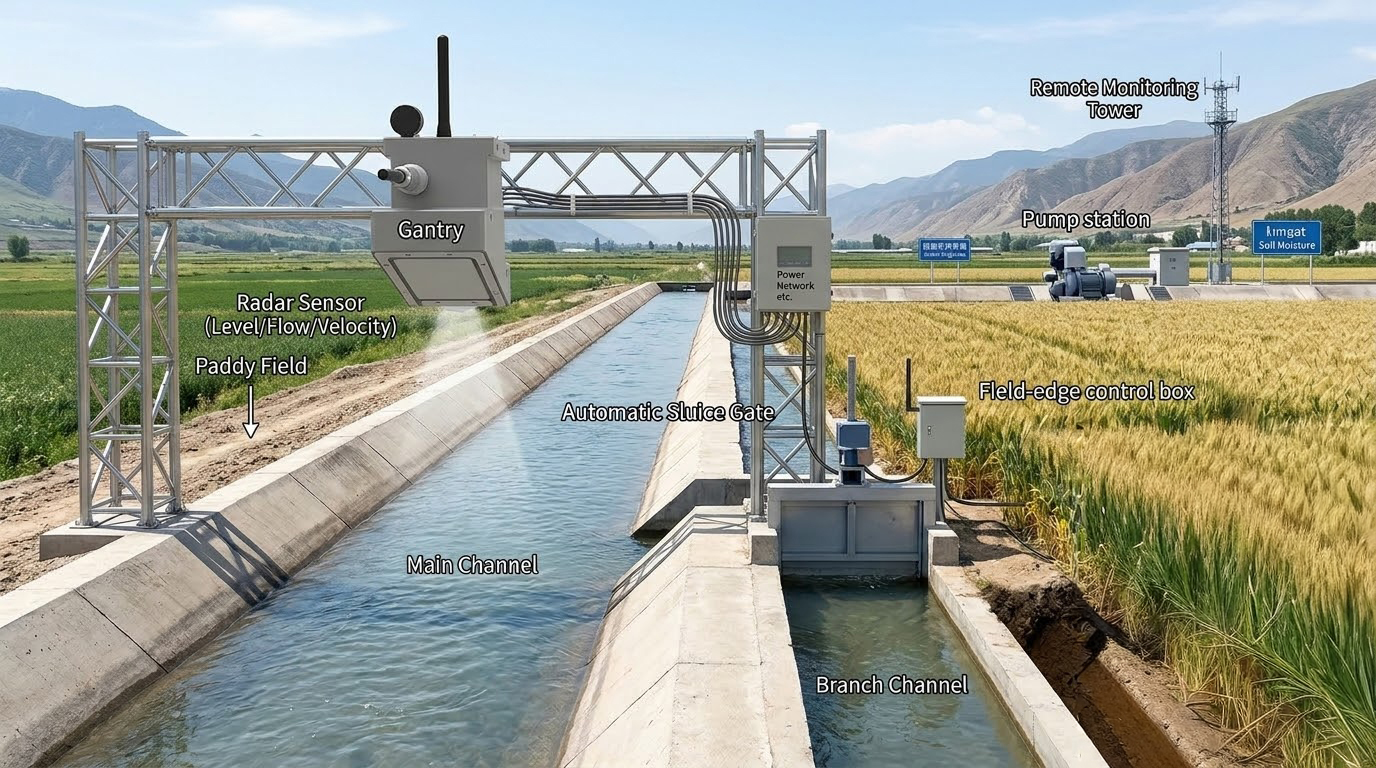
In a recent deployment for a high-output paddy field project, the RD-600-01 radar sensor was utilized to automate the bridge between hydrology and agronomy. Mounted on a cross-channel gantry, the sensor provides continuous, non-contact monitoring of the main channel’s velocity and level.
This installation is part of a holistic smart agricultural ecosystem. The radar data is processed by a field-edge control box which communicates directly with an Automatic Sluice Gate. When hydrological thresholds are met, the gate adjusts flow into the branch channels serving the crop. To provide a 360-degree view of the environment, the system is integrated with a Pump Station for active water lifting and Soil Moisture sensors embedded in the field.
All data—including hydrological trends and soil saturation levels—is transmitted via a Remote Monitoring Tower to the Honde Cloud Ecosystem. This allows for a fully automated scheduling loop where the water moves precisely from the open channel to the crop root based on real-time demand.
6. Integration and Connectivity: The IoT Backbone
The utility of the RD-600-01 is extended by its high degree of interoperability. The system is designed to fit into existing SCADA frameworks or modern IoT stacks via the following tiers:
- Data Collection & View Options:
- Option 1: Handheld Meter – Designed for field inspection and “Plug & Play” diagnostics.
- Option 2: Touch Screen Data Logger – Ideal for monitoring rooms or greenhouse sites, featuring multi-channel synchronization.
- Option 3: USB Storage & Converter – Allows for direct PC debugging and historical data export for offline analysis.
- Connectivity Protocols: Supports RS485 (Modbus), RS232, 4-20mA, and wireless transmission via 4G/GPRS, WiFi, LoRaWAN, and MQTT Cloud Integration for seamless telemetry.
- Honde Technology Cloud Ecosystem: Provides a centralized platform for multi-platform viewing (Web/App/Tablet), secure data hosting, historical report analysis, and automated alert notifications for critical threshold breaches.
7. Conclusion: The Future of Precision Water Management
Non-contact radar technology, as embodied by the RD-600-01, is the cornerstone of sustainable agricultural development. By providing high-precision data on flow, velocity, and level, these systems empower water authorities to implement volumetric billing and sophisticated scheduling. In a world of finite resources, the ability to manage every drop with scientific accuracy is the only path toward long-term agricultural resilience.
8. For More Information
We can also provide a variety of solutions for
1.Data logger with screen;
2.GPRS/4G/WIFI/LORA/LORAWAN wireless module supports MQTT Json format;
3.Cloud server and software with alram relay system support to see the real time data, history data.
Company: Honde Technology Co., Ltd.
Websites: www.hondetechco.com
Email: info@hondetechco.com
Post time: Mar-31-2026