

When storms hit, surface flooding is just a symptom—the real crisis surges underground. A microwave technology that can see through concrete and soil is uncovering the most dangerous secrets of urban subsurface pipe networks
In 1870, London municipal engineer Joseph Bazalgette could never have imagined that 150 years later, deep within the brick tunnels he designed for the world’s first modern sewer system, a beam of microwaves would be scanning every vortex of the flowing water.
Today, beneath the surface of cities worldwide lies the largest yet least understood ecosystem built by humans—the subsurface pipe network. These “urban blood vessels” constantly carry stormwater, sewage, and even historical sediment, yet our understanding of them often remains confined to blueprints and assumptions.
It wasn’t until hydrological radar flow meters descended underground that a true cognitive revolution about a city’s “underground pulse” truly began.
Technological Breakthrough: When Microwaves Meet Dark Turbulence
Traditional underground flow measurement faces three major dilemmas:
- Cannot interrupt operations: Cities cannot be shut down to install equipment
- Extreme environments: Corrosive, sediment-filled, pressurized, biogas-rich conditions
- Data black holes: The randomness and lag of manual inspections
The radar flow meter’s solution is poetic in its physics:
Working Principle:
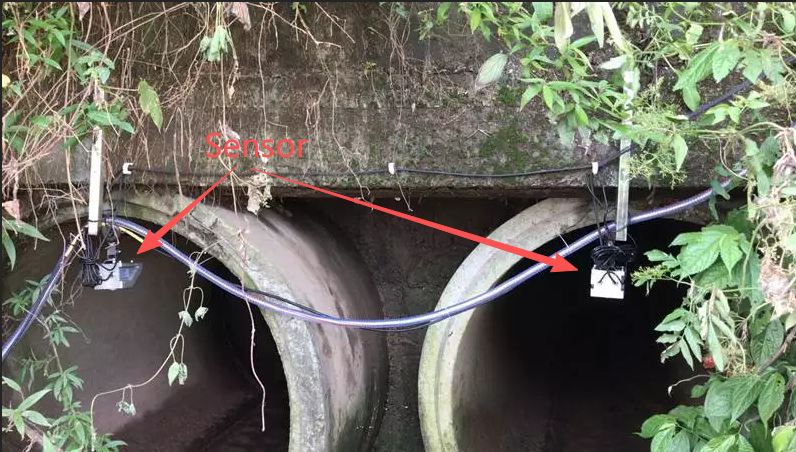
- Non-contact penetration: The sensor is mounted at the top of an inspection shaft; the microwave beam penetrates the air-water interface and strikes the flowing water
- Doppler tomography: By analyzing frequency shifts from surface waves and reflected suspended particles, it simultaneously calculates flow velocity and water level
- Intelligent algorithms: Built-in AI filters out noise like wall reflections and bubble interference, extracting pure flow signals
Key Specifications (mainstream equipment example):
- Measurement accuracy: Velocity ±0.02m/s, Water level ±2mm
- Penetration range: Maximum water surface distance 10m
- Output: 4-20mA + RS485 + LoRaWAN wireless
- Power consumption: Can operate continuously on solar power
Four Application Scenarios Changing Urban Destinies
Scenario 1: Tokyo’s “Underground Temple” Smart Upgrade
The Tokyo Metropolitan Area Outer Underground Discharge Channel—the famous “underground temple”—deployed a radar flow meter network at 32 critical nodes. During a September 2023 typhoon, the system predicted that Tunnel C would reach capacity in 47 minutes and automatically activated the third pumping station in advance, preventing flooding in six upstream districts. Decision-making shifted from “real-time” to “predicting the future.”
Scenario 2: New York’s Century-Old Network “Digital Physical”
The New York City Department of Environmental Protection conducted radar scans of cast iron pipes in Lower Manhattan dating to 1900. They discovered that a 1.2-meter diameter pipe was operating at only 34% of its designed capacity. The cause: calcified stalactite-like deposits inside (not traditional silt buildup). Targeted flushing based on this data reduced restoration costs by 82%.
Scenario 3: Shenzhen “Sponge City” Performance Validation
In Shenzhen’s Guangming District, the construction department installed mini radar meters at the outlet pipes of every “sponge facility” (permeable pavement, rain gardens). Data confirmed: during a 30mm rainfall event, a specific bioretention pond actually delayed peak flow by 2.1 hours, compared to its designed 1.5 hours. This achieved the leap from “construction acceptance” to “performance auditing.”
Scenario 4: Chemical Park Underground Defense “Second-Level Alert”
In the Shanghai Chemical Industry Park’s underground emergency pipeline network, radar flow meters are linked with water quality sensors. When abnormal flow + sudden pH change was detected, the system identified and automatically closed three upstream valves within 12 seconds, confining potential contamination to a 200-meter pipe section.
Economics: Insuring the “Invisible Asset”
Global Municipal Pain Points:
- The U.S. EPA estimates: Annual U.S. water resource losses due to unknown pipe defects total $7 billion
- European Commission report: 30% of municipal flooding actually stems from hidden subsurface issues like misconnections and backflows
Economic Logic of Radar Monitoring (for a 10km pipe network example):
- Traditional manual inspection: Annual cost ~$150K, data points <50/year, delayed response
- Radar monitoring network: Initial investment $250K (25 monitoring points), annual O&M cost $30K
- Quantifiable benefits:
- Preventing one medium-scale flooding event: $500K–$2M
- Reducing 10% of unnecessary excavation inspections: $80K/year
- Extending network lifespan by 15-20%: Asset preservation worth millions
- Payback period: Average 1.8–3 years
Data Revolution: From “Pipes” to “Urban Hydrological Nervous System”
Single-node data has limited value, but when radar networks form:
London’s DeepMap Project:
Digitized pipe network maps from 1860 to present, overlaid with real-time radar flow data, and fused with ground weather radar and subsidence monitoring to create the world’s first urban 4D hydrological model. In January 2024, this model accurately predicted seawater backflow in a Chelsea-area underground river under specific tide + rainfall conditions, enabling deployment of temporary flood barriers 72 hours in advance.
Singapore’s “Pipe Digital Twin”:
Each pipe segment has not only a 3D model but also a “health record”: flow baseline, sedimentation rate curve, structural vibration spectrum. By comparing real-time radar data with these records, AI can identify 26 sub-health conditions like “pipe cough” (abnormal water hammer) and “arteriosclerosis” (accelerated scaling).
Challenges & Future: The Technological Frontier of the Dark World
Current Limitations:
- Signal complexity: Algorithms for full-pipe flow, pressurized flow, and gas-liquid two-phase flow still need optimization
- Installation dependency: Initial installation still requires manual entry into inspection shafts
- Data silos: Pipe network data across water, drainage, subway, and power departments remains fragmented
Next-Generation Breakthrough Directions:
- Drone-mounted radar: Automatically flies to scan multiple inspection shafts without manual entry
- Distributed fiber optic + radar fusion: Measures both flow and pipe wall structural strain
- Quantum radar prototype: Utilizes quantum entanglement principles, theoretically enabling “through-soil透视” to directly locate 3D flow directions in buried pipes
Philosophical Reflection: When the City Begins to “Look Inward”
In ancient Greece, the Temple of Delphi bore the inscription “Know thyself.” For the modern city, the most difficult “knowing” is precisely its subterranean part—those infrastructures built, buried, and then forgotten.
Hydrological radar flow meters provide not just streams of data, but an extension of cognitive capability. They allow the city, for the first time, to continuously and objectively “feel” its own subterranean pulse, moving from “blindness” to “transparency” regarding its underworld.
Conclusion: From “Underground Labyrinth” to “Intelligent Organ”
Every rainfall is a “stress test” for a city’s subsurface system. In the past, we could only see the test results on the surface (ponding, flooding); now, we can finally observe the testing process itself.
These sensors installed in dark underground shafts are like “nanobots” implanted in the city’s vasculature, transforming the most ancient infrastructure into the most cutting-edge data source. They allow the water flowing beneath the concrete to enter the human decision-making loop at the speed of light (microwaves) and in the form of bits.
When a city’s “subterranean bloodstream” begins to whisper in real time, we are witnessing not merely a technological upgrade, but a profound transformation in urban governance paradigms—from responding to visible symptoms to understanding invisible essences.
Complete set of servers and software wireless module, supports RS485 GPRS /4g/WIFI/LORA/LORAWAN
For more water radar sensors information,
please contact Honde Technology Co., LTD.
Email: info@hondetech.com
Company website: www.hondetechco.com
Tel: +86-15210548582
Post time: Dec-05-2025