

In the tug-of-war between fertilizer use and environmental protection, a real-time monitoring technology is quietly changing the game, helping farmers apply nutrients precisely and safeguarding our drinking water.
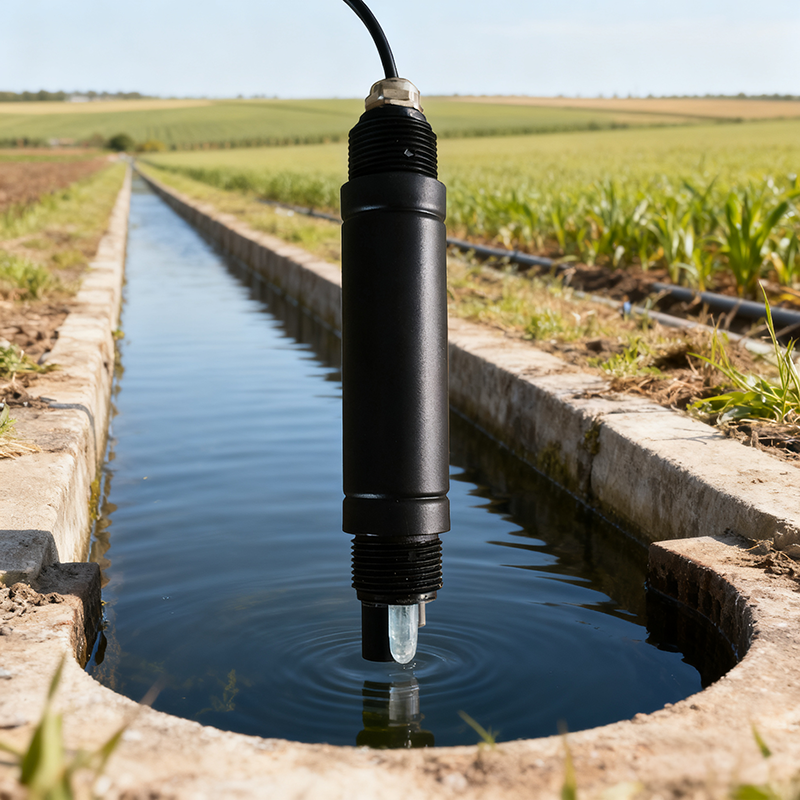
Beneath farmlands across the world, a silent “migration” occurs daily. Nitrogen fertilizer not fully absorbed by crops, in the form of nitrate, leaches into the ground and rivers with rain or irrigation water.
This “nitrate leaching” is a central challenge of modern agriculture: it represents a financial loss for the farmer and a source of environmental pollution, leading to water eutrophication and even threatening drinking water safety.
Today, a technology called the online nitrate sensor is acting as a tireless “underwater sentinel,” providing us with unprecedented insight and turning this invisible loss into a controllable, manageable variable.
I. Why Monitor Nitrate? Two Sides of One Problem
- For the Farmer: The “Navigator” of Precision Agriculture
- Traditional fertilization relies on experience and guesswork, often leading to over-application. Nitrate sensors provide real-time data on nitrogen levels in soil solution or drainage, telling farmers:
- Have the crops had enough? → Prevents over-fertilization, saving costs.
- Is fertilizer leaching away right now? → Allows for timely adjustment of irrigation and fertilization strategies.
- This enables true “spoon-feeding” of nutrients, ensuring yields while dramatically improving fertilizer use efficiency.
- Traditional fertilization relies on experience and guesswork, often leading to over-application. Nitrate sensors provide real-time data on nitrogen levels in soil solution or drainage, telling farmers:
- For the Environment & Public: The “Early Warning System” for Drinking Water
- Nitrate is one of the most common groundwater contaminants. High nitrate levels in drinking water pose a serious health risk to infants (Blue Baby Syndrome).
- Deploying nitrate sensors at river inlets or groundwater wells allows for real-time monitoring of pollution load from agricultural runoff, providing critical data for environmental agencies to take timely action.
II. The Nitrate Sensor: From “Feeling in the Dark” to “Real-Time Vision”
Unlike lab analysis, which is slow and labor-intensive, online nitrate sensors provide a continuous data stream:
- Real-Time Alerts: If a spike in nitrate concentration is detected, the system can immediately alert farmers or regulators, enabling a shift from “reactive cleanup” to “proactive prevention.”
- Closed-Loop Control: In advanced smart farming systems, sensor data can integrate directly with automated irrigation and fertigation systems. When nitrate levels indicate sufficient nutrients, the system can automatically reduce fertilizer application.
- Long-Term Trend Analysis: Continuous data logging helps analyze fertilization effectiveness and understand the nitrogen cycle for different crops and soils, providing a scientific basis for long-term farm management decisions.
III. The Technical Core: How to “Capture” Nitrate in Water?
The mainstream technology is the Ion-Selective Electrode (ISE). The sensor’s tip has a special membrane highly selective to nitrate ions. Upon contact with water, it generates an electrical signal proportional to the nitrate ion concentration, which is then converted into an accurate reading by the built-in processor and temperature compensation.
Conclusion
Under the dual pressures of food security and environmental protection, precision agriculture is no longer an option but a necessity. The water nitrate sensor, a seemingly modest piece of technology, is a key that unlocks the door to precision agriculture. It empowers farmers to move from “acting on feeling” to “deciding by data,” and enables environmental protection to shift from “passive tracing” to “active guardianship.”
It is more than just an instrument installed in a field; it is a vital bridge connecting harvests, costs, clean water, and public health.
We can also provide a variety of solutions for
1. Handheld meter for multi-parameter water quality
2. Floating Buoy system for multi-parameter water quality
3. Automatic cleaning brush for multi-parameter water sensor
4. Complete set of servers and software wireless module, supports RS485 GPRS /4g/WIFI/LORA/LORAWAN
For more water sensor information,
please contact Honde Technology Co., LTD.
Email: info@hondetech.com
Company website: www.hondetechco.com
Tel: +86-15210548582
Post time: Dec-01-2025