

While traditional rain gauges physically capture rainwater, next-generation monitoring technology has entered the “non-contact era”—a single infrared beam can reveal the unique “fingerprint” of every raindrop.
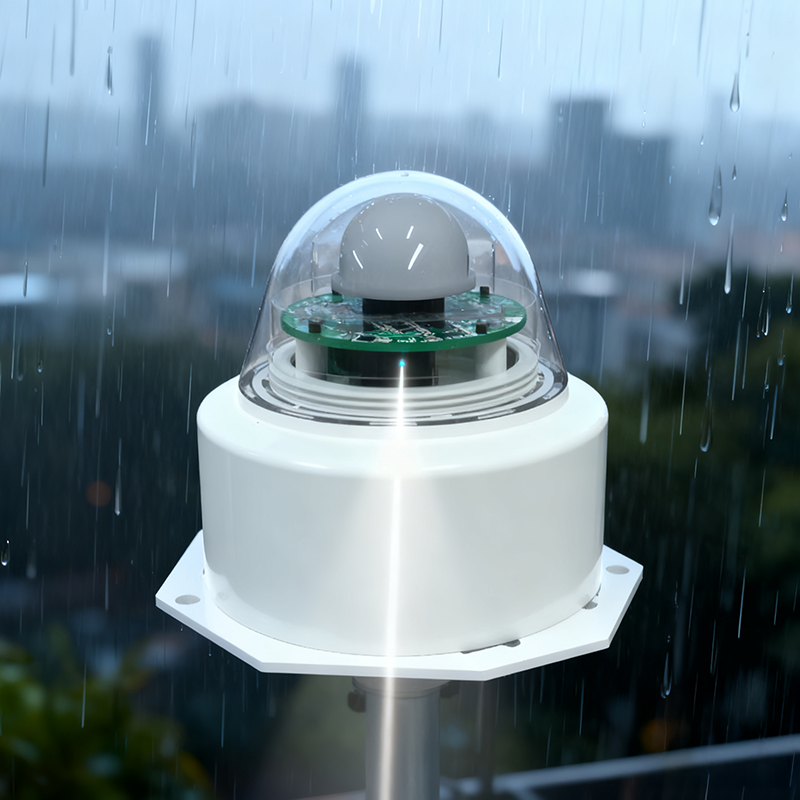
You may never have imagined that rainfall measurement is undergoing a quiet revolution from the “mechanical age” to the “photon age.” Traditional tipping-bucket rain gauges act like faithful recorders, only telling you “how much rain fell,” while infrared optical rain gauges function as acute physics detectives, using invisible beams to decode the unique identity of each raindrop.
Principle Revealed: When Infrared Light Meets Raindrops
The core of this technology is a precisely modulated infrared beam. When raindrops pass through the beam, two key optical phenomena occur:
- Scattering Effect: Raindrops scatter infrared light, creating unique light intensity variation patterns
- Attenuation Analysis: By measuring the degree and duration of light signal attenuation, the system can accurately calculate raindrop size, velocity, and shape
Even more remarkable, modern infrared optical rain gauges use multi-wavelength measurement technology, capable of distinguishing different precipitation types—rain, snow, hail, even fog—providing unprecedented detail for meteorological analysis.
Technological Breakthrough: Four Revolutionary Advantages
1. Extreme Precision and Data Integrity
- Traditional rain gauges may undercount during heavy rainfall due to slow bucket response
- Infrared technology achieves millisecond sampling, ensuring over 99% data integrity even in extreme downpours
- No mechanical wear, with long-term stability surpassing all traditional equipment
2. Multi-Dimensional Data Output
- Measures not only total rainfall but also provides:
- Raindrop size distribution spectrum
- Real-time precipitation intensity curves
- Automatic precipitation type identification
- Visibility correlation data
3. Zero-Maintenance Design
- No moving parts, no risk of water accumulation and freezing
- Self-cleaning optical window design
- Suitable for all climate environments from polar regions to deserts
4. Native IoT Compatibility
- Digital output directly interfaces with IoT platforms
- Low-power design enables continuous operation with solar power
- Provides real-time high-density data for smart city hydrological models
Application Scenarios: From Laboratory to Urban Pulse
Smart Flood Control Systems
In smart city projects in Tokyo and Singapore, infrared optical rain gauge networks have achieved “5-minute warning” capabilities. When the system detects sudden increases in raindrop size in specific areas (indicating severe convective weather), it automatically triggers regional drainage systems and traffic alerts.
Precision Agriculture Management
Case studies from California vineyards show that by analyzing raindrop size distribution, growers can more accurately predict soil erosion risks and optimize water and soil conservation measures. The “gentle irrigation” of small raindrops and the “impact effect” of large raindrops are treated completely differently.
Transportation and Aviation Safety
Infrared sensors deployed along Germany’s highway network can distinguish light rain, freezing rain, and hail in real time, providing critical safety parameters for autonomous driving systems and road maintenance. Monitoring points beside airport runways provide minute-level warnings for takeoff and landing safety.
Climate Science Research
Data from Antarctic research stations shows infrared optical technology operates stably at -40°C, providing the first year-round uninterrupted high-precision dataset for polar precipitation research, improving how polar water cycles are represented in global climate models.
Future Outlook: When Every Raindrop Becomes a Data Point
As sensor costs decrease and AI algorithms advance, we are moving toward an era of “intelligent rain eyes per square kilometer.” Future urban hydrological models will no longer rely on sparse observational point extrapolation but will be built on massive real-time raindrop-level data digital twins.
Infrared optical rain gauges represent not just an upgrade in measurement tools but a shift in observational philosophy: from passively receiving natural phenomena to actively analyzing physical processes. They make invisible precipitation visible, transform vague hydrological predictions into precise calculations, and ultimately help us build more resilient living environments in an era of intensifying climate change.
[Conclusion]
Next time it rains, remember: in some corner of the city, an invisible infrared beam is measuring, recording, and analyzing each raindrop. These silent “rulers of light” are protecting the boundaries of our weather perception in the most elegant way possible.
Complete set of servers and software wireless module, supports RS485 GPRS /4g/WIFI/LORA/LORAWAN
For more rain gauges information,
please contact Honde Technology Co., LTD.
Email: info@hondetech.com
Company website: www.hondetechco.com
Tel: +86-15210548582
Post time: Dec-02-2025