

Intro: The Promise of Instant Nutrient Measurements
Nitrogen (N), Phosphorus (P), and Potassium (K) – the three most critical macronutrients for supporting healthy plant life. Until recently, the only option for measuring these key nutrients was to send your sample to a laboratory for analysis. This process is unfortunately expensive, cumbersome, and not instantaneous. As a result, there is a surging demand for rapid, in situ tools capable of delivering much faster results back to the field.
The guide below will break down the primary categories of NPK sensors available on the market today, highlighting which underlying technologies are deployed, their key characteristics, and the fundamental scientific differences between those that are capable of measuring individual ionic concentrations and those that are not.
1. Electrochemical Sensors: Direct Ion Measurement for High Precision
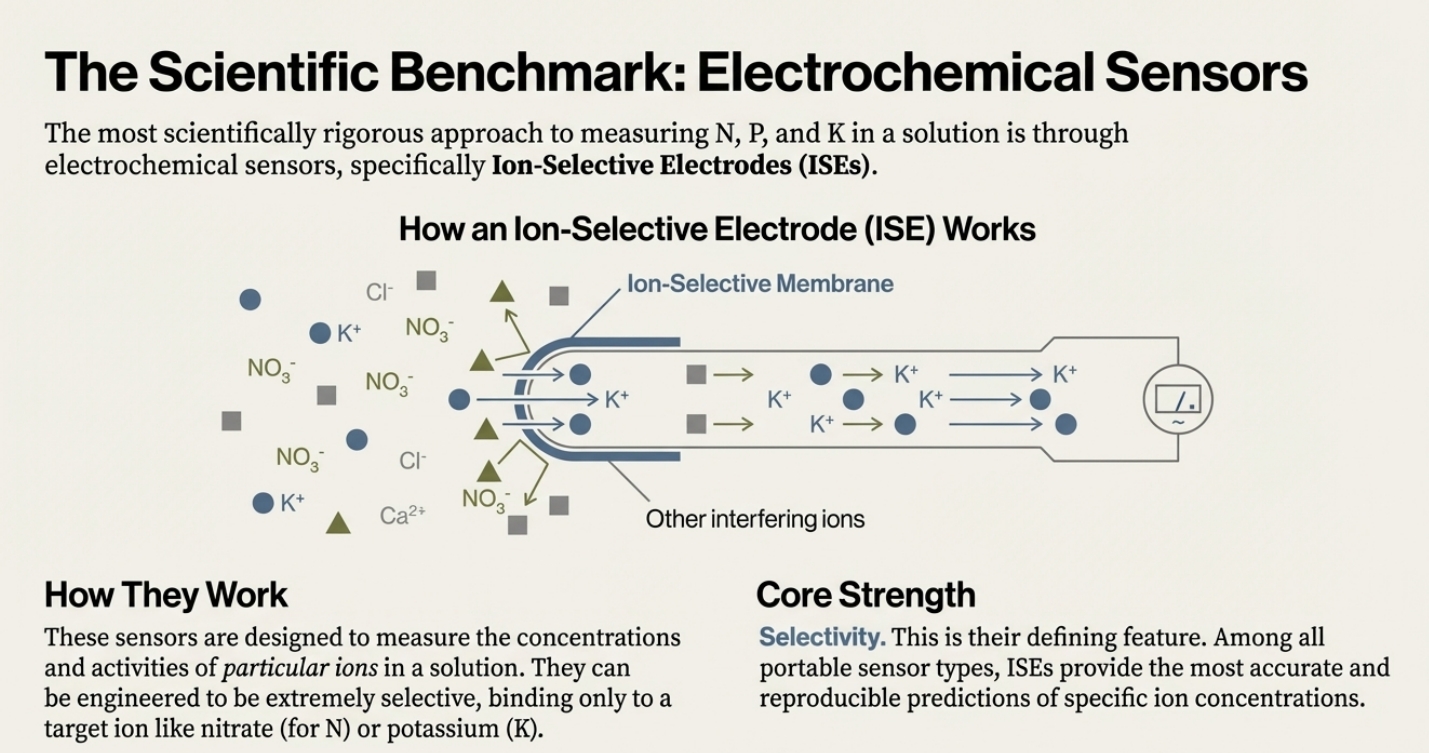
The most scientifically rigorous NPK sensor technology category falls under electrochemical sensors – more specifically, Ion-Selective Electrodes (ISE) that measure the concentrations and activities of particular ions in a solution.
Strength: Selectivity, Reproducibility, Accuracy: These sensors can be made extremely selective to certain ions, allowing for the most accurate possible predictions of ion concentrations among portable sensor types.
Weakness: Not Practical for Field Use: Despite their selectivity, these sensors tend to not be practical for field use. Not only are they expensive, but they still often require supplemental chemical solutions to operate, and their durability generally isn’t sufficient for long-term use. Most electrochemical sensors would never be buried into soil for in situ measurements, making them unreliable for accurate, widespread, real-time insights.
2. Spectroscopy: The Optical Approach
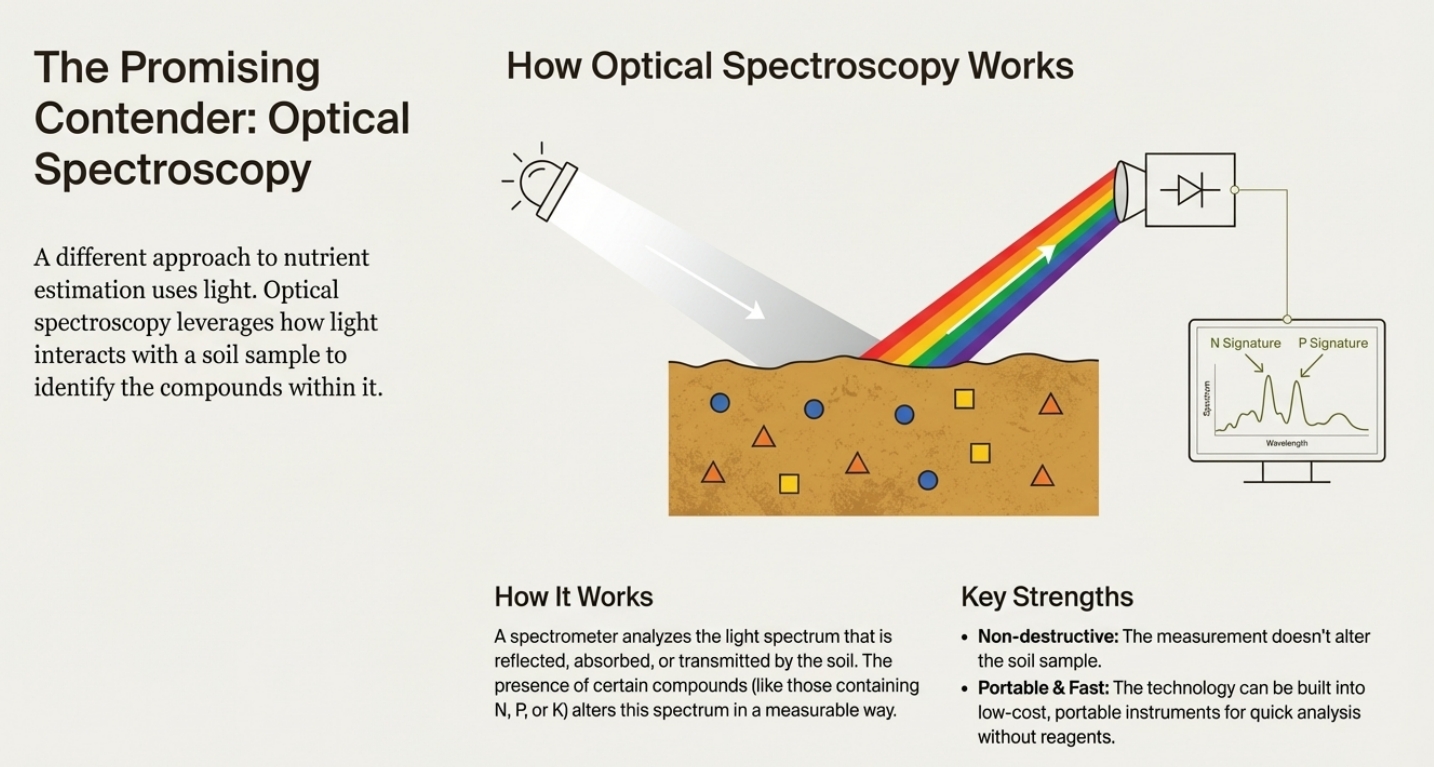
This sensor approach leverages principles of optical spectroscopy to estimate the compounds in a solution. In short, the spectrometer relies on how light interacts with the surface of a soil sample, and how that reflected, absorbed, or transmitted light spectrum changes due to the presence of a particular compound.
Strength: Non-destructive, Portable: This approach is non-destructive and can be implemented in portable, low-cost instruments for quick analysis with no reagents.
Weakness: Inconsistent Results: These sensors are also prone to inconsistent results. Their accuracy can be heavily influenced by external factors like soil texture. Moreover, some optical approaches to NPK measurement still rely on analyzing chemical reagents, similar to a laboratory process, but in a more portable form factor.
3. Electrical Conductivity (EC) Sensors: The Most Widespread “NPK” Probes
The market for low-cost, multi-pronged ‘NPK’ sensors is ballooning, but what technology is behind these small, affordable handheld probes? In short, electrical conductivity, or EC.
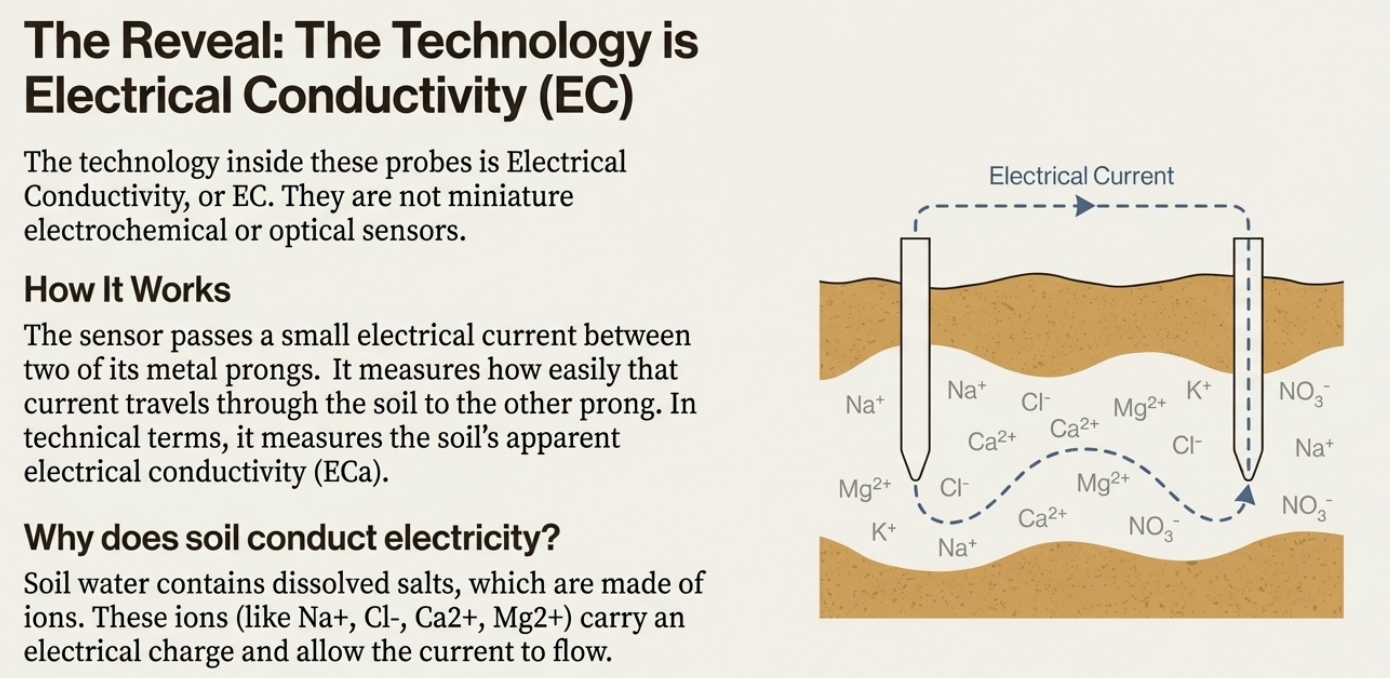
2-to-5 pronged, hand-held EC sensors work by passing an external electrical current between two contact points (the metal prongs) in the soil, and measuring how easily that current makes it to the other side. In technical terms, this is a measurement of the soil’s apparent electrical conductivity, or ECa, AKA, it’s ability to conduct electricity.
Why does electrical current flow through soil? All conductive materials contain ions, or molecules that carry an electric charge. In soil, these ions accumulate in soil water when various salts dissolve into it.
And here’s the key takeaway: A conductivity probe is not measuring the presence of NPK specifically. It’s measuring all the ions present in the soil water. You simply cannot use output from a basic EC probe to make predictions about specific ions. Thus, these are not true soil NPK sensors.
Strength: Cost, Simplicity:
First and foremost, these are incredibly affordable NPK sensors, and thus, readily available to mass markets.
They are very easy to use and return simple readings with little set-up.
The probes are often made from durable, corrosion-resistant materials suitable for repeated field use.
Critical Limitation: No Ion-Selectivity:
Their accuracy around any particular ion is a well-known limitation.
According to technical literature reviews, “Not surprisingly, the measurement is substantially influenced by other unrelated soil parameters, including the soil moisture content, pH, salt, texture, and general chemical composition.” One NPK sensor user manual claims it uses a “general rapid detection method, so there are certain errors” and that it should be used “with caution for planting reference.”
Conclusion: A Glaring Tradeoff for Practical Use
When it comes to soil NPK sensors, there is a glaring tradeoff between a sensor’s price and essential selectivity for real-time measurements. Electrochemical sensor technology will provide the most reliable data, but is expensive and impractical for everyday use, while optical sensor technologies
For more weather station information, please contact Honde Technology Co., LTD.
WhatsApp: +86-15210548582
Email: info@hondetech.com
Company website: www.hondetechco.com
Post time: Dec-30-2025