

Fragmented data, cumbersome equipment, and inefficient workflows have long been challenges in field-based environmental monitoring. The Portable Handheld Agricultural Environment Measuring Instrument is an integrated solution engineered to overcome these hurdles, offering a comprehensive, versatile, and user-friendly platform for professionals in agriculture, environmental science, and land management. This article explores the device’s core features, its wide range of connectable sensors, and practical applications that demonstrate its power and flexibility.
1. The Hub of Your Field Intelligence: The Portable Handheld Meter
The handheld meter is the central component of this system, designed for portability, ease of use, and powerful data management right in the palm of your hand.
1.1 Designed for Fieldwork
The physical design of the meter is optimized for practical use in any outdoor environment.
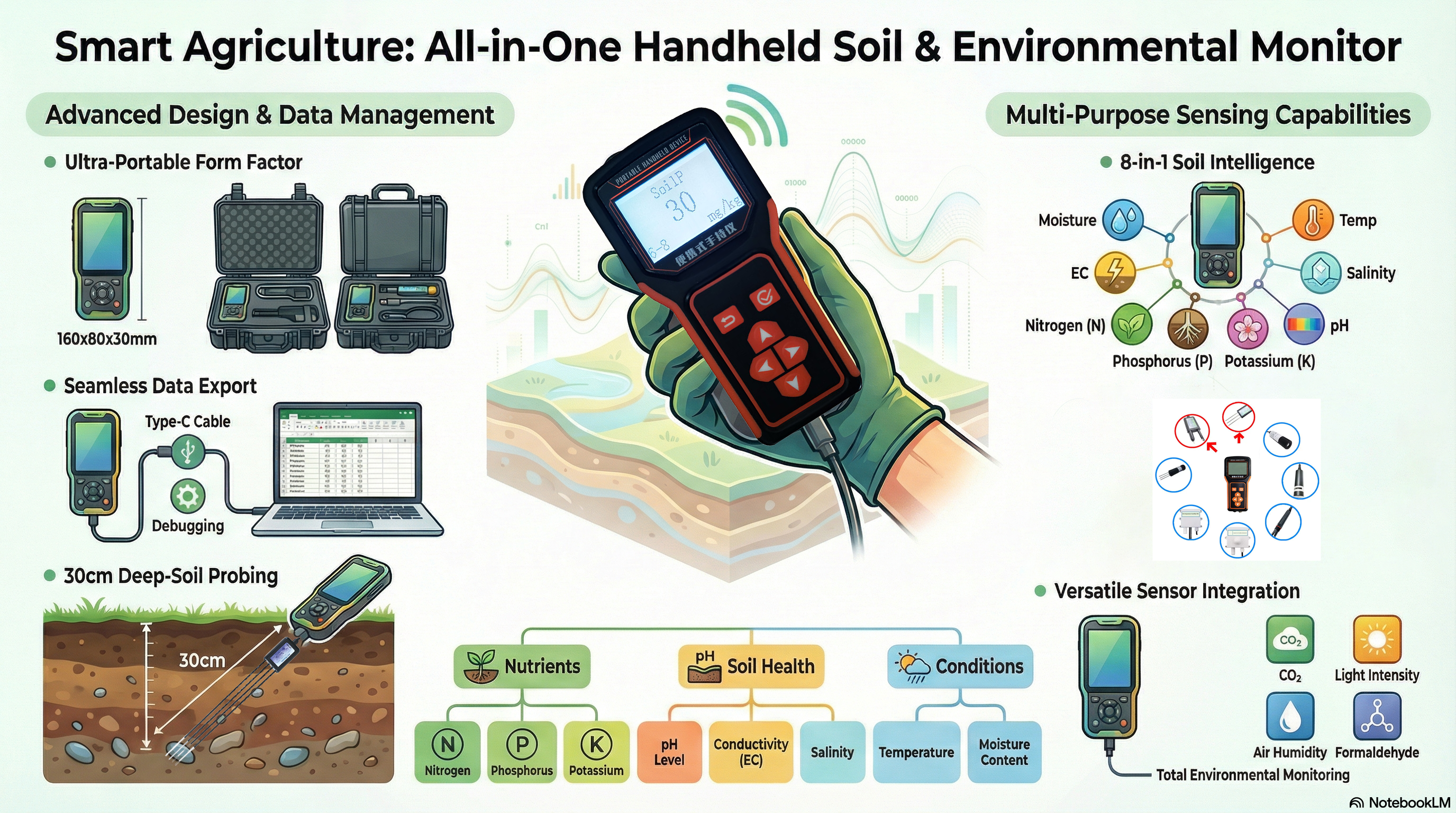
Its compact and portable housing features an ergonomic and professional design, built for reliability in the field.
Its specific dimensions are 160mm x 80mm x 30mm.
The system comes with a special lightweight suitcase, making it convenient for field operations.
1.2 Intuitive Operation and Display
The device is engineered for simplicity, ensuring users can begin collecting valuable data quickly. It features a clear LCD screen that displays real-time measurement results and battery power. For added clarity, the data can be displayed in Chinese characters, a feature designed to be intuitive and align with the usage habits of Chinese users. Operation is straightforward: a long press of the ‘Back’ and ‘Confirm’ buttons simultaneously powers the device on or off, and a simple password (’01000′) provides access to the main menu for settings adjustments. The simple control layout, which includes a confirm button, exit button, and selection buttons, makes navigation easy to operate and simple to learn.
1.3 Powerful Data Management & Power
Powered by a built-in rechargeable battery charged via a modern Type-C port, this meter is more than just a real-time display. It transforms from a simple reader into a powerful stand-alone data logger, allowing you to conduct long-term studies or extensive field surveys without needing a constant connection to another device. When you’re ready to analyze your findings, the stored data can be easily downloaded to a PC in Excel format using a standard USB cable.
For extended deployments, the low-power recording mode is exceptionally efficient. When activated, the meter records a data point at a user-defined interval (e.g., every minute), then immediately turns off the screen to conserve energy. After the interval passes, the screen momentarily wakes to confirm the next data point has been stored before going dark again. It is a critical detail that data can only be stored in this mode, a function designed specifically for planning and executing long-term field deployments.
2. One Device, Multiple Measurements: Unmatched Sensor Versatility
The handheld meter’s primary strength is its ability to connect to a vast array of sensors, transforming it from a single-purpose tool into a true multi-parameter measurement system.
2.1 Comprehensive Soil Analysis
Connect a variety of soil probes to get a complete picture of your soil’s health and composition. Measurable parameters include:
- Soil Moisture
- Soil Temperature
- Soil EC (Conductivity)
- Soil pH
- Soil Nitrogen (N)
- Soil Phosphorus (P)
- Soil Potassium (K)
- Soil Salinity
- Soil CO2
2.2 Spotlight on Specialized Probes
Beyond standard measurements, the system is compatible with highly specialized sensors designed for unique challenges.
The 30cm Long Probe 8-in-1 Sensor
This advanced sensor measures eight parameters simultaneously: Soil Moisture, Temperature, EC, pH, Salinity, Nitrogen (N), Phosphorus (P), and Potassium (K). Its key feature is the 30cm long probe, which provides a significant advantage over normal probes that are typically only 6cm long. Crucially, the sensor takes its reading only at the tip of the probe, providing a true measurement of a specific soil horizon deep underground, rather than an average value along its entire length.
The IP68 Waterproof Soil CO2 Sensor
The soil CO2 sensor is built for durability and reliability in harsh conditions. It features an IP68 waterproof rating, which means it can be buried directly in the soil or even fully submerged in water during irrigation without any problems. This makes it an ideal tool for long-term, in-situ studies of soil respiration and carbon dioxide levels.
2.3 Beyond the Soil
The system’s modularity allows it to be a central tool for comprehensive environmental analysis. The handheld meter is also compatible with a growing list of sensors, including: an air temperature and humidity sensor, light intensity sensor, formaldehyde sensor, water quality sensor, and various gas sensors.
3. From Data to Decisions: Real-World Applications
The versatility of this sensor system makes it an invaluable tool across a range of industries. Here are a few examples of how it can be put to work.
3.1 Use Case: Precision Agriculture
A farmer uses the handheld meter with the 8-in-1 soil sensor to measure NPK, moisture, and pH levels at different soil depths before planting a new crop. By gathering this precise data from various points in the field, they can create a detailed nutrient map. This allows for targeted fertilizer application, ensuring the crops get exactly what they need while reducing waste and environmental runoff. This data-driven approach not only boosts yield but also leads to significant cost savings and promotes sustainable farming practices.
3.2 Use Case: Environmental Research
An environmental scientist buries the IP68 waterproof CO2 sensor in a test plot to monitor soil health. Using the handheld meter’s low-power data logging mode, they collect soil CO2 data continuously over several weeks to study the effects of different irrigation techniques on soil respiration. Periodically, they return to the site to download the data in Excel format for in-depth analysis back at the lab. This provides researchers with a robust, high-resolution dataset essential for publishing credible findings and advancing our understanding of soil ecosystems.
3.3 Use Case: Forestry and Land Management
A forester is tasked with a land rehabilitation project. They use the handheld device to conduct rapid field assessments across a large area. By quickly connecting different sensors, they measure key parameters like soil moisture, soil temperature, and light intensity under the forest canopy. This data helps them understand the distinct microclimates on the property, enabling more informed decisions about which tree species to plant and where. This targeted approach increases the success rate of reforestation efforts and ensures a more resilient future landscape.
4. Conclusion
The Portable Handheld Agricultural Environment Measuring Instrument is a powerful, all-in-one solution for field data collection. Its compact design, high accuracy, versatility, and ease of use make it an essential tool for anyone needing reliable environmental data. By combining a robust handheld data logger with an extensive and growing family of sensors, this system provides the precision required for modern agriculture, research, and environmental management.
If you have any problem, just send us an inquiry.
Tags: soil sensor | Wireless Solutions Servers & Software Solutions
For more soil sensor information, please contact Honde Technology Co., LTD.
WhatsApp: +86-15210548582
Email: info@hondetech.com
Company website: www.hondetechco.com
Post time: Jan-20-2026