

1. Why Urban Flood Monitoring Needs a More Connected Approach
Heavy rainfall can turn an ordinary urban road into a flooded area within a short period of time. Underpasses, sunken roads, underground drainage channels and sewer networks are particularly vulnerable during intense rainstorms.
For municipal drainage departments, the challenge is not simply measuring rainfall or water levels. The more important question is how quickly they can identify potential flooding, understand what is happening inside underground drainage networks, and take action before the situation becomes dangerous.
In many cities, rainfall monitoring, road water-level measurement and underground sewer m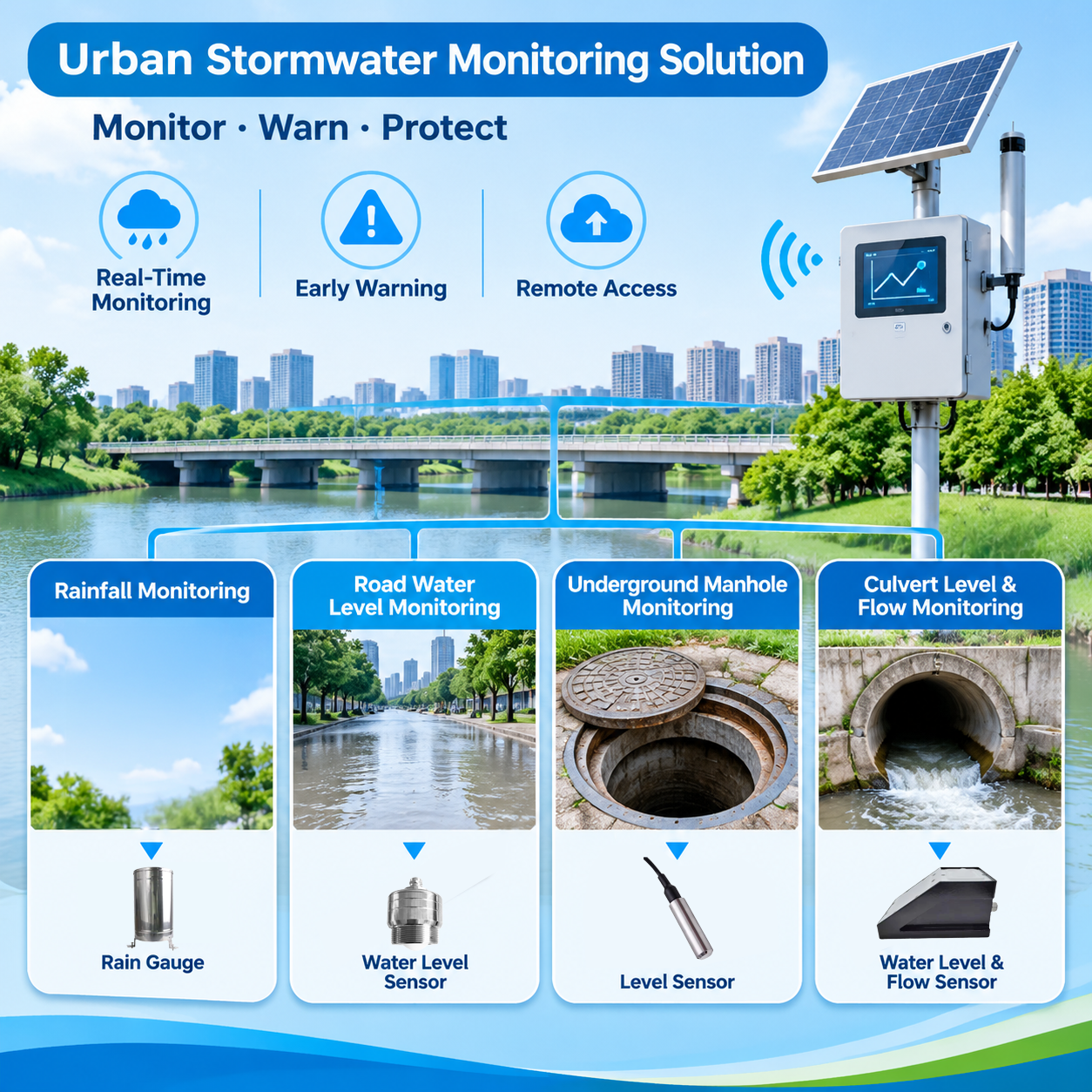 onitoring operate as separate systems. This makes it difficult for emergency management teams to obtain a complete picture of drainage conditions.
A more practical approach is to connect three monitoring layers:
- Rainfall Monitoring: Identify sudden rainfall increases and changing weather conditions.
- Road Flood Monitoring: Detect water accumulation in underpasses, low-lying roads and traffic areas.
- Underground Drainage Monitoring: Track water levels and discharge conditions inside sewer manholes and large culverts.
HONDE’s Urban Flood Monitoring Solution combines four specialized sensing technologies with wireless communication and cloud-based data management to help municipalities improve drainage visibility and flood-response efficiency.
2. Four Key Monitoring Technologies for Urban Drainage
Different monitoring locations require different sensor technologies. Selecting the appropriate instrument for each location helps improve measurement reliability while avoiding unnecessary equipment costs.
2.1 Piezoelectric Rain Sensor for Urban Rainfall Monitoring
Rainfall intensity is one of the earliest indicators of potential urban flooding.
Traditional mechanical rain gauges generally rely on moving components to collect and measure rainfall. In environments with dust, fallen leaves and other outdoor debris, regular maintenance may be required.
A piezoelectric solid-state rain sensor detects the impact energy generated when raindrops strike its sensing surface.
Key advantages:
- Solid-state sensing technology with no mechanical moving parts
- Rapid response to rainfall events
- Compact structure for outdoor installation
- Suitable for smart streetlights, weather stations and traffic monitoring poles
- RS485 communication for integration with data acquisition systems
By monitoring changes in rainfall conditions, the system can provide early information for municipal drainage management and emergency response.
2.2 Non-Contact Radar Water Level Sensor for Road Flood Monitoring
Urban underpasses, railway bridge approaches and low-lying intersections are common locations where rainwater accumulates.
Traditional contact-type water-level probes may be exposed to vehicle splashes, mud, road debris and accidental physical damage.
A non-contact radar water level sensor is installed above the road surface and measures the distance to the accumulated water.
Key advantages:
- Non-contact measurement without direct water immersion
- Suitable for underpasses, sunken roads and drainage outlets
- Reduced exposure to mud, sediment and vehicle interference
- Continuous water-level monitoring
- Suitable for integration with traffic warning and alarm systems
When the measured water level reaches a predefined warning threshold, the monitoring platform can notify operators and activate configured alarm outputs.
This provides useful information for traffic control teams deciding when to close a flooded road or restrict vehicle access.
2.3 Underground Manhole Water Level Monitor for Sewer Network Monitoring
Underground sewer systems are an important part of urban flood prevention, but monitoring them presents practical challenges.
Installing conventional powered equipment inside every manhole can be expensive, especially across large municipal drainage networks.
A battery-powered underground manhole water level monitor provides a practical alternative for locations where continuous external power is unavailable.
Key advantages:
- Designed for underground manhole applications
- Internal battery power for locations without mains electricity
- Typical battery service life of approximately 3–5 years, depending on operating and reporting conditions
- Adaptive reporting frequency for different monitoring conditions
- IP68 protection for demanding underground environments
- Remote transmission of water-level data
Under normal conditions, the device can use a lower reporting frequency to conserve battery power. When water levels rise or an alarm condition occurs, the reporting interval can be increased according to the configured monitoring strategy.
This allows drainage operators to identify rising sewer levels and potential overflow risks without routinely opening every manhole for manual inspection.
2.4 Non-Contact Radar Flow Meter for Large Underground Culverts
Monitoring water level alone does not always provide enough information to evaluate the performance of a large drainage channel.
For major underground culverts and concrete drainage channels, operators also need to understand water velocity and flow rate.
A non-contact radar flow meter combines water-level and surface-velocity measurement to calculate flow conditions.
Key advantages:
- Non-contact measurement of water level and surface velocity
- Suitable for large concrete box culverts and drainage channels
- Supports rectangular and circular channel configurations
- Real-time flow monitoring
- Helps evaluate drainage capacity during heavy rainfall
By combining water-level and velocity information, drainage operators can obtain a better understanding of how much water is being transported through the main drainage network.
3. Complete Monitoring Architecture: From Rainfall to Underground Drainage
The four monitoring devices work together to provide information from different parts of the urban drainage system.
| Monitoring location | Recommended equipment | Main monitoring function |
|---|---|---|
| Streetlights and weather monitoring poles | Piezoelectric Rain Sensor | Rainfall intensity and rainfall events |
| Road underpasses and low-lying roads | Radar Water Level Sensor | Road surface water accumulation |
| Underground sewer manholes | Underground Manhole Water Level Monitor | Sewer water level and overflow risk |
| Large underground culverts | Radar Flow Meter | Water level, surface velocity and flow rate |
How the Monitoring System Works
Step 1 – Rainfall Detection
The piezoelectric rain sensor continuously monitors rainfall conditions and sends measurement data to the acquisition system.
Step 2 – Road Flood Detection
Radar water-level sensors monitor water accumulation at critical road locations. When water levels exceed configured warning thresholds, the system sends alerts to the monitoring platform.
Step 3 – Underground Sewer Monitoring
Battery-powered manhole monitors transmit water-level information from underground drainage networks. Higher reporting frequencies can be configured during abnormal conditions.
Step 4 – Culvert Flow Monitoring
Radar flow meters measure water level and surface velocity in major drainage channels, helping operators evaluate discharge conditions.
Step 5 – Centralized Data Management and Warning
All monitoring data can be transmitted through wireless communication modules to a centralized cloud platform.
Operators can view current measurements, historical records and alarm information through a computer or mobile device.
Depending on the system configuration, alarm relay outputs can also be connected to external warning devices, traffic barriers and drainage pump control systems.
4. Wireless Communication and Cloud Monitoring Platform
A reliable drainage monitoring system requires more than accurate sensors. Data transmission, storage and alarm management are equally important.
HONDE provides integrated monitoring components for different municipal engineering requirements.
Handheld Meter and Data Logger with Display
Designed for field inspection and maintenance personnel.
- Direct connection to compatible sensors
- On-site measurement display
- Data recording and inspection
- Convenient equipment testing and maintenance
Wireless Communication Module
Suitable for distributed monitoring points across urban drainage networks.
Available communication options include:
- GPRS / 4G
- Wi-Fi
- LoRa
- LoRaWAN
The wireless module supports MQTT and JSON data formats, allowing measurement data to be integrated into compatible third-party monitoring platforms.
Cloud Server and Monitoring Software
The cloud platform provides centralized management of distributed monitoring devices.
Main functions include:
- Real-time measurement display
- Historical data storage and analysis
- Multiple monitoring point management
- Abnormal water-level and rainfall alarms
- Remote monitoring and data access
- Alarm relay integration for external control equipment
This architecture helps connect field instruments, wireless transmission and centralized municipal drainage management.
5. Typical Applications in Different Countries and Regions
Urban flooding is a global infrastructure challenge, but local drainage conditions and engineering requirements vary.
| Market | Common monitoring applications | Recommended monitoring configuration |
|---|---|---|
| Southeast Asia | Monsoon rainfall, flooded underpasses, urban drainage channels | Rain sensors, radar water-level sensors and wireless manhole monitors |
| United States and Canada | Urban stormwater systems, combined sewer networks and highway underpasses | Road flooding radar, sewer level monitoring and culvert flow measurement |
| Europe | Railway underpasses, underground retention facilities and municipal drainage networks | Rainfall monitoring, non-contact radar and flow measurement |
| Japan and South Korea | Urban intersections, underground drainage channels and densely populated city areas | Compact manhole monitors, road water-level radar and centralized cloud monitoring |
For projects in Southeast Asia, particular attention should be given to tropical rainfall intensity, outdoor equipment protection and wireless connectivity.
In developed urban infrastructure markets, integration with existing SCADA, PLC and municipal management platforms may be an important purchasing requirement.
The final equipment configuration should be determined according to the drainage structure, installation conditions, communication coverage and local engineering standards.
6. Typical Project Deployment: Urban Underpass and Sewer Flood Prevention
Consider a municipal road underpass located near a major underground drainage channel.
During heavy rainfall, water may accumulate at the lowest point of the road while the underground sewer network simultaneously experiences increasing water levels.
A coordinated monitoring arrangement can be deployed as follows:
- A piezoelectric rain sensor is installed on a nearby streetlight pole to monitor rainfall conditions.
- A non-contact radar water-level sensor is mounted above the lowest section of the underpass.
- Underground manhole monitors are installed at selected points along the sewer network.
- A radar flow meter is installed at the main drainage culvert to measure water level and flow conditions.
All devices transmit their measurements to the central monitoring platform.
When an abnormal condition is detected, operators receive an alarm and can assess the rainfall, road water level and underground drainage situation together.
If the project includes automatic control equipment, configured alarm relays can trigger warning lights, audible alarms, road barriers or drainage pump control signals.
This deployment approach provides municipal operators with a clearer understanding of the entire drainage process instead of relying on isolated measurement points.
7. Why Choose HONDE for Urban Flood Monitoring Projects?
HONDE Technology Co., Ltd. provides industrial sensing equipment and integrated monitoring solutions for environmental, hydrological and municipal infrastructure applications.
Our urban flood monitoring solution focuses on practical installation, reliable measurement and flexible system integration.
Four Specialized Monitoring Technologies
Rainfall, road water level, underground manhole level and culvert flow measurement can be configured according to project requirements.
Flexible Communication Options
RS485 Modbus, GPRS, 4G, Wi-Fi, LoRa and LoRaWAN options support different monitoring environments.
Integrated Data Management
Handheld meters, display data loggers, wireless communication modules and cloud monitoring software can be combined into one solution.
Alarm and Control Integration
Relay outputs can be configured to connect with external alarm equipment, PLC systems, traffic warning devices and pump control systems.
Project-Based Customization
Measurement ranges, installation accessories, communication methods and monitoring configurations can be customized for different municipal engineering projects.
8. Frequently Asked Questions
Q1: Which sensors are required for an urban flood monitoring system?
A complete configuration can include a rainfall sensor, road water-level radar, underground manhole water-level monitor and culvert radar flow meter. The final selection depends on the monitoring locations and project requirements.
Q2: Can road water levels be measured without contacting the water?
Yes. A non-contact radar water-level sensor can be mounted above the road surface to measure accumulated water without placing the instrument directly in the water.
Q3: Can underground manhole sensors operate without external power?
Yes. The battery-powered underground manhole water-level monitor is designed for locations without mains electricity. Its typical battery service life is approximately 3–5 years, depending on reporting frequency and operating conditions.
Q4: Can the system send alarms automatically?
Yes. With compatible wireless communication, cloud software and alarm relay configuration, the system can send remote notifications and connect to external alarm or control equipment.
Q5: Does HONDE provide complete monitoring solutions or individual sensors?
Both options are available. Customers can purchase individual sensors or configure a complete solution with data loggers, wireless communication modules and cloud monitoring software.
9. Build a Smarter Urban Drainage Monitoring Network with HONDE
As urban infrastructure expands and extreme rainfall creates increasing pressure on municipal drainage networks, reliable monitoring equipment becomes an important part of flood prevention and emergency management.
From rainfall detection to road water-level measurement, underground sewer monitoring and culvert flow analysis, HONDE provides flexible sensing technologies to help engineering contractors and municipal operators build more connected drainage monitoring networks.
Whether you are developing a smart city project, upgrading an existing drainage network or sourcing industrial sensors for municipal flood monitoring, our team can help select suitable equipment and communication solutions.
Contact HONDE Technology Co., Ltd.
Website: https://www.hondetechco.com
Email: info@hondetech.com
WhatsApp: +86-15210548582
Available Solution Components:
- Handheld Meter and Data Logger with Display
- GPRS / 4G / Wi-Fi / LoRa / LoRaWAN Wireless Communication Modules Supporting MQTT JSON
- Cloud Server and Monitoring Software with Alarm Relay System for Real-Time and Historical Data
Contact us for product specifications, installation recommendations, customized configurations and project quotations.
Post time: Nov-19-2026