

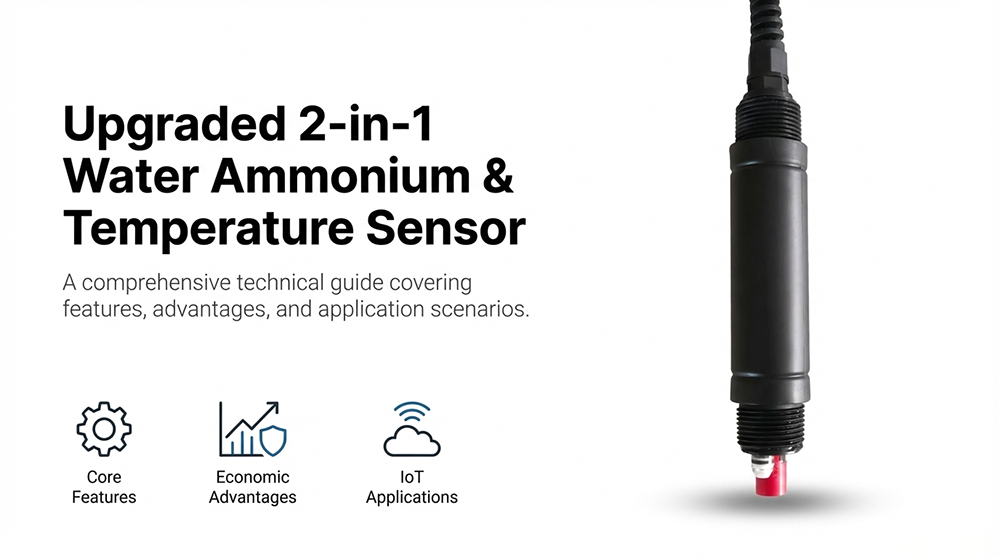
The global landscape of water quality management is undergoing a significant transformation, driven by the dual pressures of increasingly stringent environmental mandates and the economic imperative to maintain optimal aquatic conditions. At the forefront of this evolution is the monitoring of ammonium (NH_4^+), a critical bio-indicator. The industry is currently shifting away from monolithic, short-lived sensors toward modular, multi-parametric probe arrays that offer enhanced precision and a significantly lower total cost of ownership.
1.Global Market Analysis: Demand for Ammonium Ion Monitoring
The international market for ammonium sensing technology is expanding as regional economic drivers necessitate real-time, high-fidelity data. Key growth regions include:
- Southeast Asia (e.g., Vietnam and Thailand): Driven by the massive aquaculture export industry, there is a critical demand for sensors that can withstand high-salinity and high-biofilm environments. In these settings, the economic viability of shrimp and fish farming depends on preventing ammonia toxicity.
- Europe: Stringent wastewater discharge regulations (such as the Urban Wastewater Treatment Directive) mandate precise effluent monitoring to prevent eutrophication in communal water bodies.
- North America: Demand is concentrated in agricultural runoff monitoring, where nitrogen-based fertilizers impact local watersheds, necessitating robust early-warning systems for environmental compliance.
2.Primary Application Scenarios for Ammonium Sensors
Modern ammonium sensors are essential components across four primary sectors, each requiring a balance of durability and sensitivity:
- Aquaculture: Maintaining aquatic health by providing real-time alerts to prevent ammonia toxicity in high-density farming environments.
- Municipal Wastewater Treatment: Monitoring nitrification and denitrification stages to optimize the biological nutrient removal process.
- Industrial Effluent: Ensuring industrial facilities remain within legal environmental discharge limits to avoid significant regulatory penalties.
- River & Source Water Monitoring: Serving as a primary line of defense in early-warning systems to detect sudden pollution events in natural water supplies.
Industry Dispatch: The Shift Toward Multi-Parametric Tri-Node Integration
3.The Anatomy of Innovation: Features & Design Improvements
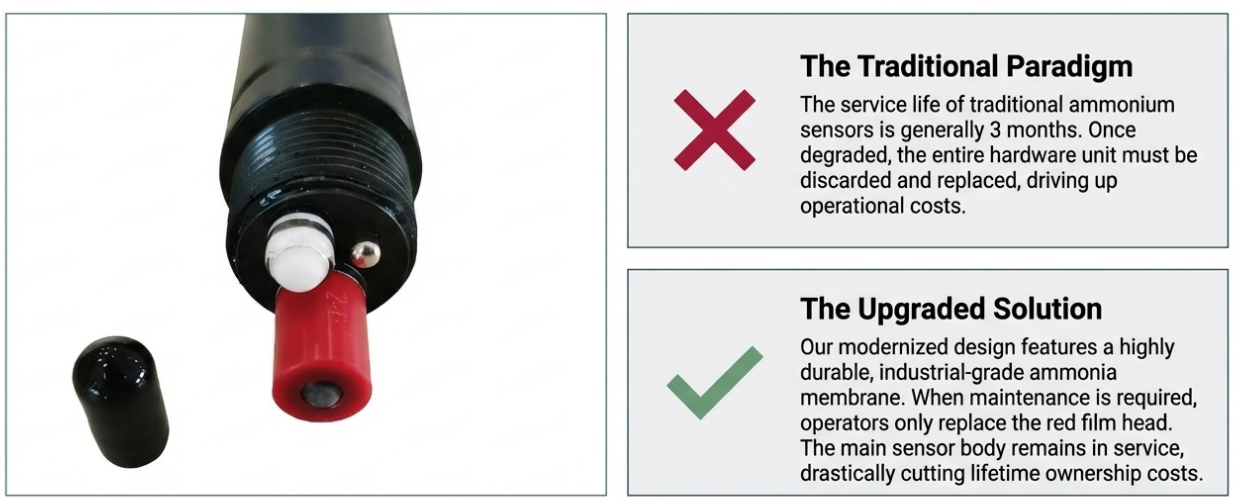
The transition from legacy hardware to the upgraded 2-in-1 design represents a fundamental shift in electrochemical sensing. The most significant advancement is the movement of the reference probe from an internal housing to an external, exposed position, which facilitates near-instantaneous ion exchange and localized thermal equilibrium.
| Feature | Legacy Design | Upgraded Design |
| Physical Form Factor | Large, bulky housing; difficult to integrate into tight spaces. | Compact (160mm x 32mm) with a modernized screw-mount design. |
| Probe Configuration | Single-function ammonium probe; separate temperature sensor usually required. | Tri-node array: Integrated chemical film, reference electrode, and temperature sensor. |
| Probe Exposure | Internal/Hidden: Reference probe was built-in, delaying water contact. | External/Exposed: White reference probe is exposed for instant reaction. |
| Reaction Speed | Slower; required longer submersion times to reach stability. | Rapid response; submerged “white part” facilitates immediate ion detection. |
| Installation Step | Complex mounting and calibration cycles. | Simplified “Cover Swap”: Remove black storage cap, install protective cage. |
| Maintenance | Total Replacement: Entire unit discarded when membrane fouled. | Modular Maintenance: Replaceable “film head” allows reuse of the transducer. |
4.Technical Advantages & Performance Specifications
The upgraded sensor is engineered for high-durability industrial applications, utilizing localized temperature compensation to reduce the margin of error at the point of measurement.
- [ ] Industrial-grade ammonium membrane for enhanced resistance to fouling.
- [ ] Integrated tri-node temperature compensation (Accuracy: ±0.3°C).
- [ ] High-quality low-noise cabling to maintain signal integrity over long distances.
- [ ] IP68 waterproof rating for continuous deep-water submersion.
- [ ] Four-level electrical isolation to resist complex site electromagnetic interference.
Measurement Specifications
| Parameter | Range | Resolution | Accuracy |
| Water Ammonia (NH_4^+) | 0.1-1000ppm | 0.01PPM | ±0.5% FS |
| Water Temperature | 0-60°C | 0.1°C | ±0.3°C |
Connectivity and “Smart” Water Management
To support the move toward Industry 4.0 in water management, the new sensor architecture supports a versatile range of digital and analog communication protocols:
- Multi-Protocol Output: Features RS485 (Modbus RTU) as the default digital standard. To accommodate legacy PLC systems, 4-20mA, 0-5V, and 0-10V analog outputs can be custom-configured.
- Extended Lead Lengths: The standard 2-meter cable can be extended significantly, with RS485 leads supporting distances up to 1000 meters for large-scale facility coverage.
- Wireless Integration: Fully compatible with GPRS, 4G, WIFI, LORA, and LORAWAN modules for remote environmental monitoring.
- Software Ecosystem: Integrated cloud servers and software enable real-time data visualization, historical data curves, and alarm thresholding via mobile, tablet, or PC.
- Autonomous Field Deployment: Optimized for mounting on 1-meter water pipes or integration into solar-powered float systems for remote lake and reservoir monitoring.
5.Conclusion: Why the “Replaceable Head” Design is a Game Changer
From a technical and economic standpoint, the “replaceable film head” is the most significant advancement in this category. Traditional ammonium sensors suffer from membrane fouling and depletion, typically resulting in a service life of approximately three months before the entire, expensive electronic assembly must be discarded.
By allowing the operator to replace only the specific film head while retaining the high-value internal transducer and housing, this upgraded design dramatically increases the Return on Investment (ROI), particularly in the high-fouling environments of Southeast Asian aquaculture.
Key Takeaway: The transition to compact, tri-node sensors with modular replacement components provides a high-performance, sustainable solution that effectively addresses the primary failure points of legacy water quality monitoring technology.
Tags: Ammonium|Ammonium ion (NH4+)|Ammoniacal nitrogen|Ammonia nitrogen
For more Water quality sensor information,
please contact Honde Technology Co., LTD.
WhatsApp: +86-15210548582
Email: info@hondetech.com
Company website: www.hondetechco.com
Post time: Mar-06-2026