

TL;DR
- In major international water resource tenders, river basin authorities and reservoir operators face an inseparable operational chain: upstream storm rainfall dictates reservoir flood inflow and spillway dispatch, but torrential runoff flushes heavy agricultural non-point source fertilizers into the impoundment, triggering sudden cyanobacteria blue-green algal blooms and severe water degradation.
- The global water quality monitoring buoy and blue-green algae sensor market is projected to reach $1.04 billion by 2033–2034 (CAGR 8.2% to 10.9%) , driven by drinking water safety mandates and harmful algal bloom (HAB) early warning directives.
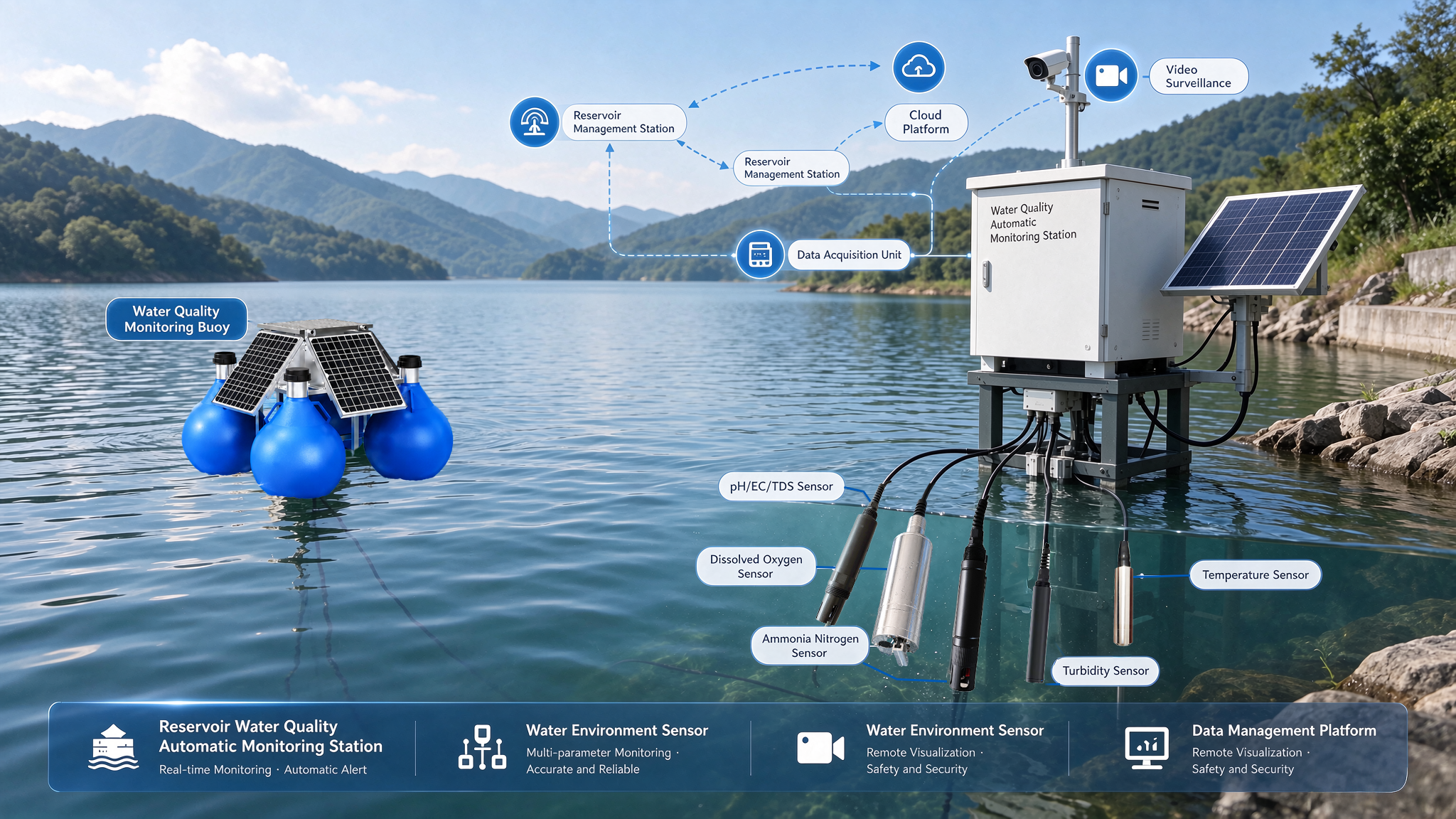
- Honde’s All-in-One River Basin Hydrological Auto-Station & Reservoir Source Eutrophication Monitoring Buoy System unifies four critical layers: catchment rainfall meteorology (HD-OR-01 optical rain gauge or MHD-600-N-01 6-in-1 compact station), hydrological stage & inflow velocity (RD-300-01 40m/100m radar level + RD-600-01 3-in-1 velocity/flowmeter), reagent-free water ecology (RD-BGAS-03 blue-green algae, HD-WDOFSS-01 optical DO with wiper, and HD-UVS2N-01 UV nitrate/COD), and anti-aging perimeter ambient gas detection (RD-ATHDGS-03 ASA weather station).
- Deployed as a floating RD-MWQFS-01 Multi-Parameter Monitoring Buoy with solar-powered LoRa/4G telemetry, the integrated network drives a complete “Rainfall -> Inflow Runoff -> Algal Bloom Prediction” digital chain, giving municipal drinking water intakes up to 7 to 10 days of advance warning before surface blooms turn toxic.
1.The Catchment Management Paradox: Flooding and Algal Blooms Are One Chain
Across municipal water authorities, hydroelectric dam concessions, and river basin commissions in North America, Western Europe, Southeast Asia, and Latin America, water engineering tenders have historically suffered from artificial departmental fragmentation:
- The Separation of Flood Dispatch and Water Quality: Hydrology teams monitor dam water level and upstream rain to prevent overtopping, while drinking water quality teams monitor reservoir intake chemistry. When an extreme storm flushes thousands of tons of agricultural nitrate and phosphorus into a reservoir, hydrology officers open bottom sluice gates blindly—unaware they are transferring toxic cyanobacterial plumes directly into downstream municipal drinking water filtration plants.
- The Runoff-to-Bloom Lag Window: Algal blooms do not appear on the day of the storm. After heavy rainfall, peak inflow delivers nutrient loads within 24 to 48 hours; warm sunshine following the storm drives cyanobacterial cell counts from benign levels to an explosive, toxic bloom within 5 to 7 days. Without real-time optical blue-green algae tracking, utilities miss the critical intervention window.
- Severe Sensor Maintenance Friction on Open Waters: Traditional wet-chemical nutrient analyzers placed on floating platforms fail due to wave tilt, reagent exhaustion, and biological biofouling. Remote reservoir buoys require 100% reagent-free optical instrumentation with automated motorized wipers capable of year-round unattended solar operation.
The Engineering Solution: Modern reservoir management demands an integrated architecture that bundles upstream rainfall forecasting, dam non-contact radar gauging, and in-situ multi-parameter water ecological buoys into a unified telemetry ecosystem.
2.System Architecture: Sensor Match List by Four Operational Modules
Honde’s Reservoir Source Water Hydrology & Eutrophication Monitoring Station integrates specialized sensing packages tailored for harsh reservoir climates and remote floating installations:
| Module Category | Monitored Parameters | Recommended Hardware Model | Core Engineering Features & Selection Logic |
|---|---|---|---|
| Rainfall & Meteorology Module | Reservoir Surface Rain Volume, Ambient Temp/Humidity, Wind Speed/Direction | HD-OR-01 (Optical Infrared Rain Gauge) or MHD-600-N-01 (6-in-1 Compact Weather Station) | HD-OR-01: Ultra-low-power solid-state optical rainfall sensor designed specifically for floating buoys and shoreline masts; completely immune to wave-induced rocking errors and bird fouling; feeds quantitative rainfall data into basin runoff models. MHD-600-N-01: Compact ultrasonic all-in-one station measuring wind, temperature, humidity, and barometric pressure with zero moving parts. |
| Hydrology & Flow Velocity Module | Reservoir Absolute Stage, Forebay Storage, Inflow Velocity, Discharge Volume | RD-300-01 (High-Range 0–40m/100m Radar Level) & RD-600-01 (Non-Contact Radar 3-in-1 Flowmeter) | RD-300-01: 80GHz high-frequency millimeter-wave radar mounted on the dam crest; 40m to 100m long range with ±1mm accuracy to track absolute capacity without cable stretch or sediment drift. RD-600-01: Overhead dual-radar unit installed at tributary river mouths; measures surface velocity and level simultaneously to calculate instantaneous inflow ( m3/h) without water contact. |
| Water Quality & Ecological Module | Cyanobacteria (Blue-Green Algae), Optical Dissolved Oxygen, UV Nitrate & COD | RD-BGAS-03 (Phycocyanin Algae Cell Sensor), HD-WDOFSS-01 (Optical DO with Wiper), HD-UVS2N-01 (Reagent-Free UV Nitrate/COD) | RD-BGAS-03: Measures phycocyanin fluorescence to provide real-time cell counts (
cells/mL), forecasting algal blooms days before surface scum forms. HD-WDOFSS-01: Luminescent optical DO sensor with motorized mechanical wiper; prevents biofouling in nutrient-rich waters. HD-UVS2N-01: Dual-wavelength 254nm/365nm UV absorption sensor measuring nitrate and organic load with 100% chemical reagent-free operation. |
| Reservoir Gas & Odor Auxiliary Module | Perimeter Microclimate, Volatile Odor, H2S, Organic Emissions | RD-ATHDGS-03 (ASA) (Weatherproof Perimeter Air & Odor Sensor) | Encased in automotive-grade ASA engineering plastic; immune to heavy solar UV degradation and thermal aging; monitors shoreline ambient air temperature, humidity, and volatilized algal decomposition odors. |
3.The Full-Chain Predictive Workflow: From Rainfall to Algal Bloom Intervention
A combined hydrological and water ecological station transforms reactive emergency management into predictive, proactive control across three automated stages:[Upstream Catchment Rain Gauges: HD-OR-01 / MHD-600-N-01]
       │
       ▼ (Quantitative Rainfall Feeds Hydrological Runoff Model)
[Tributary Mouth Radar Inflow Station: RD-600-01]
       │
       ▼ (Measures Velocity-Area Inflow Rate m³/h and Silt Load)
[Dam Forebay 80GHz Radar Level: RD-300-01]
       │
       ▼ (Calculates Total Storage Volume & Inflow-Outflow Balance)
[Floating Reservoir Monitoring Buoy: RD-MWQFS-01]
       │
       ▼ (Optical Cyanobacteria, DO & UV Nitrate Continuous Tracking)
[Cloud Alarm Relay & Predictive Decision Engine]
       │
       ├── Algal Cell Count > 20,000 cells/mL -> Dispatches Emergency Ultrasonic / Algicide Vessels
└── Surface Anoxia Detected -> Automates Hypolimnetic Aerators & Shifts Municipal Intake Depth- Precipitation-to-Runoff Inflow Calculation: As atmospheric fronts cross the catchment, HD-OR-01 optical gauges and MHD-600-N-01 ultrasonic weather stations feed live surface precipitation intensity into basin hydrological models. Downstream, the RD-600-01 overhead radar flowmeter tracks tributary discharge velocity and incoming flood volume entering the reservoir.
- Forebay Storage & Dam Crest Safety: The RD-300-01 millimeter-wave radar level gauge monitors forebay water height up to 100 meters with millimeter precision, allowing dam engineers to calculate remaining flood storage capacity and regulate spillway gates safely.
- In-Situ Ecological Buoy Tracking: Anchored in the main reservoir pool, the solar-powered RD-MWQFS-01 Multi-Parameter Monitoring Buoy suspends optical sensors at key biological depths. As storm-flushed nitrates enter the epilimnion, the RD-BGAS-03 detects micro-increases in phycocyanin fluorescence, triggering early warnings when cyanobacterial counts cross initial risk thresholds (e.g., 20,000 cells/mL)—giving water treatment plants a 7-day lead time to activate powdered activated carbon (PAC) dosing, engage hypolimnetic aeration, or mechanically adjust intake gate elevations.
4.International Water Authority Demand Analysis: Where Buoy Systems Are Sourced
| Country / Region | River Basin & Reservoir Policy Drivers | Typical Monitoring Deployment Profile | Preferred Telemetry & Payload Configuration |
|---|---|---|---|
| United States | US EPA Harmful Algal Bloom (HAB) Strategic Plan; Safe Drinking Water Act; Bureau of Reclamation dam safety | Large multi-purpose reservoirs, drinking water impoundments, Great Lakes tributaries | 80GHz radar level (dam crest), floating solar buoy with LoRaWAN / FirstNet 4G, optical phycocyanin sensors |
| European Union (Spain, France, Germany) | EU Water Framework Directive (2000/60/EC); bathing water quality and reservoir eutrophication mandates | Drinking water reservoirs, regulated river barrages, recreational lakes | Reagent-free optical sensors (zero hazardous waste), ASA UV-resistant housings, DIN-standard SCADA |
| Australia | Murray-Darling Basin Authority (MDBA); Water Quality Management Plans; toxic blue-green algae red alerts | Remote outback water storage reservoirs, irrigation supply dams | High solar capacity, 65m–100m radar level, LoRaWAN long-range telemetry, motorized wipers |
| Southeast Asia (Vietnam, Philippines) | National water security programs; hydroelectric reservoir multi-purpose dispatch (PAGASA, EVN) | Tropical river hydropower dams, municipal raw water supply lakes | Non-contact radar flowmeters, IP68 submersible multi-parameter buoys, automated alarm relays |
5.Technical Specifications: Comprehensive System Matrix
| Parameter Category | Technical Specification Details |
|---|---|
| Optical Rain Gauge (HD-OR-01) | Solid-state optical infrared refraction; Resolution: 0.1mm; Rocking angle compensation; Zero moving parts |
| 6-in-1 Compact Weather Station (MHD-600-N-01) | Ultrasonic wind speed (0–60 m/s), wind direction, air temp (-40 to +80 °C), humidity, pressure, solar radiation |
| High-Range Radar Level Gauge (RD-300-01) | 80GHz FMCW millimeter-wave radar; Range: 0–40m / 0–100m; Accuracy: ±1mm; Narrow 6° beam angle; IP68 aluminum housing |
| Radar Inflow Flowmeter (RD-600-01) | Non-contact 3-in-1 dual radar (24GHz Doppler velocity + FMCW level); Velocity range: 0.03–20 m/s; Output: m3/h,m3 |
| Blue-Green Algae Sensor (RD-BGAS-03) | Phycocyanin fluorescence method; Range: 0–200,000 cells/mL (or 0–400 µg/L); Auto-turbidity optical compensation |
| Self-Cleaning Optical DO (HD-WDOFSS-01) | Luminescent phase-shift quenching; Range: 0–20.00 mg/L; Integrated motorized mechanical wiper; 3-year sensing cap life |
| Reagent-Free UV Nitrate/COD (HD-UVS2N-01) | Dual-wavelength 254nm/365nm optical absorption; Range: NO3-N 0–100 mg/L, COD 0–1500 mg/L; 100% reagent-free |
| Perimeter Air & Odor Sensor (RD-ATHDGS-03) | Weatherproof automotive-grade ASA housing; Resistant to intense solar UV degradation; Tracks ambient microclimate & odors |
| Monitoring Buoy Platform (RD-MWQFS-01) | Rotomolded high-density polyethylene (HDPE) hull with stainless steel frame; Integrated marine solar panels & lithium battery |
| System Communications & Power | Standard RS485 Modbus-RTU, 4G LTE cellular, LoRa/LoRaWAN (868/915 MHz), GPRS; Power: Solar battery skid (12–24V DC) |
6.Commercial Value Comparison: Integrated Basin Buoy vs. Traditional Siphon & Grab Sampling
| Operational Dimension | Honde Catchment Hydrology & Ecological Buoy Station | Traditional Disconnected Station & Lab Sampling |
|---|---|---|
| Early Warning Lead Time | 7 to 10 days predictive lead time (phycocyanin fluorescence) | Reactive detection after water turns green, smelly, and toxic |
| Chemical Reagent Cost | Zero: 100% optical UV and luminescent fluorescence | High recurring costs for chemical digestion reagents & waste disposal |
| Dam Flood Safety Integration | Non-contact 80GHz radar (100m range) + tributary flow | Manual staff gauge checks and unreliable submerged pressure gauges |
| Maintenance Frequency | Once every 3 to 6 months (motorized mechanical wipers) | Weekly manual cleaning trips to scrub algae and silt off probes |
| System Integration Footprint | One single supplier; unified RS485 Modbus & MQTT JSON | Multiple vendors, conflicting protocols, fragmented databases |
| Regulatory Risk Mitigation | Continuous auditable digital compliance records 24/7 | Periodic manual grab samples miss sudden weekend storm flushes |
7.Three Turnkey Deployment Solutions for River Basins & Reservoirs
To support water authority patrol boats, regional dam dispatch centers, and national environmental telemetry networks, Honde delivers three standard deployment configurations:
1. Handmeter, Data logger with screen
Designed for reservoir limnologists, dam safety inspectors, and water utility sampling crews. The Handmeter, Data logger with screen powers any connected HONDE optical probe or radar head on-site, displays live vertical water quality profiles, cyanobacterial counts, and water level on a high-visibility outdoor display, and stores seasonal calibration logs. Technicians can calibrate buoy probes boat-side and export certified CSV/Excel logs via USB without taking delicate laptops onto choppy open water.
2. GPRS/4G/WIFI/LORA/LORAWAN wireless module supports MQTT Json format
Engineered for floating buoys, remote mountain tributaries, and perimeter weather stations spanning hundreds of square kilometers. Honde packages sensors with an industrial GPRS/4G/WIFI/LORA/LORAWAN wireless module. The node aggregates meteorological, hydrological, and limnological metrics, transmitting them in standardized MQTT Json format. LoRaWAN is ideal for expansive reservoir catchments surrounded by hills, transmitting up to 15 km back to a single shore gateway without ongoing cellular data subscription fees.
3. Cloud server and software with alram relay system support to see the real time data, history data
Designed for central water authority crisis rooms, hydroelectric dispatch centers, and municipal water intake SCADA networks. The Cloud server and software with alram relay system support to see the real time data, history data visualizes real-time reservoir heatmaps, multi-year water level storage curves, and cyanobacteria growth trajectories. Crucially, the platform features an automated alarm relay system: when upstream storm precipitation triggers flash runoff models or blue-green algae cell counts cross pre-epidemic thresholds, the cloud server automatically trips physical on-site relays to activate shoreline aerators, switch water intake gates to deeper clean strata, and dispatch urgent SMS/email alerts to municipal water plant directors.
8.Real-World Case Study: Drinking Water Catchment & Dam Safety in the Ebro Basin, Spain
A major regional water authority in Northern Spain manages a critical multi-purpose reservoir supplying potable water to 320,000 residents while providing downstream irrigation and flood control.
- The Challenge: Intense autumn storms regularly washed high concentrations of agricultural fertilizer from upstream cereal farms into the reservoir. Within days of storm termination, sudden cyanobacterial blooms contaminated the raw water intake with geosmin and 2-methylisoborneol (MIB), causing severe earthy-musty taste and odor consumer complaints. Concurrently, the dam’s legacy wire-suspended level float was frequently jammed by storm drift logs during flood discharge.
- The Solution: The water board deployed an integrated Honde monitoring suite: an RD-300-01 80GHz radar level gauge (40m range) installed on the central spillway bridge; two RD-600-01 radar 3-in-1 flowmeters at the primary river inlets; and an RD-MWQFS-01 Multi-Parameter Monitoring Buoy anchored in the deep storage pool equipped with RD-BGAS-03 blue-green algae, HD-WDOFSS-01 optical DO with wiper, and HD-OR-01 optical rainfall sensors, streaming via 4G cellular module in MQTT Json format.
- The Outcome: During a major storm event delivering 85 mm of rain, inlet flowmeters and dam radars tracked 1.8 million cubic meters of flood inflow with millimeter precision. Five days post-storm, the buoy detected phycocyanin fluorescence doubling before any visible surface bloom appeared. The cloud alarm relay notified the water plant 6 days in advance, allowing operators to adjust coagulation dosing and shift intake depth, successfully averting a public water quality crisis while saving over €45,000 in emergency chemical treatments.
9.Sourcing & Engineering Cooperation
Honde Technology Co., Ltd. is currently accepting commercial inquiries, international water resources tenders, and OEM/ODM engineering integration partnerships for the All-in-One River Basin Hydrological Auto-Station & Reservoir Source Eutrophication Monitoring Buoy System.
Municipal water authorities, reservoir dam operators, and environmental monitoring EPC contractors can request technical datasheets, CAD buoy anchoring schematics, and evaluation packages directly from our engineering team:
1.Handmeter, Data logger with screen;
2.GPRS/4G/WIFI/LORA/LORAWAN wireless module supports MQTT Json format;
3.Cloud server and software with alram relay system support to see the real time data, history data.
WhatsApp: +86-15210548582 Email: info@hondetech.com Company Website: www.hondetechco.com
High-Volume & High-Conversion Keyword Strategy
Primary Keyword
- reservoir water quality buoy and hydrological monitoring system
Secondary Keywords (High Search Volume)
- blue green algae sensor for reservoir
- 80GHz radar water level sensor for dam
- solar powered water quality monitoring buoy
- non contact radar open channel inflow meter
- cyanobacteria algal bloom early warning system
Long-Tail Keywords (High Commercial Intent)
- integrated reservoir flood hydrology and water quality buoy price
- optical blue green algae sensor with automatic wiper
- LoRaWAN reservoir water quality monitoring buoy MQTT Json
- 100m range 80GHz radar water level transmitter for dams
- reagent free UV nitrate and COD sensor for drinking water reservoir
LSI & Semantic Vocabulary
- phycocyanin fluorescence, cyanobacteria cell density (cells/mL), harmful algal blooms (HABs)
- agricultural non-point source runoff, reservoir eutrophication, epilimnion nutrient surge
- 80GHz FMCW radar level sensor, 40m/100m range, 3-in-1 radar inflow velocity flowmeter
- rotomolded HDPE buoy hull, automotive-grade ASA housing, RS485 Modbus, cloud alarm relay
Search Intent Matrix
| User Search Intent | Representative Keyword Query | Answering Article Module |
|---|---|---|
| Informational | “how does storm runoff cause reservoir cyanobacteria blooms” | The Catchment Management Paradox & Workflow |
| Commercial | “water quality monitoring buoy vs manual reservoir sampling” | Sensor Match List & Commercial Comparison Table |
| Transactional | “reservoir water quality buoy complete system quotation” | Turnkey Solutions, Ebro Basin Case Study & Contact Block |
On-Page SEO Elements
- H1: Full-Chain Catchment Intelligence: Why Modern Water Authorities Are Bundling Hydrological Auto-Stations with Reservoir Eutrophication Monitoring Buoys
- Meta Title: Reservoir Water Quality Buoy & Dam Hydrology System | HONDE Tech
- Meta Description: Unify reservoir flood control and drinking water protection with HONDE’s catchment monitoring system. 80GHz dam radars, optical algae sensors, and solar buoys with cloud alarms.
Post time: Nov-04-2026