

Traditional tipping bucket rain gauges are rapidly being phased out in favor of radar technology to eliminate mechanical failure and high maintenance costs. The HD-RDPS-01 radar sensor utilizes 24 GHz Doppler radar wave technology to distinguish between rain, snow, and hail, while accurately identifying “no precipitation” states. By providing instantaneous intensity and accumulated data without moving parts or heating elements, these sensors ensure 24/7 reliability for highways and agriculture—industries where real-time weather intelligence is a prerequisite for safety and operational continuity.
Beyond Liquid Rain: The Critical Importance of Multi-Type Precipitation Detection
The HD-RDPS-01 leverages 24 GHz Doppler radar wave technology to provide data depth that traditional liquid-only sensors cannot match. By analyzing the frequency shifts of reflected waves from falling particles, the sensor offers real-time monitoring of the physical state of precipitation.
- Rain: Measures both instantaneous precipitation intensity (0-200mm/h) and accumulated values. It is highly sensitive to small droplets, with a detectable drop range of 0.5–5.0mm.
- Snow: Detects snowfall directly without the need for energy-intensive heating elements to melt solid matter, ensuring data stays live in sub-zero temperatures.
- Hail: Provides immediate detection of ice pellets, enabling early warning protocols to protect high-value assets.
- No Precipitation: A vital data state for automated systems, confirming dry conditions with a 1-second sample frequency.
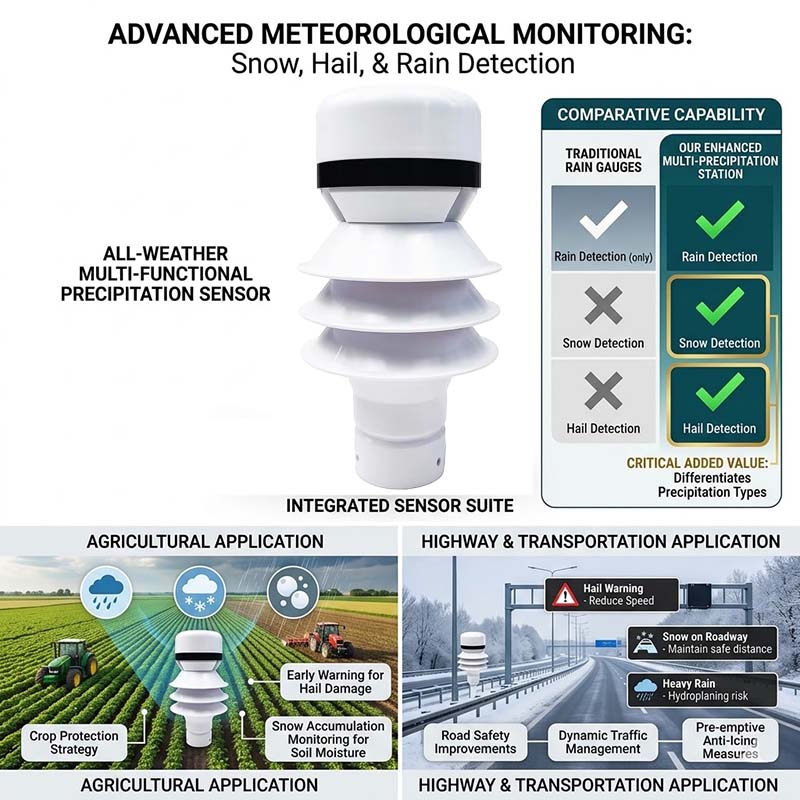
Radar vs. Tipping Bucket: Why Modern Infrastructure is Switching
For decades, the tipping bucket was the default. However, the high “cost of ownership” associated with manual cleaning and mechanical failure has shifted the industry toward the HD-RDPS-01.
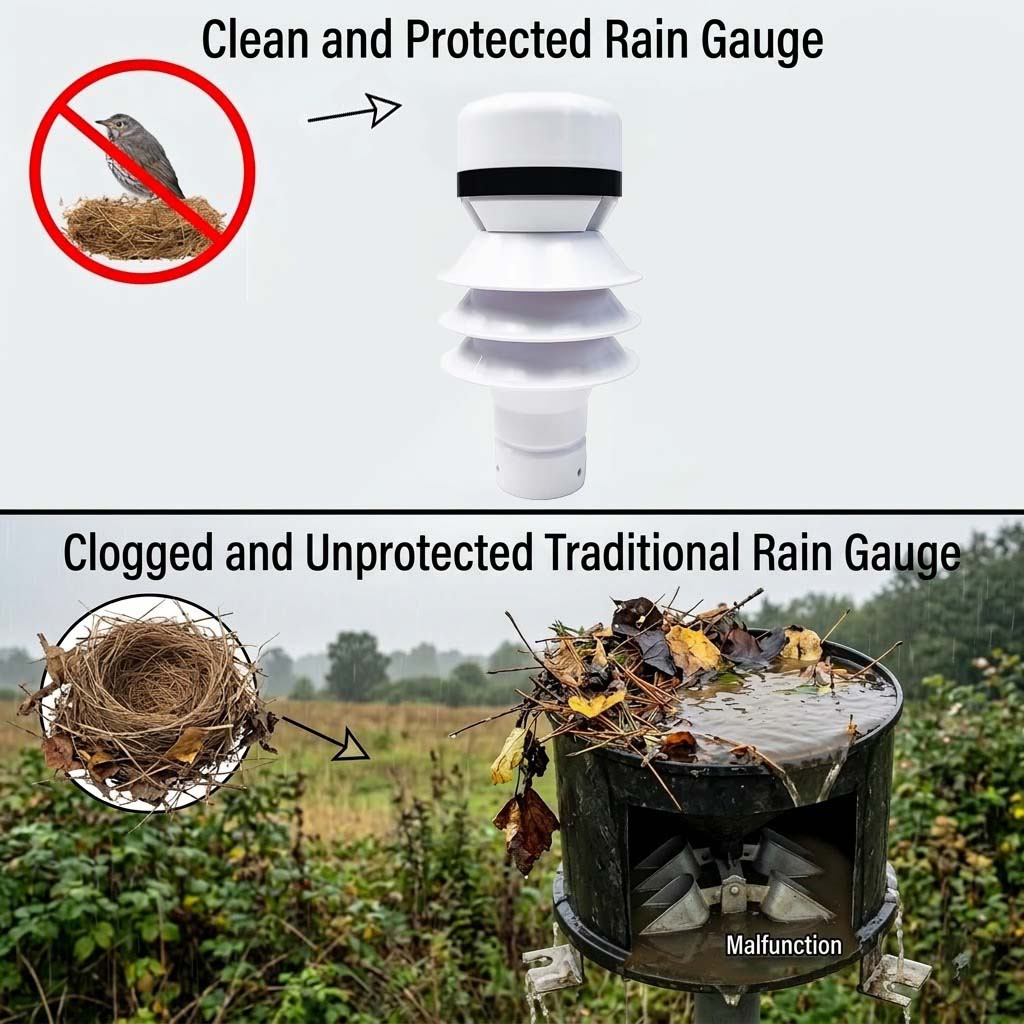
| Feature | Radar Sensor (HD-RDPS-01) | Traditional Tipping Bucket |
| Maintenance | Maintenance-Free; no moving parts to fail. | Frequent cleaning required; prone to mechanical wear. |
| Response Speed | Instantaneous; 1-second sample frequency. | Delayed; requires bucket to fill before “tipping.” |
| Debris Impact | Leaves, dirt, and bird droppings do not affect measurement. | Highly prone to clogging; requires constant debris removal. |
| Precipitation Types | Rain, Snow, Hail, and No Precipitation. | Measures liquid rain only. |
| Extreme Weather | Operates -40°C to +70°C; no heater needed. | Freezes in winter; requires external heating kits. |
| Durability | Rugged ABS material; IP65 rated. | Often fragile metal or plastic; susceptible to corrosion. |
Strategic Industry Applications: Highways and Agriculture
From an engineering perspective, the “pain points” of weather monitoring have always been rooted in field-hardened reality. If you’ve been in this business long enough, you’ve seen it all: “zero-data events” caused by a funnel clogged with spider webs, bird droppings, or autumn leaves. Even worse is the mechanical fatigue of a tipping bucket that simply stops registering during a critical storm, or a mechanism that freezes solid in January, forcing a technician to climb a pole in dangerous conditions.
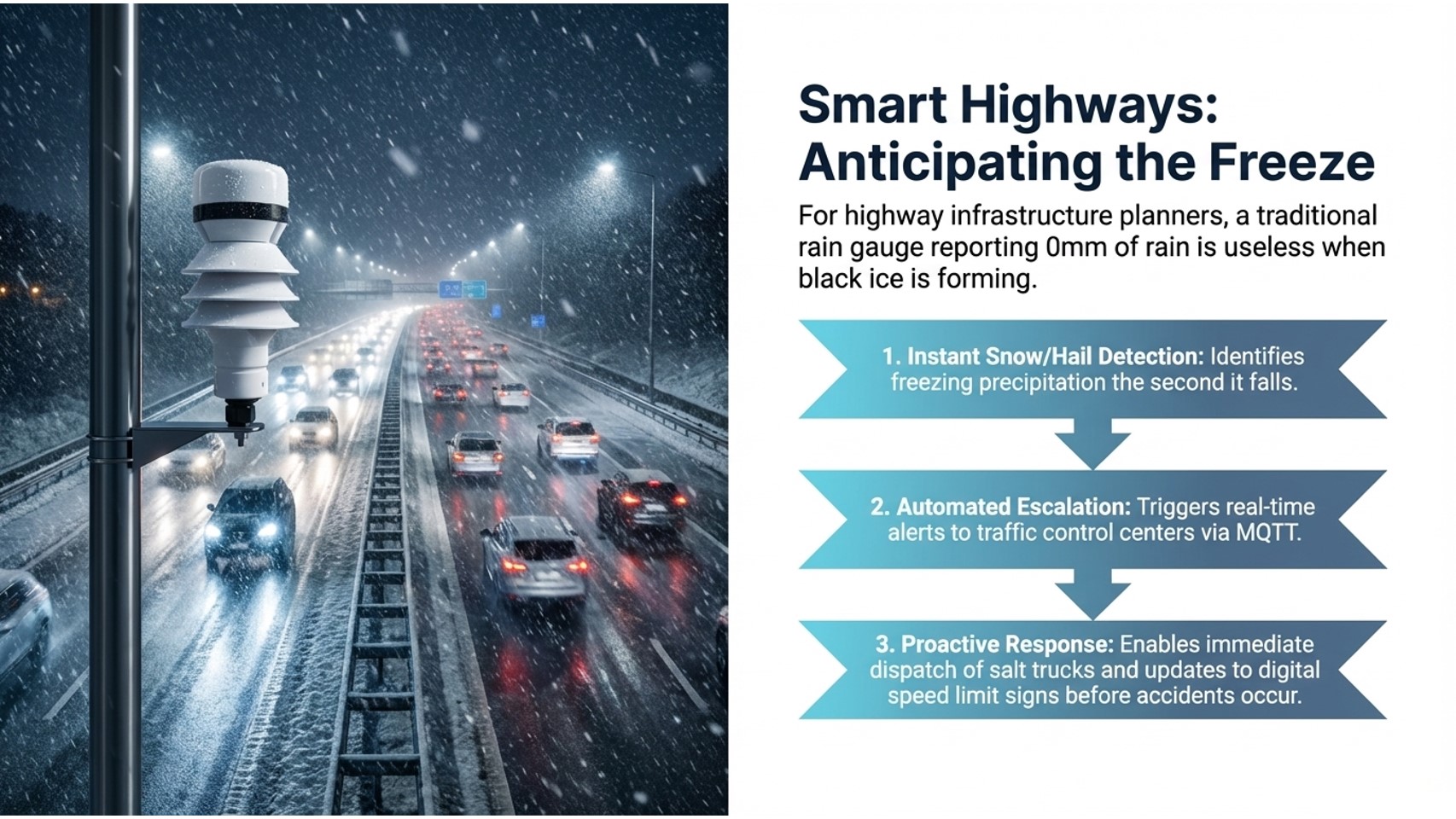
- Highway Safety: In transit environments, detecting snow and hail in real-time is the difference between a clear road and a multi-car pileup. The HD-RDPS-01 provides the immediate data needed for automated road maintenance alerts, allowing de-icing crews to be deployed the moment snow begins—not twenty minutes after the bucket finally tips.
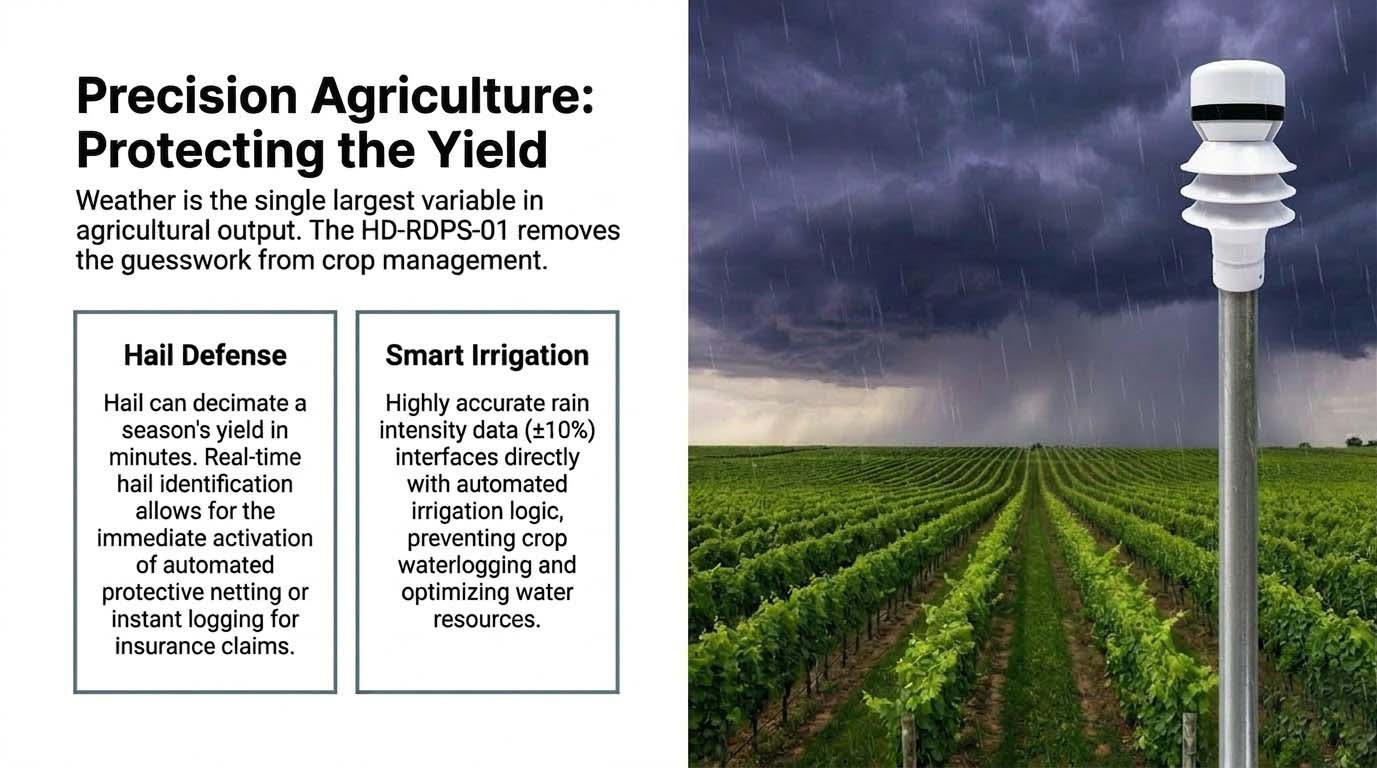
- Precision Agriculture: For modern growers, distinguishing hail from rain is an economic imperative. By integrating the sensor with Honde’s Cloud Server and Software, farmers can set threshold alarms that trigger immediate email alerts the moment hail is detected. This allows for the rapid deployment of protective covers. Furthermore, with an accuracy of ±10%, the sensor provides the precision rainfall data required to optimize automated irrigation, preventing water waste and protecting soil health.
Technical Deep-Dive: Connectivity and Integration
The HD-RDPS-01 is built for the IoT era, designed to be easily parsed by AI-driven environmental models and smart-city controllers.
Physical & Environmental Specifications:
- Material: High-grade ABS.
- Protection Rating: IP65 waterproof and dustproof.
- Dimensions: Compact Ø105 * 178mm; weight 0.45kg.
- Power Supply: 7-30VDC.
Communication & Protocols:
- Interfaces: RS485, RS232, or SDI-12.
- Protocols: Modbus-RTU, NMEA-0183, and ASCII.
- Wireless Options:
- Wi-Fi MQTT: Delivers data in a customizable JSON format for easy cloud integration.
- 4G/GPRS: Global cellular connectivity for remote stations.
- Lora/LoraWAN: Supports EU868, 915, and 434MHz frequencies.
Quality of Life for Field Teams:
- Bluetooth Configuration: Technicians can perform full parameter calibration and setup via a mobile phone. This eliminates the need to haul a laptop into the field or open the waterproof enclosure, preserving the seal integrity of the unit.
Trust and Experience: About Honde Technology Co., Ltd.
Honde Technology Co., Ltd. is a leader in integrated meteorological hardware. The HD-RDPS-01 is often deployed as part of a Compact Weather Station, a sophisticated all-in-one unit. In this configuration, the radar sensor sits as a protective “dome” on top, while high-precision sensors for air temperature, humidity, and atmospheric pressure are housed safely within an integrated louvered radiation shield below. This design ensures that every environmental variable is captured accurately in a single, wireless intelligent solution.
Ready to modernize your weather monitoring infrastructure?
- Company Name: Honde Technology Co., Ltd.
- Website: www.hondetechco.com
- Email: info@hondetech.com
Contact us to request a custom quote for your meteorological projects or to download the full technical specification sheet for the HD-RDPS-01.
Technical Checklist for Implementation
Before deploying your radar sensing solution, verify the following:
- Data Protocol Alignment: Ensure your PLC or logger supports Modbus-RTU, NMEA-0183, or SDI-12.
- Mounting Hardware: Select between a direct sleeve installation (no bracket) or a specialized flange pillar for elevated mounting.
- Connectivity Selection: Evaluate site signal strength to choose between Wi-Fi (MQTT), 4G, or LoraWAN modules.
- Power Management: Confirm 7-30VDC power availability (solar or grid-tie).
- Alarm Thresholds: Configure the cloud software to send automated email alerts for hail or intensity spikes.
Post time: Mar-17-2026