

The US Army Corps of Engineers operates 14 federal dams on the Columbia and Snake rivers. Each dam has a Biological Opinion — a legal instrument under the Endangered Species Act that specifies the conditions under which the project can operate without triggering a formal jeopardy finding for listed salmon and steelhead populations. Dissolved oxygen is a core Biological Opinion parameter. When the tailwater below a dam drops below 8 mg/L — the Oregon and Washington cool-water criterion for salmonid rearing habitat — the dam’s operations are constrained. When the measuring instrument that records that reading is unreliable, the compliance record is contested.
Oregon’s DEQ revised cool-water dissolved oxygen criteria have been at the center of a dispute documented in a March 2025 Puget Sound Institute analysis: natural conditions, human influences, and regulatory standards are in tension in ways that make continuous, high-credibility DO data more important — not less — to resolving the dispute. Simultaneously, NOAA’s confirmation of expanding low-oxygen zones off the Washington and Oregon coasts, documented since 2021 and ongoing through 2026, has pushed Pacific fisheries DO monitoring from a local compliance matter to a regional environmental concern.
The self-cleaning optical DO sensor addresses the data-quality end of this dispute. It cannot make the contested science less contested. It can ensure that the monitoring record used to evaluate compliance is not degraded by bio-fouling between maintenance visits.
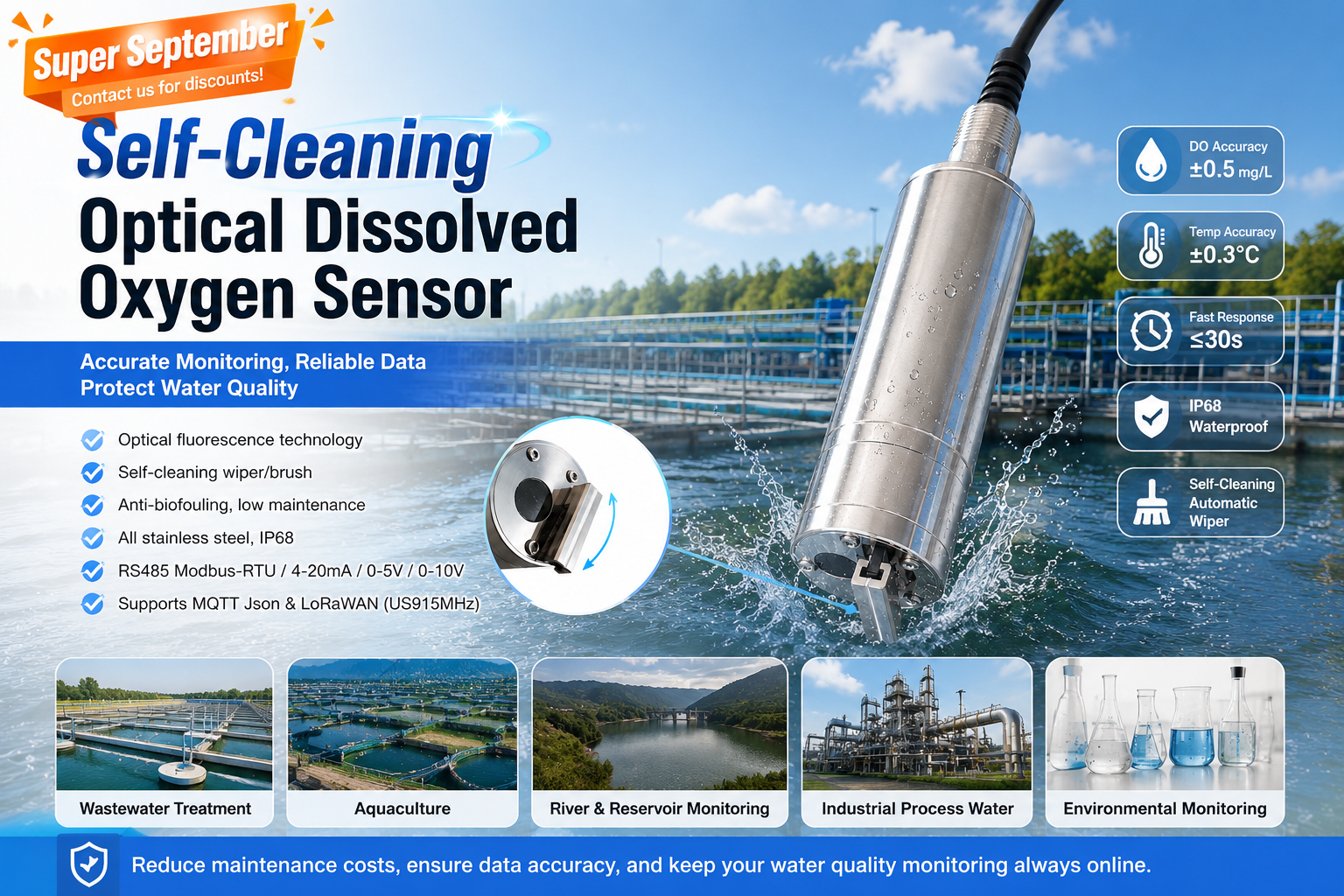
The Bio-Fouling Problem in Columbia River Monitoring
A dissolved oxygen sensor deployed in a Columbia River tailrace in April — the beginning of salmon smolt outmigration — enters a biological race. Diatoms colonize the sensor face within the first week. Filamentous algae attach within the first three weeks. By week six, an unprotected optical window carries a biofilm layer thick enough to reduce measured DO by 15–25%, systematically under-reading in the direction that matters most for compliance: apparent DO appears lower than actual DO, creating false low readings that constrain dam operations unnecessarily during the critical spring migration window.
Cleaning a submerged sensor deployed in a 12 m/s tailrace current requires a dive crew, a dive safety officer, and a dive plan. At a remote run-of-river project on the Snake River, a dive operation costs approximately $3,500 per cleaning event. A sensor that requires cleaning every six weeks generates nine cleaning events per monitoring season — $31,500 in cleaning labor for one sensor at one installation point. A dam with eight monitoring points multiplies that to $252,000 annually in cleaning labor alone.
The self-cleaning brush eliminates the dive crew from the calculation. A motor inside the sensor housing drives a wiper element across the optical face at a programmed interval — every 15 minutes, every hour, configurable. The cost of a cleaning event is one wiper cycle’s worth of battery power. The cleaning happens whether the river is running at 2 m/s or 8 m/s, in daylight or at 3 AM, with or without a dive crew available.
The Sensor
| Specification | Value |
|---|---|
| Measurement principle | Optical fluorescence quenching |
| DO range / accuracy | 0–20.00 mg/L / ±0.5 mg/L |
| Temperature range / accuracy | 0–60°C / ±0.3°C |
| Resolution | 0.01 mg/L / 0.01°C |
| Output | RS485 Modbus-RTU / 4–20 mA / 0–5V / 0–10V |
| Wireless | GPRS / LoRa / LoRaWAN (EU868 / US915 MHz) |
| Protocol | MQTT Json |
| Housing | All-stainless steel, IP68 |
| Self-cleaning | Integrated motorized wiper / brush, programmable interval |
| Power | 12–24 VDC, low-consumption sleep mode |
The US915 MHz LoRaWAN frequency band is the critical specification for Pacific Northwest deployments. Sensors at remote run-of-river projects cannot use EU868 equipment in the US — Federal Communications Commission Part 90 licensing requirements apply, and a sensor that ships with EU868 firmware requires requalification. The US915 MHz native support eliminates this barrier.
Regulatory DO Thresholds — Columbia Basin
| Water body category | DO criterion | Oregon/Washington legal basis |
|---|---|---|
| Salmonid spawning streams | 11.0 mg/L (minimum 7-day mean) | OAR 340-041-0031 |
| Cool-water salmonid rearing | 8.0 mg/L (minimum) | OAR 340-041-0031 |
| Warm-water fisheries | 6.5 mg/L (minimum) | WAC 173-201A |
| Dam tailwater (Biological Opinion) | 8.0 mg/L (95th percentile compliance) | NOAA Fisheries BiOp 2021 |
| Irrigation canal return flows | 5.0 mg/L (7-day mean minimum) | OAR 340-041 |
The Solution Architecture for Dam Network Monitoring
The self-cleaning DO sensor deploys in a fixed stainless mounting bracket at a specified depth in the dam tailrace or monitoring reach. A Data logger with screen in the dam’s instrumentation shelter stores 90 days of 15-minute interval DO and temperature records — the data the USACE’s Columbia River Water Quality Program requires to document Biological Opinion compliance. The USACE’s water quality technician uses a Handmeter during monthly field visits: a portable optical DO reference dipped at the same depth, compared against the installed sensor, confirming calibration before the comparison is logged in the federal monitoring record.
Remote run-of-river projects transmit via LoRaWAN (US915 MHz) to gateways at the dam powerhouse, which backhaul via 4G to the USACE regional operations center. Mainstem projects near cell infrastructure use 4G or WiFi modules directly. All data is packetized in MQTT Json format, feeding the USACE’s water quality data portal (currently the Columbia River Data Access in Real Time — DART — system).
The Cloud server and software consolidates DO data from all monitoring points along the river, showing real-time data and history data. The Alarm relay system implements the Biological Opinion compliance logic: when 7-day mean DO at a tailwater monitoring point falls below 8.0 mg/L, the relay alerts the dam operations center and triggers the spill protocol — releasing additional water over the spillway to increase turbulent aeration — before the exceedance accumulates into a reportable Biological Opinion violation.
Field Results: Snake River Run-of-River Project, 2026
A USACE-operated run-of-river project on the lower Snake River replaced conventional galvanic DO sensors with Honde self-cleaning optical units at four tailrace monitoring points between February and March 2026 — ahead of the April 1 start of the Biological Opinion monitoring season.
- Hardware: 4 self-cleaning optical DO sensors in stainless mounting brackets at specified depths, LoRaWAN US915 MHz modules, powerhouse gateway, 4G backhaul.
- Local: Data logger with screen in instrumentation shelter; Handmeter verification monthly.
- Cloud: MQTT Json to USACE DART portal.
- Alarm: 7-day mean DO < 8.2 mg/L (pre-compliance alert); < 8.0 mg/L (spill protocol trigger).
| Metric | Galvanic sensor baseline (2025) | Self-cleaning optical (2026) |
|---|---|---|
| Scheduled cleaning events | 36 | 0 |
| Data completeness | 87.3% | 98.6% |
| Mean DO error vs. Handmeter | −0.8 mg/L | −0.1 mg/L |
| False low DO readings triggering spill | 7 | 0 |
| Cleaning labor cost (season total) | $126,000 | $0 |
| Sensor replacement (bio-fouling damage) | 2 | 0 |
- The 7 false low DO readings in 2025 had each triggered a spill protocol activation — releasing additional water over the spillway at an estimated hydropower generation cost of $18,000 per event. Total false-trigger cost in 2025: $126,000 in lost generation revenue, plus $126,000 in cleaning labor — $252,000 attributable to sensor bio-fouling at four monitoring points.
- 98.6% data completeness in the 2026 season — the 1.4% gap was a 3-day LoRaWAN gateway power outage; the on-site data logger preserved the complete record and the gap was backfilled when connectivity restored.
- Mean DO error of −0.1 mg/L against the monthly Handmeter reference — within the ±0.3 mg/L federal acceptance criterion for USACE water quality monitoring data throughout the five-month season, without any cleaning or calibration intervention between monthly visits.
- The self-cleaning wiper operated at a 30-minute cycle throughout the season. Internal wiper-cycle counts confirmed the brush operated 7,200 times across the five-month season — no mechanical failures.
Contact Honde Technology for Environmental Compliance Monitoring
Honde Technology is a Germany TUV & Alibaba verified manufacturer. We supply the self-cleaning optical DO sensors, the US915 MHz LoRaWAN wireless modules, and the compliance data logging architecture required for federal environmental monitoring programs in North America.
For more sensor information and customized IoT solutions, please contact Honde Technology Co., LTD.
- WhatsApp: +86-15210548582
- Email: info@hondetech.com
- Company Website: www.hondetechco.com
The Demand Map Across Developed Environmental DO Markets
The self-cleaning optical DO specification is the procurement standard emerging across developed countries with continuous environmental DO compliance requirements in rivers and estuaries. Canada’s Department of Fisheries and Oceans monitors DO in Pacific salmon habitat streams under the Fisheries Act, with the same bio-fouling problem in the turbid rivers of the Fraser and Skeena systems. The European Union’s Water Framework Directive DO monitoring for hypoxic zone assessment in estuaries such as the Elbe, the Scheldt, and the Po delta requires continuous deployment through the biologically active summer months — exactly the season when bio-fouling is most aggressive. Japan’s MLIT river quality monitoring network specifies DO continuously in designated first-class rivers, with seasonal bio-fouling on static deployments a documented data-quality issue that self-cleaning sensors address. Australia’s Murray-Darling Basin DO monitoring for fish passage through weir pools — a requirement under the Basin Plan’s environmental water provisions — specifies sensors that maintain calibration through the algae season without diver intervention. Each compliance framework and each river environment arrives at the same hardware requirement: an optical sensor that does not drift from bio-fouling, because the regulatory record it generates cannot be reconstructed after the fact.
Post time: Sep-02-2026