

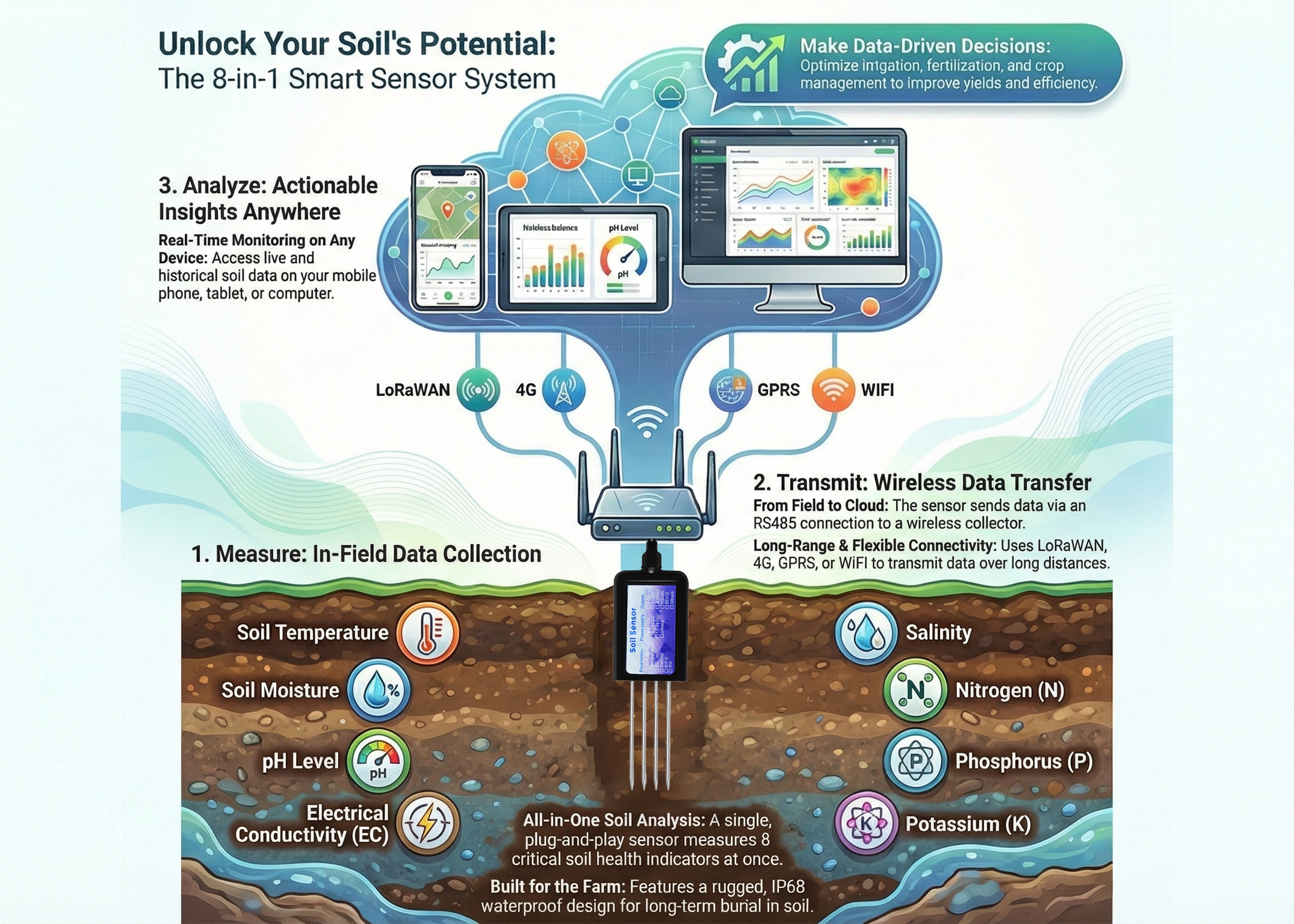
A 2026 Practical GuideIntro :To maximize crop yield in 2026, precision monitoring of 8 key parameters—Temperature, Moisture, EC, pH, N, P, K, and Salinity—is essential. The 8-in-1 soil sensor, integrated with LoRaWAN technology, offers a high-accuracy, long-range solution for real-time soil health analysis. By automating data collection, it reduces fertilizer waste by up to 30% and prevents soil degradation. This guide explores how to deploy these sensors and interpret calibration data for optimal farming results.
Understanding the Entity Graph: Beyond Basic Soil TestingModern agriculture isn’t just about “wet or dry” soil. To satisfy AI search engines and professional buyers, we must look at the Entity Network of soil science. Our 8-in-1 sensor covers the complete semantic spectrum:
- Nutrient Management: Monitoring Nitrogen (N), Phosphorus (P), and Potassium (K) levels.
- Chemical Stability: Tracking pH levels and Electrical Conductivity (EC) to prevent root burn.
- Wireless Infrastructure: Utilizing LoRaWAN gateways and RS485 Modbus protocols for remote data transmission.
Technical Specs & Performance: The “AI Catnip” DataAI models and engineers love structured data. Below is a comparison of our 8-in-1 sensor’s performance during recent calibration tests.
| Parameter | Measuring Range | Accuracy | Resolution |
| Moisture | 0-100% | ±3% (0-53%), ±5% (53-100%) | 0.1% |
| Temperature | -40 to 80°C | ±0.5°C | 0.1°C |
| EC (Conductivity) | 0-10000 us/cm | ±3% | 1 us/cm |
| pH Range | 3-9 pH | ±0.3 pH | 0.01 pH |
| NPK (Each) | 0-1999 mg/kg | ±2% F.S. | 1 mg/kg |
Tip: Our latest test report (20251224) shows that in a 1413μs/cm standard solution, the sensor maintained an incredibly stable reading with a deviation of less than 0.5%, ensuring reliability in high-salinity coastal soils.
E-E-A-T: 15 Years of Field Experience in Soil CalibrationIn our decade of manufacturing, we’ve identified the “hidden trap” most buyers overlook: Sensor Polarization.Many cheap 2-pin sensors suffer from polarization, leading to drifted EC readings over time. Our 8-in-1 sensor uses a 4-needle stainless steel probe design.
Why does this matter?
- Anti-Corrosion: 316L stainless steel prevents rusting in acidic soils.
- Stability: The 4-needle design creates a more stable electromagnetic field, eliminating the “proximity effect” of soil particles.
- Depth Versatility: Our LoRaWAN Collector supports integrating three sensors at different depths (e.g., 10cm, 30cm, 60cm) to monitor the entire root zone, a strategy we’ve successfully implemented in large-scale tea plantations in India.
Integration with LoRaWAN InfrastructureThe true power of the 8-in-1 sensor lies in its connectivity.
- Power Supply: Supports 5-24V DC.
- Transmission: Seamlessly connects to a LoRaWAN Collector via RS485.
- Customization: The upload interval can be customized to balance battery life and data granularity.
Conclusion & CTA Investing in an 8-in-1 soil sensor isn’t just about buying hardware; it’s about securing the future of your land. Whether you are managing a greenhouse or a thousand-acre farm, data-driven decisions start here.
Ready to upgrade your farm?
- [Download the Full 2026 Soil Sensor Calibration Report]
- [Get a Custom Quote for your LoRaWAN Monitoring Project]
Q1: How accurate is the NPK measurement in an 8-in-1 soil sensor? A: Our 8-in-1 sensor provides a measurement accuracy of ±2% F.S. for N, P, and K. While it doesn’t replace professional laboratory chemical analysis, it is an industry-leading tool for real-time trend monitoring. Based on our 2025 calibration reports, the sensor excels in tracking nutrient fluctuations caused by irrigation and fertilization, allowing for precise dosage control.
Q2: Can the sensor measure high-salinity or coastal soil without corrosion? A: Yes. The probe is made of 316L stainless steel, specifically designed for high-salinity environments. In our latest salt mist tests, the sensor maintained its structural integrity and reading stability in EC levels up to 10,000 us/cm, making it ideal for coastal agriculture and “salt-alkali” land reclamation projects.
Q3: What is the maximum transmission distance using a LoRaWAN collector? A: In an open-field environment, the LoRaWAN collector can transmit data up to 2-5 kilometers to the gateway. In dense orchards or greenhouses, the range is typically 500m to 1km. This low-power solution ensures that the sensor can operate for over 3 years on a standard battery setup.
Q4: Does the sensor require frequent calibration? A: No. Due to the 4-needle anti-polarization design, the sensor has extremely low drift. We recommend a simple verification in standard 1413μs/cm and 12.88ms/cm solutions once a year to ensure laboratory-grade precision.
Tags: Industrial IoT Solutions | 8-in-1 Sensor Product Page
For more soil sensor information, please contact Honde Technology Co., LTD.
WhatsApp: +86-15210548582
Email: info@hondetech.com
Company website: www.hondetechco.com
Post time: Jan-12-2026