

1. The Silent Failure of Submerged Sensors
In the high-stakes arena of industrial wastewater and national hydrological monitoring, traditional contact-based sensors are increasingly viewed as a liability. Whether in the sludge-heavy environments of treatment plants or the debris-strewn turbulence of mountain rivers, submerged sensors are perpetually under siege from corrosion, sedimentation, and mechanical wear. This leads to “silent failures”—data gaps that occur precisely during flood peaks or critical discharge events when accuracy is paramount.
As an Industrial IoT strategist, I see the adoption of the RD-600s radar flow meter as more than just a hardware upgrade; it is a fundamental paradigm shift from “immersive” to “overhead” monitoring. This transition is being driven by global policy mandates, such as China’s 14th Five-Year Plan for water management and the EU’s Urban Wastewater Treatment Directive, which demand nearly universal, high-reliability monitoring. By moving the point of measurement above the surface, we eliminate the physical vulnerabilities that have plagued water management for decades.
2. The Power of “Non-Contact”: Measuring Without Touching
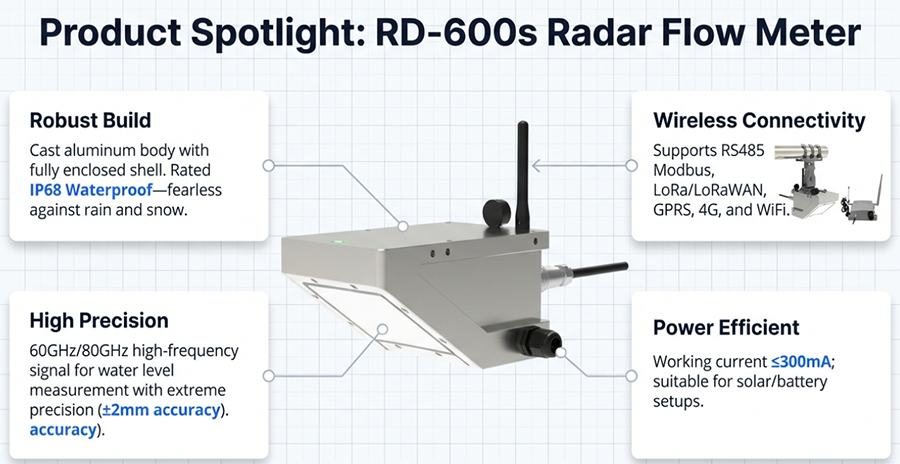
The core innovation of the RD-600s lies in its use of planar microwave technology and the Doppler radar principle. By emitting signals that reflect off the moving water surface, the device calculates surface velocity and water level simultaneously without a single component ever touching the medium.
“Non-contact measurement, not affected by debris.”
This “invisible” interface is the ultimate solution to the 80% maintenance burden typically associated with contact sensors. Because the hardware is shielded from corrosive chemicals and physical impacts, the RD-600s ensures consistent data integrity in environments where traditional meters would fail within months. In a recent industrial emission project, this non-contact approach allowed a chemical plant to maintain compliance in highly corrosive conditions that previously destroyed sensors every 90 days, successfully avoiding potential environmental fines exceeding ¥5 million.
3. The Precision of the “High-Frequency” Advantage
Technical precision is dictated by frequency selection. While 24GHz radar is the industry standard for measuring flow velocity in wide, open channels, the RD-600s leverages 60GHz and 80GHz frequencies for water level gauging to achieve surgical accuracy. The “High-Frequency” advantage lies in the beam angle; a narrow 3-5° beam allows the sensor to operate in confined spaces—like narrow manholes or under low bridges—without “multipath interference” from walls or railings.
Frequency Selection Decision Matrix
|
Application Scenario
|
Recommended Frequency
|
Beam Angle
|
Technical Advantage
|
|---|---|---|---|
|
Wide River Channels
|
24GHz (Flowrate)
|
12°
|
Wide coverage; cost-effective for large scale
|
|
Confined Spaces
|
80GHz (Level)
|
3–5°
|
High anti-interference; ±2mm level accuracy
|
|
High Precision Needs
|
80GHz (Level)
|
3°
|
Resolution for ±1%FS flowrate accuracy
|
4. The “Maintenance Myth” and the 14-Month Payback
The most common barrier to IOT adoption is the perceived “radar premium.” However, a strategic Total Cost of Ownership (TCO) analysis quickly dismantles this myth. While an RD-600s unit may require an initial investment of ¥80,000 compared to ¥50,000 for a traditional ultrasonic meter, the long-term economics are indisputable.
Consider the case of a Shanghai wastewater treatment plant: by switching to radar technology, they reduced annual maintenance costs by 75% and extended continuous operation from three months to two years. Furthermore, the high-fidelity data allowed for process optimization that saved 15% in total energy consumption. When factoring in these operational efficiencies and the elimination of downtime, the payback period for the RD-600s is just 14 months. Over a three-year horizon, the radar solution costs ¥95,000, whereas the “cheaper” ultrasonic alternative balloons to ¥150,000.
5. Rugged Resilience: Built for the “Fearless” Environment
Engineering for climate resilience requires hardware that treats extreme weather as a standard operating condition. The RD-600s is housed in a cast aluminum, IP68-rated body designed for “fearless” operation in rain and snow.
Its technical parameters reflect this rugged philosophy:
• Operating Humidity: 0%~100%, allowing for accurate measurement in heavy fog or tropical humidity.
• Electrical Fortification: Built-in 6KV lightning protection to survive the electrical volatility of outdoor hydrological stations.
• Proven Scale: This resilience has been proven at the Three Gorges Reservoir, where radar networks manage ultra-large flows of up to 50,000 m³/s across a 175-meter water level variation range, optimizing power generation by 1.2% annually.
6. From Raw Data to Digital Twins: The Intelligence Layer
The RD-600s acts as the digital foundation for the “Smart City” ecosystem. With multiple output methods including 4G, LORA, and RS485, it integrates seamlessly into broader IoT architectures. The true value, however, is unlocked through its AI-enhanced “Water Surface Pattern Recognition.”
This edge-computing capability allows the sensor to intelligently filter out interference from waves, turbulence, or reflections from bridge structures. This clean data feed is essential for creating “Digital Twins” of river systems. In Singapore’s Smart National Water Grid, over 500 radar monitoring points feed AI flood prediction models, reducing emergency response times by 40% and providing a 92% accuracy rate for flood warnings.
7.Performance Comparison: Radar vs. Traditional Tech
|
Metric
|
Radar Flow Meter
|
Ultrasonic Flow Meter
|
Electromagnetic Flow Meter
|
|---|---|---|---|
|
Installation
|
Non-contact, overhead
|
Non-contact / Contact
|
Immersive (must touch liquid)
|
|
Medium Constraints
|
None (Works in sludge/acid)
|
No bubbles/suspended solids
|
Must be conductive liquid
|
|
Fouling Resistance
|
★★★★★
|
★★★☆☆
|
★★☆☆☆
|
|
Environment Adaptation
|
★★★★★
|
★★★☆☆
|
★★☆☆☆
|
|
Maintenance
|
Annual (Minimal)
|
Quarterly
|
Monthly (High)
|
8. Application Scenarios: Proving the ROI
Hydrological Monitoring: The Yangtze & Singapore Success
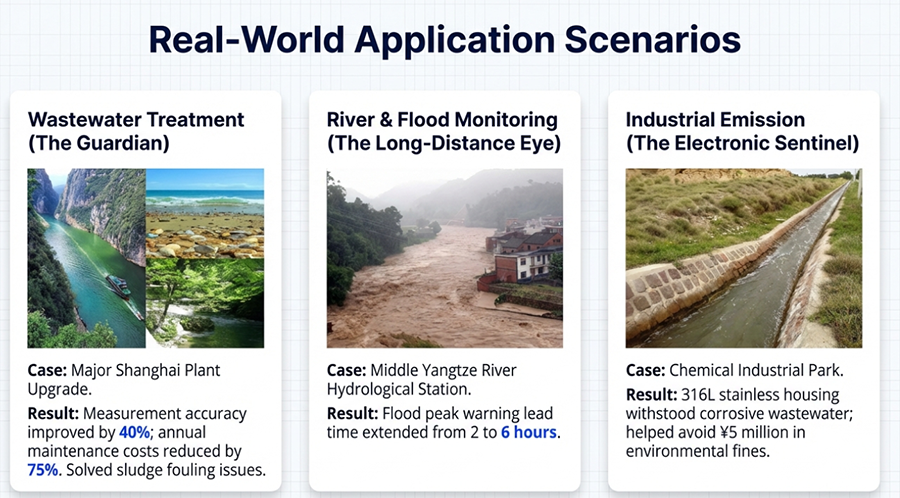
In the Middle Yangtze River, 80GHz radar units installed 8 meters above the water provide real-time flood peak warnings. In Singapore’s Smart National Water Grid, over 500 radar points integrated with AI models have achieved a 92% flood warning accuracy rate, reducing emergency response times by 40%.
Urban Infrastructure: The Shanghai Wastewater Upgrade
A major Shanghai treatment plant replaced failing ultrasonic meters with RD-600s radar technology. In an environment dominated by thick sludge, the radar system improved measurement accuracy by 40% and reduced annual maintenance costs by 75%. Most importantly, the real-time data allowed for process optimization that resulted in a 15% total energy saving.
Industrial & Wastewater: The “Electronic Sentinel”
In chemical industrial parks, where corrosive discharge can melt a standard sensor in three months, our 316L stainless steel radar units offer continuous operation for over 2 years. This provides tamper-proof compliance data, helping one firm avoid over ¥5 million in potential environmental fines.
The ROI Factor: While radar has a higher initial cost, the payback period is typically just 14 months. When you factor in the 80% reduction in maintenance and the elimination of downtime, the 10-year Net Present Value (NPV) of a radar installation is significantly higher than any contact-based alternative.
9. FAQ:
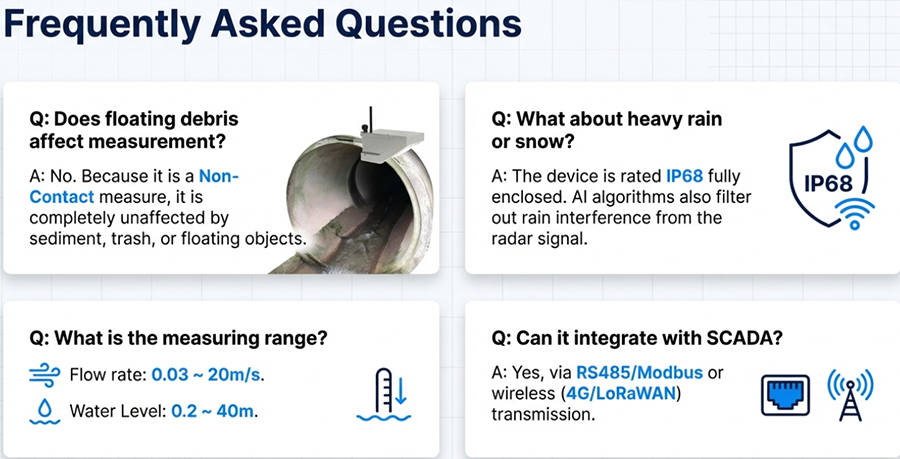
Q: Can it work in heavy rain or snow?
A: Absolutely. The RD-600s is designed for 24-hour operation and is IP68 rated. Its radar signal penetrates rain and snow, and its AI algorithms filter out environmental noise to maintain signal integrity.
Q: How does it handle different channel shapes?
A: The system includes pre-set hydraulic models for circular, rectangular, and trapezoidal sections. You simply input the cross-sectional parameters, and the device calculates the flow rate automatically.
Q: Is it affected by floating debris or foam?
A: No. Since it is a non-contact instrument, floating objects pass underneath it without interference. The 24GHz/80GHz frequency is specifically tuned to detect the water surface velocity regardless of surface debris.
10. Conclusion: A New Era Above the Water
As we strive to meet UN Sustainable Development Goal 6 (Global Water Monitoring), the transition to non-contact radar technology has become a strategic necessity. The RD-600s represents the evolution of sensing—from vulnerable, high-maintenance hardware to durable, intelligent systems that support climate adaptation and ESG compliance.
As climate change intensifies extreme weather events, can we really afford to rely on sensors that are vulnerable to the very elements they are meant to monitor?
Tags: water flow sensor | water level sensor | water speed sensor
For more weather station information,
please contact Honde Technology Co., LTD.
WhatsApp: +86-15210548582
Email: info@hondetech.com
Company website: www.hondetechco.com
#Radar Flow Meter #Smart Water #IoT #Flood Control #Water Monitoring #Non Contact Measurement #Wastewater Management #Digital Twin #Smart City #Industrial IoT
Post time: Jan-16-2026