

1. The Evolution of Environmental Monitoring
In the landscape of modern industrial telemetry, the shift from traditional wired systems to autonomous, wireless IoT solutions is driven by a need for lower Total Cost of Ownership (TCO) and higher data fidelity. As a Solutions Architect, I see many projects fail not because of software, but because of hardware degradation in the field. Precision monitoring requires more than just a good sensor; it requires a hardened ecosystem. The Wireless Air Quality Sensor represents this evolution—a robust, multi-protocol platform housed in advanced ASA material, designed to provide real-time, actionable data without the constant need for site maintenance or housing replacement.
2. The “ASA” Advantage: Why Material Science Dictates Longevity
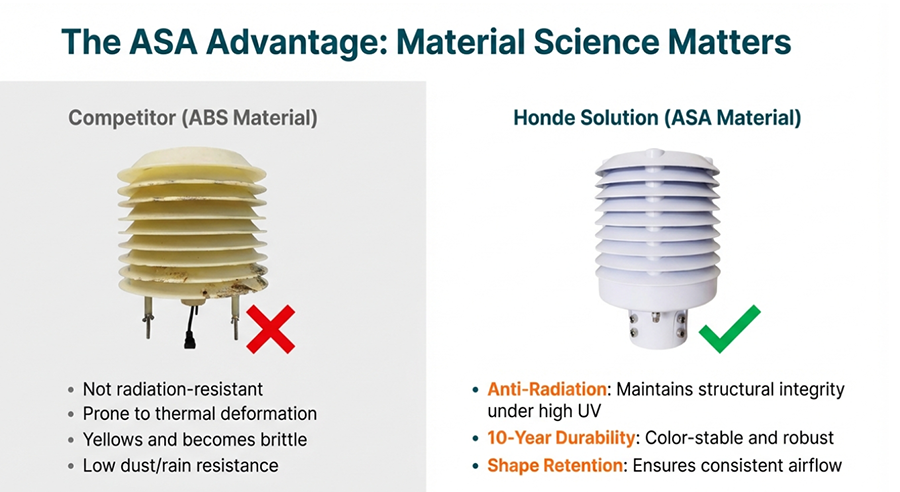
The housing is the most critical point of failure for outdoor sensors. While ABS is common, it lacks the resilience required for decadal deployments. We have transitioned to ASA (Acrylonitrile Styrene Acrylate) to ensure the stability of your monitoring network.
|
Feature
|
ABS Material
|
ASA Material
|
|---|---|---|
|
Radiation Resistance
|
None; susceptible to solar heat gain
|
High anti-radiation; maintains internal temp
|
|
UV Resistance
|
Poor; yellows and becomes brittle
|
Superior; designed for high-UV environments
|
|
Structural Stability
|
Prone to warping/deformation
|
High-strength; retains shape
|
|
Blade Thickness
|
Standard/Thin
|
2.2 cm Heavy-Duty Blades
|
|
Environmental Shielding
|
Low dust/rain protection
|
IP65 High-level dust/rain protection
|
|
Service Life (Outdoor)
|
2–3 years (typical)
|
10 Years Guaranteed
|
Engineering Insight: The Double-Rim Louver Design
Longevity is also a matter of internal hygiene. Our shutter box features a specialized “double-rim” design. By creating a labyrinthine path for airflow, the housing effectively blocks dust and rain ingress while maximizing air exchange. This architectural choice ensures the “window channel” remains readable, significantly reducing sensor drift and thermal lag, which are common in inferior single-rim or ABS housings.
3. Technical Specifications & Measurement Capabilities
This platform is engineered for extreme versatility, supporting a comprehensive suite of 19 parameters to satisfy the most demanding environmental and industrial requirements.
Comprehensive Parameter Matrix
|
Parameter
|
Measurement Range
|
Resolution
|
|---|---|---|
|
Air Temperature
|
-40 to 120°C
|
0.1°C
|
|
Air Relative Humidity
|
0 to 100% RH
|
0.1%
|
|
Illumination
|
0 to 200K Lux
|
10 Lux
|
|
EX (Combustible Gas)
|
0 to 100% LEL
|
1% LEL
|
|
O2 (Oxygen)
|
0 to 30% vol
|
0.1% vol
|
|
H2S (Hydrogen Sulfide)
|
0 to 100 ppm
|
0.1 ppm
|
|
CO (Carbon Monoxide)
|
0 to 1000 ppm
|
1 ppm
|
|
CO2 (Carbon Dioxide)
|
0 to 5000 ppm
|
1 ppm / 0.1% vol
|
|
NO (Nitric Oxide)
|
0 to 250 ppm
|
1 ppm
|
|
NO2 (Nitrogen Dioxide)
|
0 to 20 ppm
|
0.1 ppm
|
|
SO2 (Sulfur Dioxide)
|
0 to 20 ppm
|
0.1 / 1 ppm
|
|
CL2 (Chlorine)
|
0 to 20 ppm
|
0.1 ppm
|
|
H2 (Hydrogen)
|
0 to 1000 ppm
|
1 ppm
|
|
NH3 (Ammonia)
|
0 to 100 ppm
|
0.1 / 1 ppm
|
|
PH3 (Phosphine)
|
0 to 20 ppm
|
0.1 ppm
|
|
HCL (Hydrogen Chloride)
|
0 to 20 ppm
|
0.001 / 0.1 ppm
|
|
CLO2 (Chlorine Dioxide)
|
0 to 50 ppm
|
0.1 ppm
|
|
HCN (Hydrogen Cyanide)
|
0 to 50 ppm
|
0.1 / 0.01 ppm
|
|
C2H4O (Ethylene Oxide)
|
0 to 100 ppm
|
1 / 0.1 ppm
|
|
O3 (Ozone)
|
0 to 10 ppm
|
0.1 ppm
|
Power & Connectivity Architecture
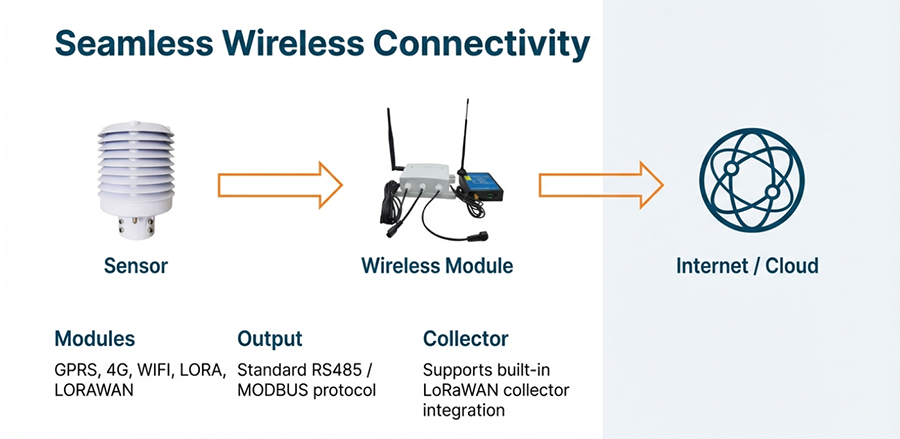
• Wireless Protocol Versatility: LoRaWAN (868MHz, 915MHz, 434MHz), GPRS, 4G, and WiFi.
• Wired Reliability: RS485 output using standard MODBUS communication protocol.
• Extended Lead Length: Supports RS485 cable runs up to 1000 meters for large-scale facility integration.
• Electrical Efficiency: Optimized for low-power operation: 85mA@5V, 50mA@12V, 40mA@24V.
• Durability Standards: IP65 protection; operating range of -30 to 70°C.
4. Wireless Ecosystem & Visualization
Data is only valuable if it is accessible. Our system provides a seamless pipeline from the edge to the end-user.
• Real-Time Visualization: View critical data via Web View, Mobile App, or Tablet PC interfaces.
• LoRaWAN Solar Integration: Remote deployments benefit from integrated solar panels on the collectors, allowing for completely autonomous, grid-independent operation.
• Modular Construction: The ASA shutter box is fully customizable; while the standard unit is compact, the stack can be expanded from 4 to 20 layers to accommodate complex multi-sensor arrays.
5. Real-World Application Scenarios
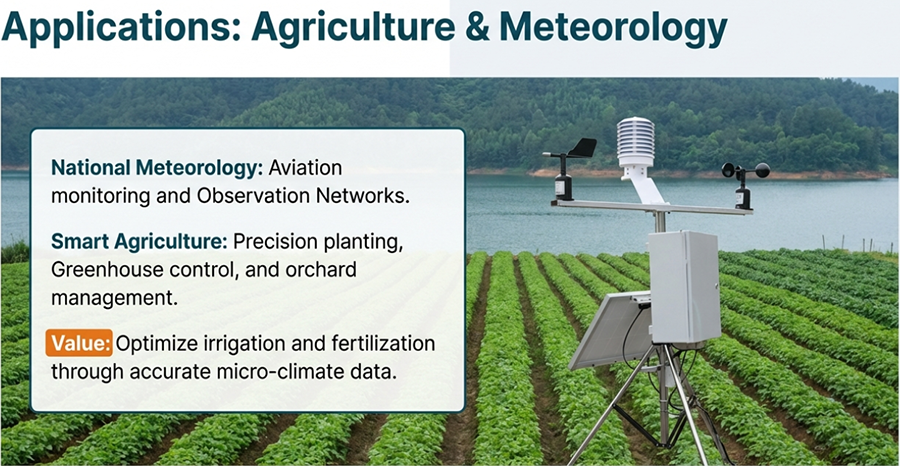
This sensor’s durability and parameter range make it ideal for high-stakes environments:
• Meteorological Observation: Deployment in national networks and airport aviation safety systems.
• Smart Agriculture: Precision monitoring for greenhouses, tea plantations, and orchards.
• Environmental Monitoring: Urban air quality tracking and forest/hydrological conservation.
• Industrial & Infrastructure: Mission-critical monitoring for Data Centers, Transportation Infrastructure, and New Energy Stations.
• Scientific Research: High-resolution gas and climate data for laboratory and field research.
6. FAQ
7. Conclusion
For more GAS SENSOR information,
please contact Honde Technology Co., LTD.
WhatsApp: +86-15210548582
Email: info@hondetech.com
Company website: www.hondetechco.com
Post time: Jan-30-2026