

Quick Answer
A 4G WiFi IoT off-grid weather station is a remote environmental monitoring solution designed for locations where conventional power infrastructure or wired communication is difficult to access. By combining weather sensors, wireless connectivity, and an appropriately configured off-grid power system, it can collect meteorological data and transmit it to a remote monitoring platform.
For agricultural fields, solar power plants, environmental monitoring networks, highways, and other remote outdoor sites, this type of weather station can reduce the need for on-site data collection and simplify deployment. The most important purchasing considerations are measurement parameters, 4G or WiFi connectivity, solar power capacity, battery autonomy, outdoor protection, and compatibility with the customer’s IoT platform.
Honde Technology Co., Ltd. provides weather monitoring and IoT solutions that can be configured according to different environmental monitoring requirements.
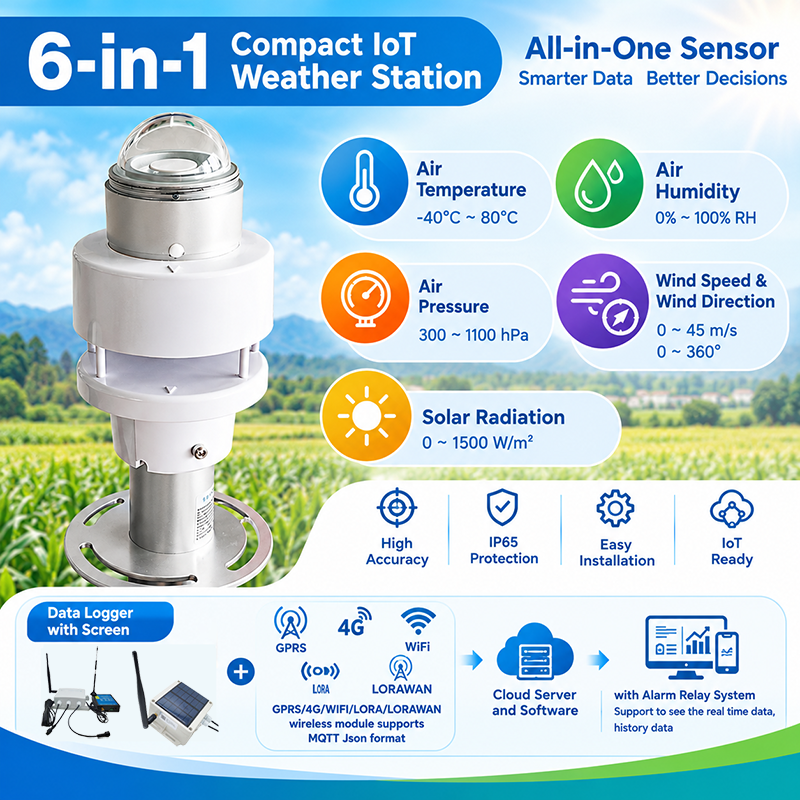
1. What Is a 4G WiFi IoT Off-Grid Weather Station?
A 4G WiFi IoT off-grid weather station is an integrated weather monitoring system designed to collect environmental data and transmit it wirelessly without relying on a conventional grid connection when a suitable independent power supply is configured.
Traditional weather monitoring installations may require separate sensors, data acquisition equipment, communication devices, and power infrastructure. An integrated IoT weather station brings these functions together into a more coordinated monitoring solution.
A typical system architecture is:
Weather Sensors → Data Acquisition → 4G/WiFi Communication → Cloud Platform → Remote Monitoring
For an off-grid deployment, the power architecture can be configured as:
Solar Panel → Charge Controller → Battery → Weather Station and Communication Module
The actual equipment configuration depends on the required parameters, power consumption, network conditions, and project environment.
2. Key Features of an Off-Grid IoT Weather Monitoring System
2.1 Independent Power for Remote Deployment
Remote agricultural fields, photovoltaic power plants, and environmental monitoring locations may lack convenient access to grid electricity.
A properly sized solar panel and battery system can supply the energy needed for weather measurement and wireless data transmission. This helps reduce dependence on external electrical infrastructure.
However, solar-powered operation is not determined by panel size alone. Battery capacity, local solar radiation, seasonal weather, transmission frequency, and daily energy consumption must all be considered.
2.2 4G and WiFi Wireless Connectivity
Wireless communication allows monitoring data to be accessed without requiring a dedicated communication cable between the station and the monitoring center.
| Communication Method | Typical Application | Main Consideration |
|---|---|---|
| 4G | Remote farms, solar plants, outdoor monitoring sites | Requires compatible cellular coverage and service |
| WiFi | Greenhouses, buildings, and connected facilities | Requires reliable WiFi coverage |
| RS485 Modbus RTU | Industrial equipment and local data acquisition | Requires a compatible wired connection |
| LoRa/LoRaWAN | Distributed, low-power sensor networks | Requires a suitable gateway or network architecture |
These are general communication choices for weather monitoring systems. Confirm which interfaces are included in the exact product configuration before ordering.
2.3 Remote Data Access and IoT Integration
A connected weather station can form part of a larger environmental monitoring system.
Depending on the selected hardware and software configuration, project functions may include:
- Real-time meteorological data viewing
- Historical data storage and trend analysis
- Remote monitoring through a computer or mobile device
- Alarm notifications for configured thresholds
- Integration with a customer’s existing IoT platform
For projects requiring direct server integration, buyers should confirm the supported communication protocol, data format, transmission interval, and server compatibility.
3. What Parameters Should a Weather Station Monitor?
The correct measurement configuration depends on the intended application. Buyers should define the required parameters before selecting the product.
| Application | Potential Measurement Parameters | Main Objective |
|---|---|---|
| Smart agriculture | Air temperature, humidity, wind, rainfall, solar radiation | Crop and field-condition monitoring |
| Solar photovoltaic plants | Solar radiation, air temperature, humidity, wind speed, wind direction | Environmental assessment and PV operations |
| Environmental monitoring | Temperature, humidity, pressure, rainfall, illuminance | Local environmental observation |
| Transportation infrastructure | Wind, rainfall, temperature, humidity | Roadside weather monitoring |
| Distributed IoT networks | Selected meteorological parameters and wireless communication | Remote data collection across multiple sites |
Important: This table describes typical application requirements, not a confirmed standard parameter list for every 4G WiFi off-grid model. The final configuration should be checked against the product datasheet.
For example, photovoltaic monitoring may require solar radiation measurements, while agricultural projects may prioritize rainfall and temperature. Selecting only the parameters needed by the project can help avoid unnecessary equipment costs.
4. How Does a Solar-Powered Remote Weather Station Work?
A solar-powered IoT weather station generally follows five operating stages.
Step 1: Solar Energy Collection
The solar panel converts available sunlight into electrical energy.
Step 2: Battery Charging and Energy Storage
A charge controller manages the charging process, while the battery stores energy for periods when solar generation is insufficient.
Step 3: Meteorological Data Collection
The configured sensors measure environmental conditions at the installation site. The data acquisition unit gathers the measurements for processing and transmission.
Step 4: Wireless Data Transmission
The communication module sends collected information through the selected network. A 4G connection is useful when the site has cellular coverage, while WiFi is suitable where a reliable local network is available.
Step 5: Remote Monitoring and Analysis
The receiving platform presents the data for monitoring and analysis. Depending on the system configuration, users may also access historical records, configure alarms, or export data.
The resulting workflow reduces dependence on manual field visits and makes distributed monitoring easier to manage.
5. Where Can a 4G WiFi Off-Grid Weather Station Be Used?
Smart Agriculture
Agricultural operators need local weather information to understand changing field conditions.
A remote weather station can support:
- Field microclimate monitoring
- Irrigation planning
- Rainfall observation
- Crop-condition assessment
- Agricultural research and environmental data collection
For larger projects, weather stations can be combined with soil moisture, soil temperature, or other agricultural sensors when the application requires both atmospheric and root-zone information.
Solar Photovoltaic Power Plants
Solar radiation and weather conditions provide important environmental context for photovoltaic system assessment.
A weather monitoring installation may collect solar radiation, temperature, humidity, and wind data, depending on the project requirements.
For remote solar farms, an off-grid power system and wireless communication can help simplify the deployment of monitoring points where grid electricity or wired communication is inconvenient.
Environmental Monitoring Networks
Environmental agencies, research organizations, and industrial operators may need data from multiple outdoor locations.
A connected weather station can serve as one node in a larger network, allowing monitoring personnel to review measurements remotely rather than visiting every site to retrieve data manually.
Highways and Remote Infrastructure
Roadside infrastructure, bridges, and remote industrial facilities may require local weather information for operational monitoring.
The suitability of a particular station depends on the required measurement parameters, installation conditions, communication coverage, and environmental protection rating.
6. Off-Grid Weather Station vs. Grid-Powered Weather Station
Which power configuration is better? The answer depends on the installation site and operating requirements.
| Comparison Factor | Off-Grid Configuration | Grid-Powered Configuration |
|---|---|---|
| External grid electricity | Not required when the independent power system is correctly designed | Required |
| Remote deployment | Often advantageous | May require electrical infrastructure |
| Initial power-system design | Requires solar and battery sizing | Requires a suitable electrical supply |
| Long periods of low sunlight | Battery autonomy must be evaluated | Less dependent on solar availability |
| Installation considerations | Solar exposure, battery capacity, energy consumption | Power access, wiring, electrical safety |
| Typical use | Remote fields and infrastructure | Sites with reliable electricity |
An off-grid system is not automatically the best option for every project. Where grid power is readily available, a grid-powered installation may be simpler. Where power infrastructure is expensive or unavailable, solar-powered operation may offer a more practical deployment strategy.
7. How to Choose the Right 4G WiFi IoT Weather Station
Before purchasing a remote weather monitoring system, B2B buyers should evaluate the complete configuration rather than focusing on the product name alone.
1. Confirm the Required Weather Parameters
Prepare a list of the measurements needed for the application. Confirm whether each parameter is standard, optional, or supplied through an additional sensor.
2. Check Communication Coverage
Verify that the installation site has suitable 4G coverage or an available WiFi network. For multi-site deployments, consider how the data will reach the central monitoring platform.
3. Calculate Solar Power and Battery Capacity
Ask the supplier to evaluate:
- Daily power consumption
- Solar panel output under local conditions
- Battery capacity
- Required autonomy during low-sunlight periods
- Wireless transmission frequency
- Seasonal operating conditions
A properly sized power system is essential for reliable off-grid operation.
4. Verify Outdoor Protection
Check the enclosure protection rating, operating temperature range, mounting method, and suitability for the local environment. Do not assume that a particular IP rating applies unless it is documented for the exact model.
5. Confirm Software and Data Compatibility
For IoT projects, confirm whether the station can communicate with the intended server or software platform. Ask about available protocols, data formats, API or integration options, and data export functions where applicable.
6. Request a Complete Project Configuration
For B2B applications, the final solution may include the weather station, solar panel, battery, mounting hardware, communication module, and monitoring software.
A supplier that can help coordinate these components may simplify procurement, installation planning, and long-term maintenance.
8. Why Consider Honde Technology for Remote Weather Monitoring?
Honde Technology Co., Ltd. develops and supplies environmental monitoring equipment and IoT solutions for applications including agriculture, renewable energy, and outdoor environmental monitoring.
Its broader weather monitoring portfolio includes compact weather stations, solar-powered monitoring configurations, wireless communication options, and related server and software solutions.
For a 4G WiFi off-grid weather monitoring project, the configuration should be evaluated against the customer’s actual measurement requirements, communication environment, power budget, and installation conditions.
Honde can discuss project requirements such as:
- Required meteorological parameters
- 4G or WiFi communication
- Solar power and battery configuration
- Mounting structures and installation accessories
- Remote data access and software integration
- Customized monitoring solutions for B2B projects
For more information about solar-powered remote monitoring, read the related guide: Solar Panel with Compact Weather Station: A Complete Guide for Remote Weather Monitoring.
9. Frequently Asked Questions
Can a 4G WiFi off-grid weather station operate without grid electricity?
Yes, if the selected system includes an appropriately sized independent power supply, such as a solar panel and battery. Actual operating autonomy depends on energy consumption, sunlight availability, and battery capacity.
Does a 4G weather station need a SIM card?
A cellular-connected configuration generally requires an appropriate SIM or cellular service arrangement, depending on the communication module and network architecture. Confirm supported network bands and service requirements before deployment.
Can I use WiFi instead of 4G?
WiFi can be suitable when a stable local wireless network is available. For remote sites without WiFi infrastructure but with cellular coverage, 4G may be more practical.
Can the weather station connect to cloud software?
That depends on the hardware, communication protocol, and software configuration. Confirm whether the model supports the required data format and server integration.
Can I customize the measured parameters?
Some weather monitoring systems support optional sensors or customized configurations. The available parameters, interfaces, and compatibility should be confirmed with the supplier before placing an order.
How do I choose the right solar panel and battery?
Start with the station’s power consumption and required operating autonomy. Then consider local solar radiation, seasonal weather, charging efficiency, communication frequency, and battery specifications. Request a power-budget assessment for demanding remote installations.
What information should I provide when requesting a quotation?
Provide the application, installation location, required parameters, communication method, power requirements, expected quantity, and any cloud integration requirements. This information helps the supplier recommend an appropriate configuration.
10. Get a Customized 4G WiFi Off-Grid Weather Station Solution
Choosing a remote weather station is not only about selecting sensors. Reliable operation depends on the combination of measurement capability, independent power, wireless communication, data management, and installation design.
If you are sourcing a 4G WiFi IoT off-grid weather station for smart agriculture, solar power plants, environmental monitoring, or another remote application, contact Honde Technology to discuss your project.
Company Name: Honde Technology Co., Ltd.
Website: www.hondetechco.com
Email: info@hondetech.com
Send us your required parameters, installation environment, communication preferences, and expected quantity to request a suitable product configuration and customized quotation.
Contact Honde Technology today to discuss your remote weather monitoring project.
Post time: Oct-13-2026