

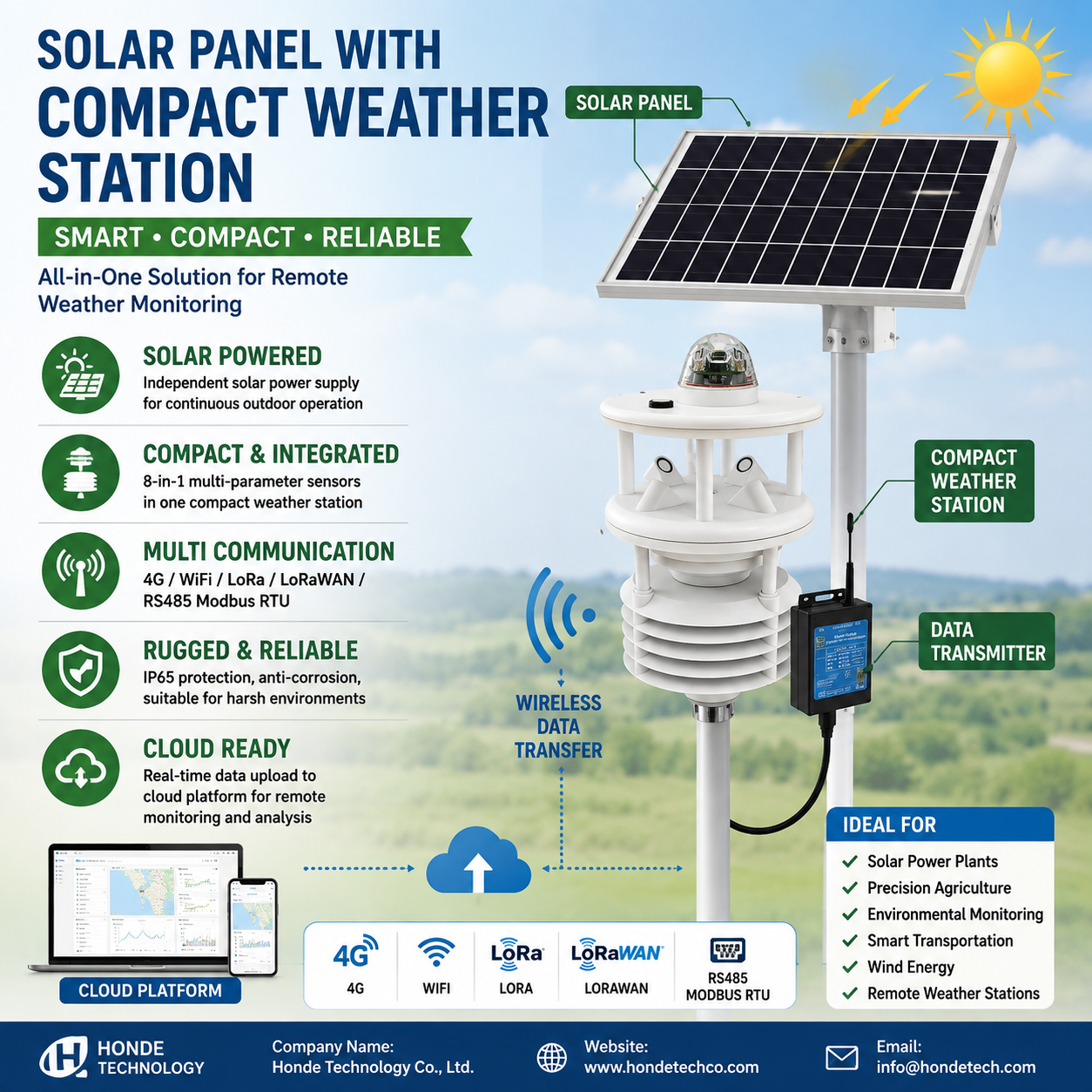
Honde Technology’s compact weather station can integrate multiple meteorological measurements, including air temperature, relative humidity, wind speed, wind direction, atmospheric pressure, rainfall, illuminance, and total solar radiation. The system can also be configured with solar power and wireless communication technologies such as 4G, WiFi, LoRa, and LoRaWAN, making it suitable for remote and unattended monitoring applications.
What Is a Solar-Powered Compact Weather Station?
A solar-powered compact weather station is an integrated environmental monitoring system that uses a solar panel and battery system to provide power for weather sensors, data acquisition, and wireless communication.
Instead of installing several independent instruments, an integrated compact weather station combines multiple sensors into one outdoor unit. This reduces wiring, installation space, maintenance requirements, and overall system complexity.
For remote monitoring projects, the typical system architecture can be simplified to:
Depending on project requirements, data can be transmitted through RS485 Modbus RTU, 4G, WiFi, LoRa, or LoRaWAN. Honde can also provide matched solar panels, controllers, mounting brackets, wireless modules, server and software solutions.
Why Combine a Solar Panel with a Compact Weather Station?
The main advantage is simple: the monitoring station can operate where grid power is unavailable or inconvenient to install.
1. Suitable for Remote Locations
Agricultural fields, photovoltaic power plants, highways, wind farms, ports, and environmental monitoring sites may be far away from reliable electrical infrastructure. A solar power system can provide an independent energy source, reducing dependence on grid electricity.
2. Lower Installation Complexity
Traditional meteorological stations may require separate sensors for temperature, humidity, pressure, wind, rainfall, radiation, and illumination. A compact integrated station combines multiple parameters into one device. Honde’s HD-4VWS series, for example, integrates eight meteorological parameters and provides a single digital output.
3. Reduced Maintenance
The compact weather station uses ultrasonic wind measurement, which has no mechanical moving parts. This can reduce mechanical wear compared with traditional cup-and-vane wind sensors. The station also uses radar rainfall measurement, providing real-time rainfall monitoring without relying on a conventional tipping-bucket mechanism.
4. Continuous Outdoor Monitoring
For projects requiring 24/7 environmental monitoring, the combination of solar power, battery storage, low-power electronics, and wireless communication creates a practical autonomous monitoring system. This is particularly useful for sites where frequent manual visits are expensive or difficult.
What Weather Parameters Can a Compact Weather Station Measure?
The exact configuration can be customized according to the application.
For the Honde HD-4VWS compact weather station, the standard configuration can monitor:
| Weather Parameter | Typical Measurement Range |
|---|---|
| Wind Speed | 0–60 m/s |
| Wind Direction | 0–359.9° |
| Air Temperature | -40 to 85°C |
| Relative Humidity | 0–100% RH |
| Atmospheric Pressure | 500–1100 hPa |
| Illuminance | 0–100 Klux |
| Rainfall | 0–200 mm/h |
| Total Solar Radiation | 0–1500 W/m² |
The station supports RS485 communication with Modbus RTU and can be configured with different wireless transmission technologies.
For photovoltaic applications, Honde also offers a dedicated integrated photovoltaic environmental monitoring solution combining solar radiation with weather parameters such as air temperature, humidity, pressure, module temperature, and ultrasonic wind speed and direction.
Solar Panel + Weather Station for Photovoltaic Power Plants
One of the most important applications is solar PV environmental monitoring.
Weather conditions directly influence photovoltaic power generation. Solar radiation determines the available solar energy, while air temperature, module temperature, wind, humidity, and other environmental conditions provide important context for evaluating PV system performance.
A photovoltaic weather monitoring system can therefore collect environmental information alongside PV power generation data.
Typical applications include:
- Solar photovoltaic power plants
- PV resource assessment
- Solar power station O&M
- Solar radiation monitoring
- Renewable energy research
- Solar panel environmental monitoring
- Remote PV site monitoring
Honde’s photovoltaic environmental monitor integrates multiple parameters into a compact structure and supports RS485 communication. Wireless options including 4G, WiFi, LoRa, LoRaWAN, and GPRS are available for remote data transmission.
Solar-Powered Weather Station Communication Options
A solar-powered weather station is only useful when measurement data can reach the user reliably.
Different communication technologies are suitable for different project environments.
| Communication | Suitable Application | Main Advantage |
|---|---|---|
| RS485 Modbus RTU | Local industrial systems | Stable wired communication |
| 4G | Remote outdoor monitoring | Wide-area cellular coverage |
| WiFi | Buildings and connected sites | Easy network integration |
| LoRa | Long-distance local networks | Low-power communication |
| LoRaWAN | Large IoT deployments | Scalable network architecture |
| GPRS | Existing legacy systems | Compatible with older infrastructure |
Honde’s compact weather station supports RS485/Modbus RTU as a standard interface, with wireless communication options including LoRa, LoRaWAN, GPRS, 4G, and WiFi.
How Does a Solar-Powered Weather Monitoring System Work?
A typical remote weather monitoring system follows five steps.
Step 1: Solar Energy Collection
The solar panel converts sunlight into electrical energy.
Step 2: Battery Charging
A solar controller regulates the charging process and stores energy in the battery.
Step 3: Environmental Measurement
The compact weather station continuously measures meteorological parameters such as temperature, humidity, wind, pressure, rainfall, illuminance, and solar radiation.
Step 4: Data Transmission
The collected data can be transmitted through RS485, 4G, WiFi, LoRa, or LoRaWAN depending on the project design.
Step 5: Cloud Monitoring and Analysis
For systems using wireless communication, data can be transferred to a server or cloud platform for remote monitoring, historical data analysis, and alarm management.
This architecture makes the system suitable for unattended weather monitoring.
Where Can Solar-Powered Compact Weather Stations Be Used?
The compact design allows the system to be deployed across multiple industries.
Precision Agriculture
Farmers and agricultural operators can monitor weather conditions around fields and greenhouses. Weather information can support irrigation planning, crop protection, agricultural forecasting, and microclimate monitoring.
Solar Energy
PV operators can monitor solar radiation and environmental conditions around photovoltaic installations. The weather data can support PV resource assessment and operation and maintenance activities.
Smart Transportation
Compact weather stations can be installed along highways and transportation infrastructure to monitor local weather conditions.
Environmental Monitoring
The small integrated structure is useful for distributed environmental monitoring networks.
Wind Power
Wind speed and wind direction measurements can provide environmental data for wind-energy projects.
Smart Cities
Multiple compact monitoring stations can be deployed across different locations to create a distributed environmental monitoring network.
Honde specifically lists applications including meteorological monitoring, micro-environmental monitoring, agricultural meteorology, traffic meteorology, photovoltaic environmental monitoring, and wind power meteorology.
Compact Weather Station vs Traditional Weather Station
Why would a project choose an iegrated compact weather station instead of several individual sensors?
| Feature | Compact Integrated Weather Station | Traditional Separate Sensors |
|---|---|---|
| Installation | Simple | More complex |
| Wiring | Reduced | More cables |
| Installation Space | Small | Larger |
| Sensor Integration | High | Individual devices |
| Maintenance | Lower | Higher |
| Data Interface | Centralized | Multiple interfaces |
| Remote Monitoring | Easy to integrate | Requires additional equipment |
| Solar Power | Easy to configure | More complex |
| Large-Scale Deployment | Suitable | Higher installation cost |
For projects requiring many monitoring points, the compact integrated approach can be particularly attractive because installation and maintenance become easier to standardize.
What Should You Consider When Choosing a Solar-Powered Weather Station?
Before purchasing a solar weather monitoring system, buyers should evaluate more than just the sensor specifications.
1. Required Weather Parameters
First determine exactly which parameters are required.
Agriculture: temperature + humidity + wind + rainfall
PV monitoring: temperature + humidity + pressure + wind + solar radiation + module temperature
Environmental monitoring: temperature + humidity + pressure + rainfall + illuminance + additional air-quality sensors
2. Communication Distance
Choose the communication technology according to the monitoring site’s network conditions. If cellular coverage is available, 4G can be a practical choice. For large distributed IoT networks, LoRaWAN may be more appropriate. For local industrial communication, RS485 Modbus RTU remains a widely used option.
3. Solar Power Capacity
The solar panel and battery should be selected according to:
- Weather station power consumption
- Wireless transmission frequency
- Local solar radiation
- Required autonomy days
- Winter operating conditions
- Battery capacity
Honde can provide customized solar panel power, controllers, and mounting brackets according to project requirements.
4. Outdoor Protection
Outdoor meteorological instruments must withstand rain, humidity, temperature changes, dust, and other environmental conditions. The Honde HD-4VWS compact weather station is specified with an IP65 enclosure and an outdoor operating temperature range of approximately -20°C to 60°C.
5. Customization
Large projects rarely have exactly the same requirements. For example, a customer may need:
- GPS
- Electronic compass
- Solar radiation
- PM2.5
- PM10
- UV
- CO₂
- Additional air-quality sensors
- 4G communication
- LoRaWAN communication
- Cloud server
- Customized mounting structures
Honde provides OEM/ODM customization and can integrate additional sensors according to project requirements.
Why Choose Honde Technology for Solar-Powered Weather Monitoring?
Honde Technology Co., Ltd. develops and manufactures environmental monitoring and IoT equipment for agriculture, renewable energy, transportation, smart cities, and other outdoor applications.
Its compact weather station solutions combine:
Integrated Sensors + Solar Power + Wireless Communication + Data Acquisition + Cloud Monitoring
This allows buyers to source more of the monitoring system from one supplier instead of coordinating multiple sensor manufacturers.
Honde’s product portfolio includes compact weather stations, solar radiation weather stations, wireless data transmission modules, cloud server/software solutions, and related environmental sensors. For photovoltaic applications specifically, Honde has developed dedicated weather monitoring equipment for solar power stations, with the goal of supporting PV operation, maintenance, environmental monitoring, and renewable-energy management.
Frequently Asked Questions
Can a compact weather station be powered by solar energy?
Yes. Honde can provide a matched solar power system, including customized solar panels, solar controllers, and mounting brackets.
Can the weather station work without grid electricity?
Yes. When correctly sized with a solar panel, controller, and battery system, it can be deployed in remote areas without conventional grid power.
Does the weather station support 4G?
Yes. Honde offers 4G wireless transmission options in addition to GPRS, WiFi, LoRa, and LoRaWAN.
Does it support RS485 Modbus?
Yes. RS485 with Modbus RTU is a standard communication option for the compact weather station.
Can Honde customize the weather station?
Yes. Honde states that OEM and ODM services are available, including integration of additional sensors and customized system configurations.
Can solar panels and installation accessories be supplied?
Yes. Solar panels, solar controllers, mounting brackets, stand poles, equipment cases, and other accessories can be supplied as part of the system solution.
Conclusion: Is a Solar Panel with Compact Weather Station Worth It?
For remote weather monitoring projects, a solar panel with compact weather station can provide an efficient combination of autonomous power, multi-parameter sensing, wireless connectivity, and simplified installation.
The most important point is not simply choosing a weather sensor. Buyers should evaluate the complete system:
Sensors → Power → Communication → Data Platform → Installation → Maintenance
For agricultural monitoring, photovoltaic power plants, smart transportation, environmental monitoring, wind-energy projects, and distributed IoT networks, an integrated solar-powered weather station can significantly simplify system deployment.
If you are sourcing a compact weather station manufacturer, solar-powered weather station, 4G weather station, LoRaWAN weather station, or photovoltaic weather monitoring system, Honde Technology can provide both standard products and customized OEM/ODM solutions.
Get a Customized Weather Monitoring Solution
Company Name: Honde Technology Co., Ltd.
Website: www.hondetechco.com
Email: info@hondetech.com
Contact Honde Technology to discuss your required weather parameters, communication method, solar power capacity, mounting structure, and monitoring platform.
Request a customized quotation for your solar-powered weather monitoring project today.
Post time: Aug-18-2026